


Block Walls: Expert Guide 2025 for Strong Yards
Uncovering the Power of Block Walls
When you hear “block walls,” you might think of simple, sturdy structures. But these unsung heroes of construction and landscaping are incredibly versatile. Built from individual concrete blocks, often called Concrete Masonry Units (CMUs), they form strong, lasting barriers and features. Block walls serve many purposes, from retaining walls holding back soil to foundations and decorative garden elements. They are highly durable, resist moisture, and stand up well to harsh weather, changing spaces while adding significant value to your property.
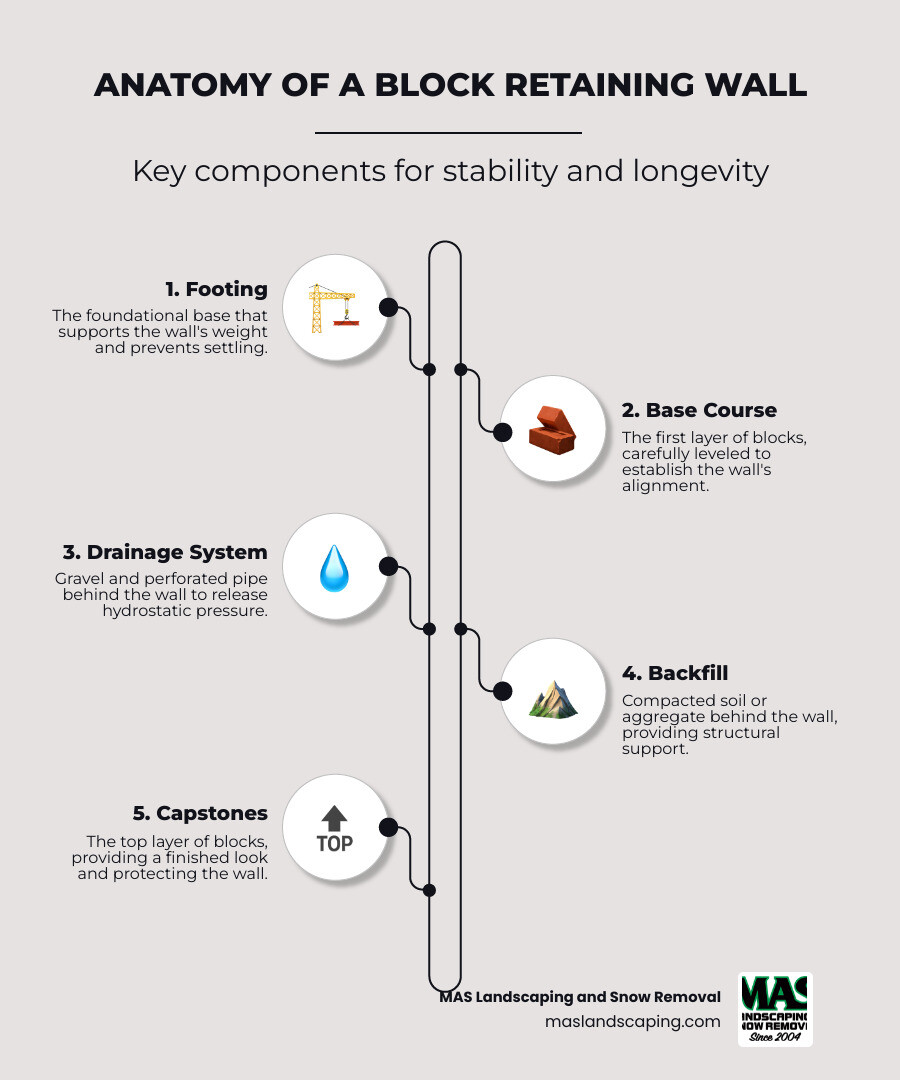
Here’s a quick look at the basic anatomy of a block retaining wall, a common use for these versatile blocks:
Simple block walls glossary:
Why Choose Block Walls for Your Landscape?
When designing outdoor features for our clients in Saugus, MA, and surrounding areas, we often recommend block walls. They offer an incredible mix of strength, versatility, and beauty, making them a foundational part of many gorgeous and useful landscape designs. Block walls can hold back soil, create charming garden beds, or build a private outdoor living space. They are tough, look great, and add real value to your property.
Here’s a quick look at why we believe block walls are a fantastic choice for your next outdoor project:
| Key Benefit | Description |
|---|---|
| Durability | Concrete block walls are built to last. They are inherently resistant to moisture and can withstand harsh weather conditions like high winds. Fully cured, they offer the reliability you need. |
| Load-Bearing Capacity | Properly constructed and reinforced block walls can hold significant vertical weight, making them excellent for supporting substantial structures or large amounts of soil. |
| Eco-Friendliness | Many concrete blocks use recycled, sustainable materials such as water, gravel, rocks, and sand, often sourced locally, making them a responsible choice. |
| Ease & Speed of Installation | Concrete blocks are relatively lightweight compared to solid concrete, which eases manual labor and can save time and money during construction. |
| Design Flexibility | Concrete blocks come in a variety of colors, textures, and shapes, allowing for immense creativity in designing walls that complement any landscape or architectural style. |
| Cost-Effectiveness | The ease of installation and reduced need for heavy equipment often make block walls a more budget-friendly option compared to other wall construction methods. |
The strength and reliability of concrete construction are often guided by standards set by groups like the American Concrete Institute (ACI). This helps ensure that materials meet high quality benchmarks.
Strength and Durability
The core strength of a block wall is undeniable. Concrete blocks are tough, built to withstand weather and time. They offer excellent compressive strength (vertical load-bearing), and when hollow cores are filled with grout and steel rebar, their strength becomes truly impressive. Reinforced concrete block foundations can often support more weight than poured concrete. They also resist lateral (sideways) forces effectively, especially when built with staggered joints (a running bond) and horizontal reinforcement in the mortar.
Properly constructed block walls are a long-term investment, with some lasting up to 80 years. Their excellent moisture resistance makes them ideal for humid climates, preventing rot and mold that affect other materials. This durability ensures your wall remains strong and attractive for generations.
Installation and Cost
A key benefit of block walls is their efficient and often cost-effective installation. Concrete blocks are manageable in size, speeding up the construction process and reducing labor costs compared to poured concrete. This often eliminates the need for heavy equipment, simplifying the project.
While small projects like low garden walls can be a DIY task using interlocking blocks, professional help is recommended for anything larger or more complex to ensure structural integrity. Mortared walls require curing time; footings may need 2-3 days, and the wall itself several days to a week to reach full strength.
Cost varies based on block type, wall size, complexity, and labor rates. Based on internet data and not actual costs for MAS Landscaping, the typical range for block walls is $15 to $60+ per square foot. High-end projects with custom designs or engineering can exceed $150 per square foot. The total cost includes not just the blocks (around $2-$3 each) but also labor, excavation, base materials, and drainage. We provide clear estimates custom to your project in the Saugus, MA area.
Types of Block Walls and Their Common Uses
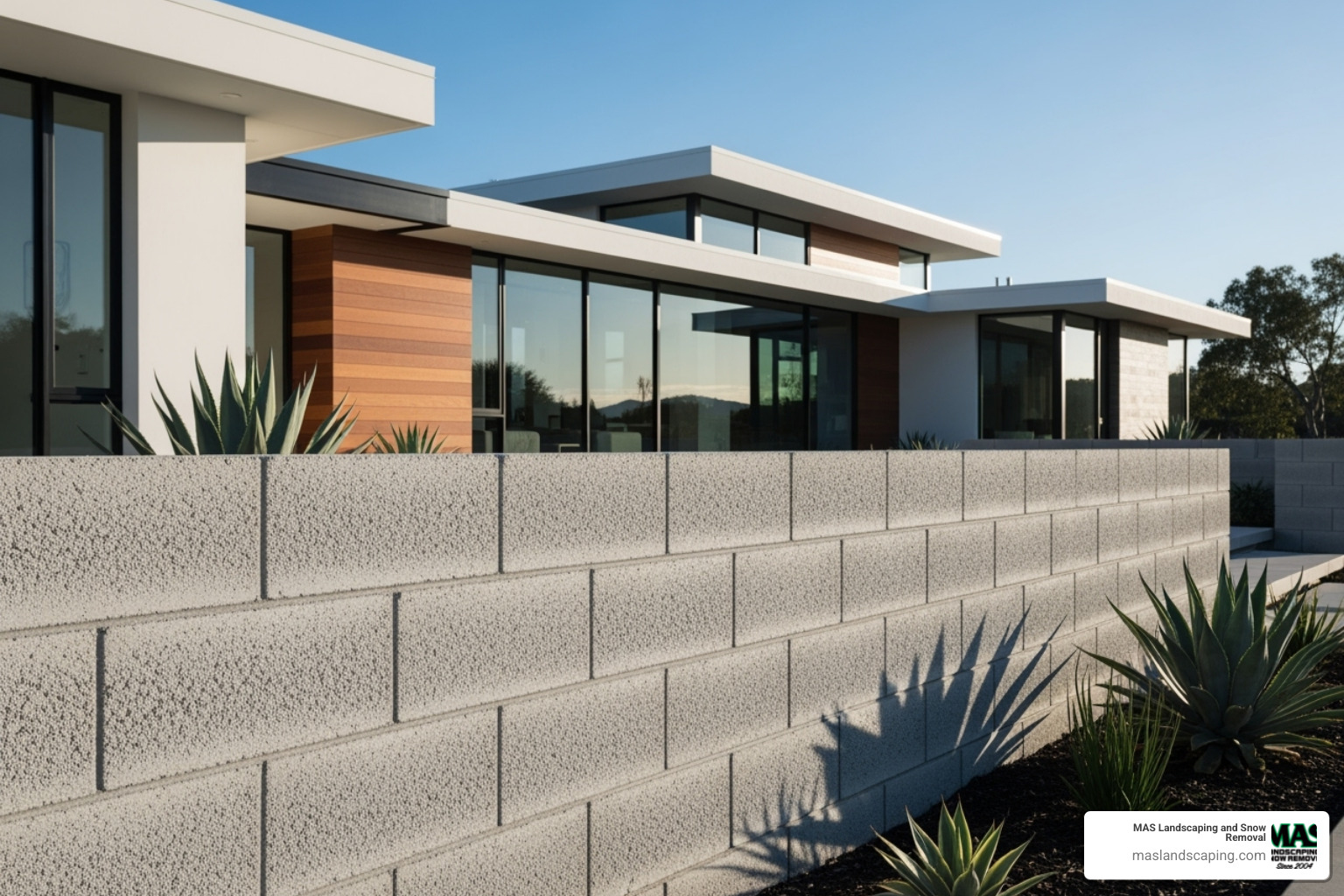
Block walls are not a one-size-fits-all solution. The variety available allows us to tailor the material and aesthetic to match your vision and the functional requirements of your project. Whether you’re looking for a modern, sleek finish or a rustic, natural stone look, there’s a block type for you.
We love exploring the possibilities with our clients. To see some of the diverse projects we’ve undertaken, explore More info about our hardscaping projects.
Standard Concrete Masonry Units (CMUs)
These are the workhorses of the block wall family, often called “cinder blocks.” You’ll recognize them by their hollow core blocks, which are crucial for reinforcement. CMUs are widely chosen for the sturdy foundations of basements and crawl spaces, as well as for structural walls in homes and commercial buildings. For maximum strength, we fill the hollow cores with grout and insert steel reinforcing bars (rebar). Because of their utilitarian appearance, CMUs are often veneered for aesthetics with materials like stone, brick, or stucco to achieve a more appealing finish.
Interlocking and Segmental Retaining Wall Blocks
These block walls are specifically designed for retaining soil. A key feature is their mortarless systems, which rely on the blocks’ weight and design for stability, much like LEGOs. This dry-stacked method simplifies installation. They often feature a rear lip or pin systems that automatically sets the correct backward setback and locks each course securely. Their straightforward stacking makes them ideal for DIY projects like garden walls up to 2-3 feet. However, for taller or more complex retaining walls, professional installation is crucial to ensure proper base preparation and drainage. You can find resources on How to build a retaining wall using these systems.
Decorative and Architectural Blocks
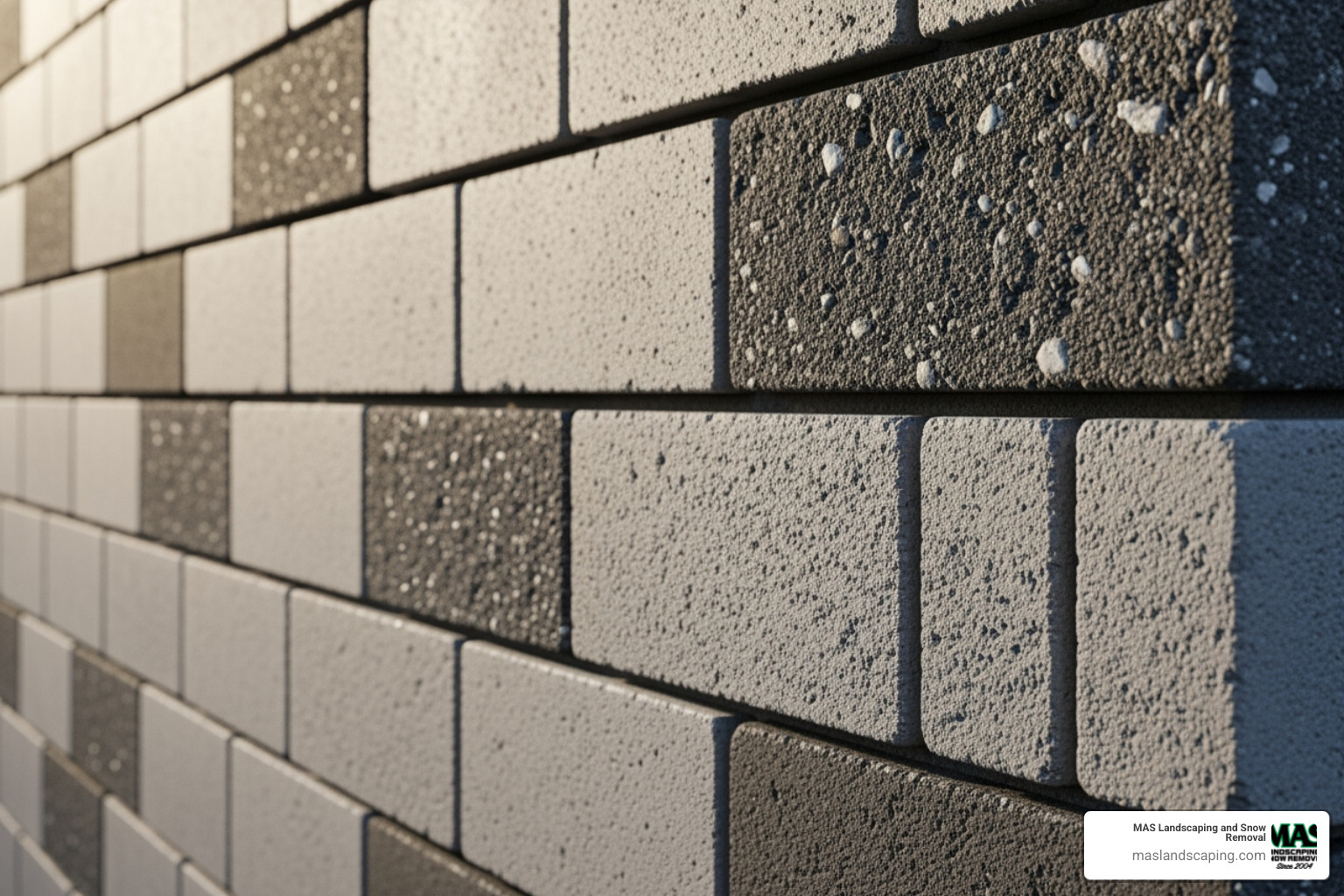
Beyond structure, block walls can be chosen for their aesthetic qualities. Split-face blocks have a textured face resembling rough, natural stone, often eliminating the need for a separate veneer. For a sleeker look, ground-face blocks are polished to a smooth, granite-like finish, popular for modern privacy fences and facades. Slump blocks offer a softer, rounded appearance similar to handmade adobe brick, often used in Spanish-style architecture.
Modern manufacturing provides an impressive variety of colors and textures, emulating tumbled, chiseled, or quarried stone. This versatility allows us to create stunning privacy fences, outdoor kitchens, and other landscape features that integrate perfectly with your home’s design.
How to Build a Simple Block Retaining Wall
Building a block retaining wall can be a rewarding project. While larger walls require professional expertise, constructing a simple, low retaining wall (under 2-3 feet) can be a feasible DIY endeavor.
Safety first! Always wear safety glasses, heavy-duty gloves, and sturdy footwear. When cutting blocks, use hearing protection and a respirator. Call 811 before you dig to locate underground utilities.
Essential Tools and Materials:
- Tools: Shovel, tape measure, string line, level, rubber mallet, hand tamper or plate compactor, wheelbarrow, masonry saw, and all necessary safety gear.
- Materials: Retaining wall blocks, gravel/paver base, drainage gravel, landscape fabric, and construction adhesive for capstones. For CMU walls, you’ll also need mortar, concrete mix, and rebar.
Step 1: Planning and Site Preparation
Careful planning is the foundation of a successful wall.
- Marking the Layout: Use stakes and a string line or marking paint to outline the wall’s footprint.
- Calculating Materials: Measure the wall’s length and height to calculate the number of blocks needed. Purchase about 10% extra to account for cuts and breakage.
- Checking Local Codes: This is critical. Check with your local municipality (like Saugus or Everett) for permits or restrictions, especially for walls over 2-3 feet. We at MAS Landscaping are well-versed in local regulations.
- Excavating the Trench: Dig a trench for the foundation. For low walls, a trench 4-6 inches deep and twice the block’s width is typical. Taller walls require a deeper, wider trench.
Thinking about a larger landscape change? Explore landscape design options with us.
Step 2: Creating a Level Foundation
A solid block wall starts with an unshakeable, level foundation to prevent shifting or cracking.
- Compacting the Soil: After excavating, thoroughly compact the soil at the bottom of the trench using a hand tamper or plate compactor.
- Adding and Leveling a Gravel Base: Add a 3-inch layer of gravel or paver base into the trench, spread it evenly, and compact it again. Use a long level to ensure this base is perfectly flat.
- Importance of a Solid Footing: The first course of blocks must be perfectly level. Any irregularities here will be magnified as you build. We often bury the first row of blocks about halfway for added stability.
Step 3: Laying the Courses and Backfilling
Now your wall takes shape as the blocks come together.
- Setting the Base Course: Lay your first course of blocks on the prepared gravel base. Use your level on each block and a rubber mallet to gently tap them into place until perfectly level.
- Staggering Joints (Running Bond): On subsequent courses, stagger the vertical joints so each block overlaps the two blocks below it. This running bond pattern significantly increases the wall’s strength.
- Adding Drainage and Backfilling: As you build, place landscape fabric behind the wall and backfill with a 6-12 inch layer of drainage gravel. Behind the gravel, add soil in 8-inch “lifts,” compacting each layer thoroughly before adding the next. This prevents the soil from settling and putting pressure on your wall.
The Keys to Longevity: Drainage and Reinforcement
A perfectly built block wall can fail if two crucial elements are overlooked: proper drainage and smart reinforcement. These are the unsung heroes that ensure your wall stands strong for decades.
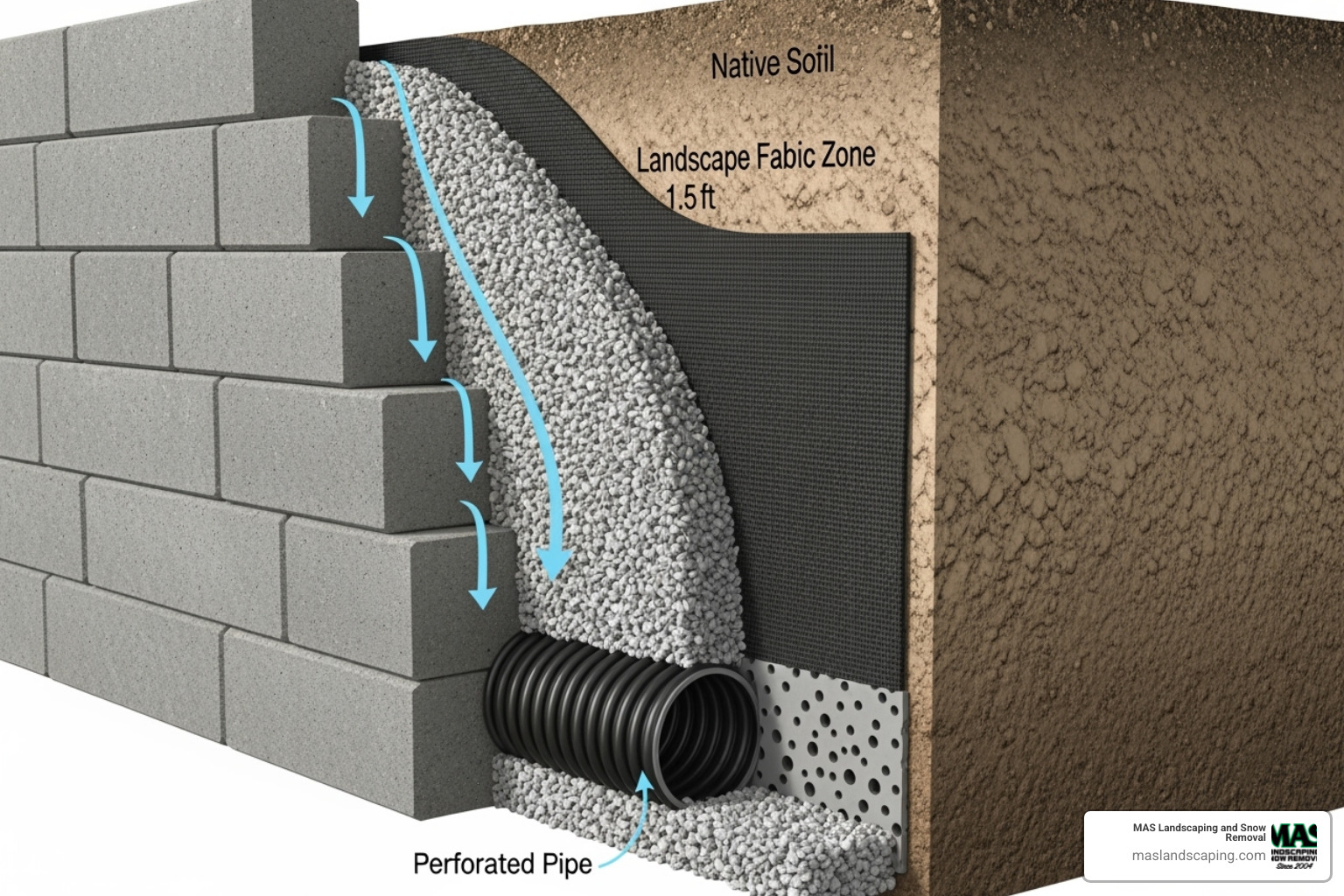
Why do walls fail? Often, it’s due to hydrostatic pressure—the immense force of water building up in the soil behind the wall. After heavy rain, this pressure can cause a wall to lean, bulge, or even collapse. Fortunately, this is preventable.
The Critical Role of Proper Drainage
Managing hydrostatic pressure is the number one job for a long-lasting block wall. The goal is to give water an easy escape route.
A generous layer of gravel backfill directly behind the wall creates a permeable zone, allowing water to filter down instead of pooling. For any retaining wall over a few feet tall, a perforated drain pipe at the base is a game-changer. It collects water from the gravel and directs it safely away. To keep this system from clogging with soil over time, we use landscape fabric as a filter between the soil and the gravel. Proper drainage is a non-negotiable component for a wall that will last for generations.
When to Use Reinforcement
While low block walls rely on gravity, taller walls or those under extra load need reinforcement.
For retaining walls over 3-4 feet, geogrid is often used. This polymer mesh is laid in horizontal layers within the backfill, interlocking with the soil to create a stable, reinforced mass. For structural CMU block walls, steel rebar is inserted vertically into the block cores, which are then filled with grout. This provides essential tensile strength against lateral pressure.
Any retaining wall over 2 feet, or one supporting extra weight (a “surcharge load” like a driveway or steep slope), typically requires review by a qualified civil engineer. We at MAS Landscaping are well-versed in these requirements and work with engineers to ensure your wall is safe, strong, and compliant with all local codes in our service areas.
Frequently Asked Questions about Block Walls
We often get excellent questions from our clients about block walls. Here are some of the most common questions we encounter, along with our insights:
How deep should the footing be for a block retaining wall?
The footing depth is crucial for stability and depends on several factors. For most low, non-engineered block walls, a good general rule of thumb is to bury the first course of blocks about halfway. The trench for this course is typically 4 to 6 inches deep and about twice the width of your block.
However, this changes as the wall gets taller. Taller block walls need a deeper and wider footing to provide stability against increased soil pressure. The footing must also account for soil type—loose or clay soils may require a deeper base. In Massachusetts, it’s critical that the footing extends below the local frost line to prevent damage from frost heave.
Do all block walls need a concrete foundation?
Not necessarily! It depends on the type of block wall and its purpose.
- Retaining Walls: For block walls built with standard CMUs (cinder blocks), especially if they are tall or load-bearing, a poured concrete footing with rebar is often required. This provides a rigid, stable base to distribute the immense pressure from the soil.
- Freestanding Walls: For many segmental, mortarless freestanding block walls (like privacy or garden walls), a compacted gravel or paver base is a sufficient foundation. This provides excellent drainage and a stable, level surface. However, taller CMU freestanding walls still benefit from a poured concrete footing for maximum stability.
While concrete foundations are essential for many structural block walls, modern segmental systems often allow for a simpler, yet still effective, compacted gravel base.
What is the maximum height for a block wall without an engineer?
This is a critical question for safety and compliance. As a general rule of thumb, most local building codes allow non-engineered block walls (especially segmental retaining walls) to be built up to a maximum height of 2 to 3 feet without requiring an engineer’s design or a building permit.
However, it is absolutely essential to check local building codes. These limits are not universal and can vary by municipality. We at MAS Landscaping are well-versed in the local regulations in Saugus, Melrose, Revere, and our other service areas and can guide you through the process.
Professional engineering is almost certainly required if your proposed block wall exceeds the local height limit or if it has “surcharge loading”—extra weight behind it from a driveway, building, or steep slope. This ensures the wall is designed to be safe and stable for the long term.
Conclusion
From the sturdy footing to the beautiful capstones, it’s clear that block walls are far more than simple structures. They are incredibly versatile, surprisingly durable, and truly functional elements that can completely transform any landscape. We’ve seen their incredible strength, their diverse applications—from retaining hillsides to creating garden beds—and the meticulous process required to build them right.
Whether your project needs crucial structural support, wants to beautifully define outdoor spaces, or simply aims to add aesthetic touch, block walls stand out as a robust and long-lasting solution. The key to a successful project is the precision of the planning, the integrity of the installation, and careful consideration of vital elements like drainage and reinforcement. These steps ensure your wall will stand strong and improve your property for decades.
Here in the Saugus, MA area—and for our clients in Everett, Lynnfield, Malden, and beyond—if you’re dreaming of durable, beautiful block walls, trust the experts at MAS Landscaping. We are committed to creating outdoor spaces that are both functional and beautiful, built with the quality and care you deserve.
Ready to take the next step? Learn more about our retaining wall installation services today, and let’s start building a block wall that will stand proudly for generations.