




how much is a cubic yard of mulch 2025: 7 Powerful Cost Truths
Understanding the True Cost of Mulch
When it comes to landscaping materials, how much is a cubic yard of mulch is one of the most common questions homeowners ask. The short answer? A cubic yard of mulch typically costs between $30 and $110 for materials only, with most people paying around $50-60 for standard hardwood mulch. If you’re having it professionally installed, add another $20-45 per cubic yard for labor.
| Mulch Cost Breakdown | Price Range |
|---|---|
| Materials Only | $30-$110 per cubic yard |
| Delivered | $100-$250 per cubic yard |
| Professionally Installed | $50-$155 per cubic yard (includes materials) |
| Bagged Equivalent | $45-$90 (13.5 bags at $3.25-$6.50 each) |
I remember the first time I ordered mulch by the cubic yard instead of bags. The delivery truck arrived, dumped what looked like a small mountain in my driveway, and I thought, “Did I really order that much?” That’s the thing about cubic yards – they can be hard to visualize until you see them in person.
Mulch isn’t just about making your garden look pretty (though it certainly does that). It’s working hard for your landscape in several ways. It acts like a protective blanket for your soil, locking in moisture during hot summer days and reducing your water bills. It creates a natural barrier against weeds, saving you hours of pulling and spraying. As organic mulches break down, they even feed your soil with nutrients – like getting fertilizer for free.
As one veteran landscaper told me, “It can be pretty tough for the everyday person to work with cubic yard measurements.” And he’s right – most of us don’t regularly think in terms of cubic volume in our daily lives.
That’s exactly why understanding the true cost of mulch matters. When you’re planning your landscape budget, the difference between buying bagged mulch at the big box store versus ordering in bulk can mean hundreds of dollars in savings for larger projects.
In this guide, I’ll walk you through everything that affects mulch pricing – from the type of wood used to whether you’re picking it up yourself or having it delivered and spread professionally. By the end, you’ll know exactly how to calculate what you need and what represents good value for your specific project.
Whether you’re refreshing the beds around your mailbox or tackling several thousand square feet of commercial property, knowing the real costs helps you make smarter decisions and get the most value for your landscaping dollar.
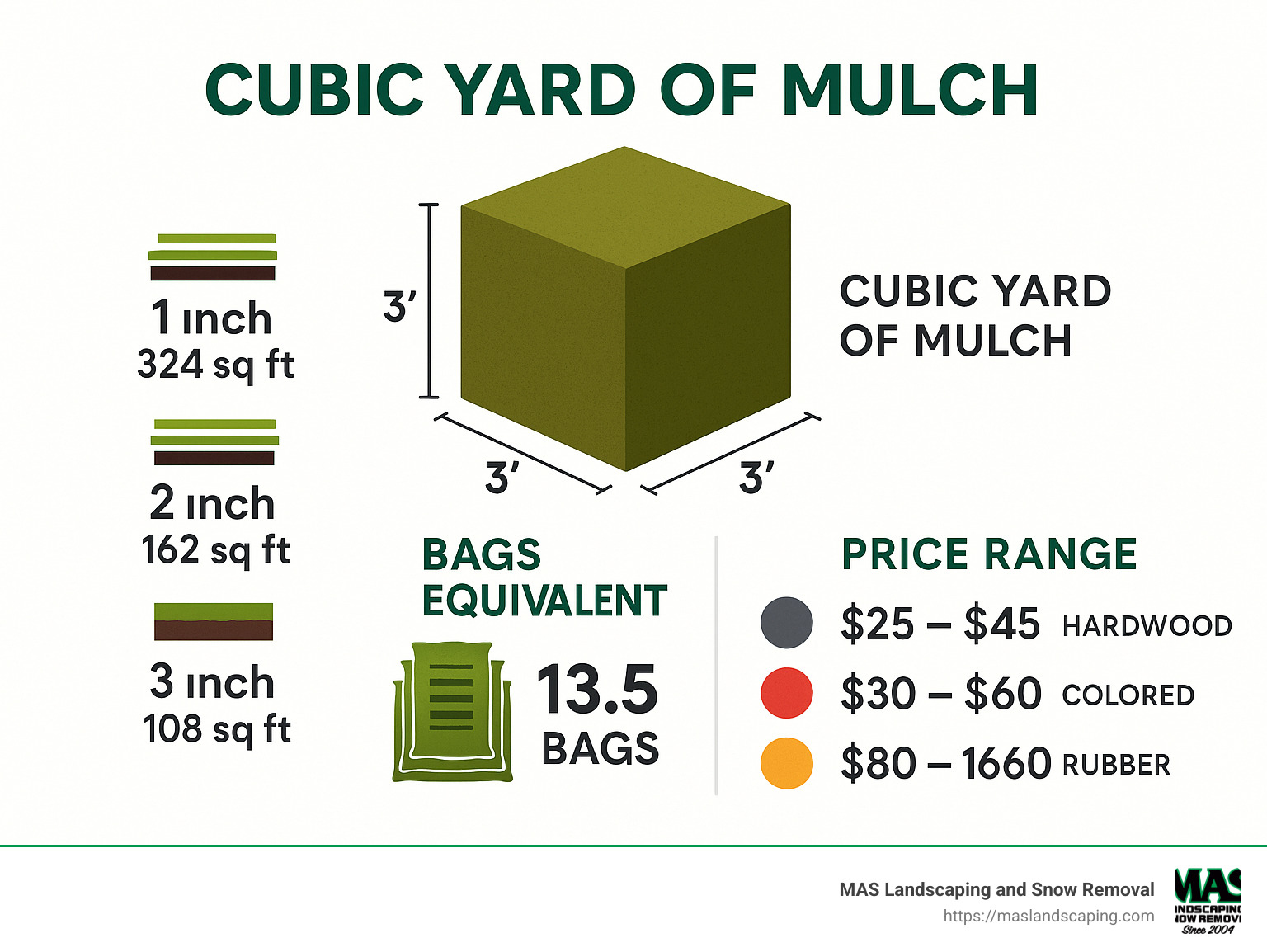
Must-know how much is a cubic yard of mulch terms:
– mulch delivery and installation
– installing mulch
– bark landscaping
How Big Is a Cubic Yard of Mulch & What Will It Cover?
When you hear “cubic yard,” think of a box that measures 3 feet in length, 3 feet in width, and 3 feet in height. That’s exactly what a cubic yard of mulch is – a volume of mulch that would fill this imaginary box completely.
“Imagine a box 3′ tall, 3′ wide, and 3′ long,” explains a mulch supplier. “That’s a cubic yard.”
In more technical terms, a cubic yard equals 27 cubic feet (3′ × 3′ × 3′ = 27 cubic feet). This standardized measurement helps ensure you’re getting a consistent amount whether you’re buying mulch in Everett, Lynnfield, or anywhere else in Massachusetts.
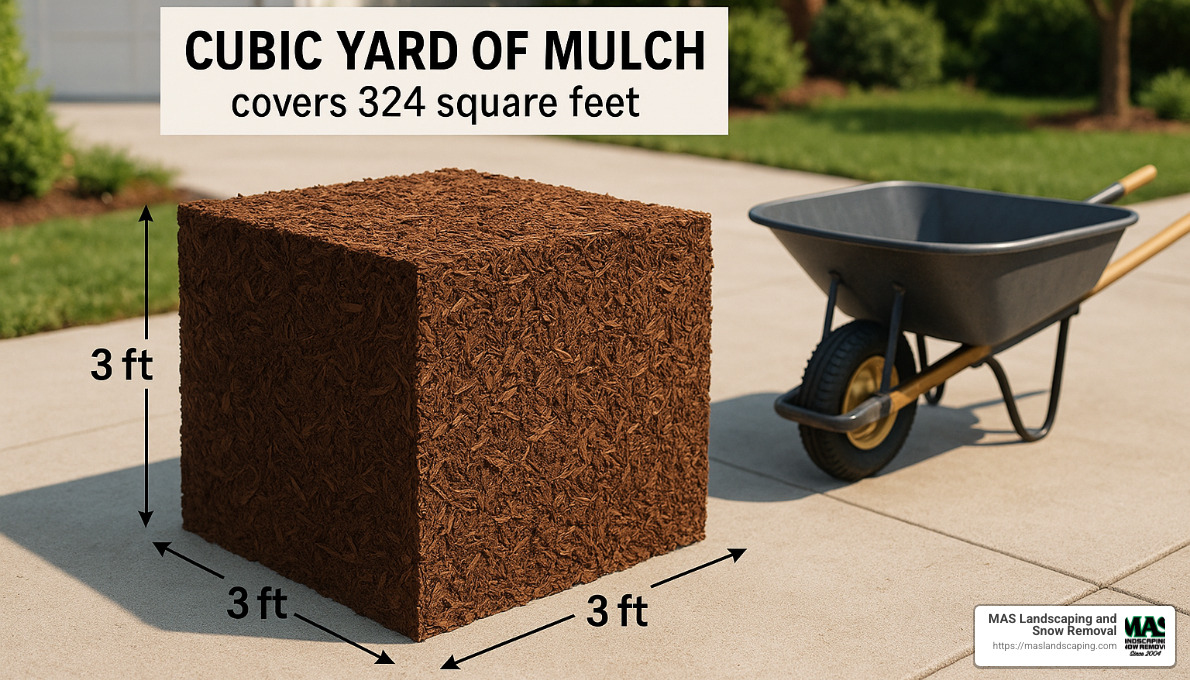
Cubic-yard definition & size reference
To help visualize a cubic yard of mulch, consider these practical references:
A standard wheelbarrow with a 6 cubic foot capacity can hold about 1/4.5 of a cubic yard. In other words, you’d need to fill that wheelbarrow 4.5 times to move one cubic yard of mulch. This is particularly helpful to know if you’re planning a DIY weekend project!
If you’re thinking about transporting mulch yourself, keep in mind that a full-size pickup truck with the bed level full typically holds about 2-3 cubic yards of mulch. As one landscaper notes, “A full-size pickup truck holds about 2½ cubic yards level full.” This can save you a delivery fee if you’re working on a smaller project.
For larger jobs, professional landscapers like us at MAS Landscaping often use contractor’s dump trucks, which can hold approximately 10-15 cubic yards level full – enough to mulch a substantial property in one go.
Coverage depth chart
How much area will a cubic yard of mulch cover? That depends entirely on how deep you spread it. Most garden beds need about 2-3 inches of mulch for optimal weed suppression and moisture retention, but you might go deeper for problem areas or shallower for established beds.
Here’s a handy reference chart for coverage:
| Depth | Area Covered by 1 Cubic Yard |
|---|---|
| 1 inch | 324 square feet |
| 2 inches | 162 square feet |
| 3 inches | 108 square feet |
| 4 inches | 81 square feet |
As a rule of thumb, one cubic yard of mulch covers approximately 100 square feet at a 3-inch depth (the most common recommendation for new beds) or about 160 square feet at a 2-inch depth (perfect for refreshing existing mulch).
This means that for a typical 10′ × 10′ garden bed with a 3-inch application, you would need approximately one cubic yard of mulch. For larger areas, like the perimeter of a typical suburban home, you might need 3-5 cubic yards depending on the size and number of planting beds.
Bag conversion math
If you’re used to buying bagged mulch from garden centers, understanding the conversion to cubic yards will help you compare costs and potentially save quite a bit of money.
Standard small bags contain 2 cubic feet of mulch, while larger bags typically contain 3 cubic feet. To equal one cubic yard (27 cubic feet), you would need 13.5 bags of the 2 cubic foot size (commonly found at big box stores) or 9 bags of the 3 cubic foot size.
This conversion is crucial for cost comparison. As one industry expert notes, “We encourage you to look at the savings of buying by the cubic yard vs. by the bag.” Indeed, buying in bulk can save you up to 40% compared to purchasing the equivalent volume in bags.
For larger projects, the savings become even more significant. When you need to cover multiple beds around your property, those savings can add up to hundreds of dollars. Plus, bulk mulch often comes fresher and hasn’t been sitting in plastic bags for months, which means better quality for your plants.
At MAS Landscaping and Snow Removal, we’ve helped countless homeowners in Saugus, Malden, and surrounding areas save substantially by switching from bagged to bulk mulch for their properties. Not only does it save money, but it’s also more environmentally friendly since it eliminates all those plastic bags.
How Much Is a Cubic Yard of Mulch in 2025?
Mulch prices have evolved in 2025, and if you’re planning your landscape budget, you’ll want to know what to expect. Let’s dig into the current costs for how much is a cubic yard of mulch and break down all the factors that influence what you’ll pay.
Before we jump in, it’s worth noting that all prices mentioned here are average costs based on internet data and industry surveys, not actual costs for MAS Landscaping and Snow Removal services. For your specific project in Saugus or surrounding areas, we always recommend requesting a personalized quote.
Average cost range for how much is a cubic yard of mulch
When shopping for mulch in 2025, expect to pay between $30 and $110 per cubic yard for just the materials. Most homeowners in our Everett and Lynnfield service areas typically spend between $40 and $65 for standard hardwood varieties—the “middle of the road” option that balances quality and affordability.
Once you factor in delivery, that same cubic yard will generally cost between $100 and $250 total. Why such a wide range? It depends on how far the mulch needs to travel, whether you meet minimum order requirements, and what the going rates are in your specific neighborhood.
If you’d rather leave the heavy lifting to the professionals, fully installed mulch (including materials, delivery, and labor) averages about $85 per cubic yard, though prices typically range from $50 to $155 depending on the complexity of your landscape.
As landscape expert Kelsey Ross points out, “When choosing hardwood mulch, consider single-grind for a rougher, long-lasting, rustic look.” This coarser variety generally costs less than double-ground mulch, which breaks down more quickly but releases nutrients into your soil faster—a classic trade-off between longevity and immediate soil benefits.
Cost by mulch type & color
Your choice of mulch type and color significantly impacts what you’ll pay. Here’s what you can expect to shell out for different varieties in 2025:
The budget-friendly options in the organic category start with economy wood mulch at $15-$30 per cubic yard, followed by pine straw at $20-$55. Standard hardwood mulch—the most popular choice for many of our Malden clients—runs about $30-$40 per cubic yard.
If you’re looking for something more distinctive, colored mulches (available in rich black, vibrant red, or natural brown) typically cost $40-$50 per cubic yard. These colored options usually run about $5-$10 more than their natural counterparts. The dyes used are generally iron oxide-based for red mulch or carbon-based for black, and both are considered safe for your plants and soil.
Premium organic options include cedar mulch at $40-$100, cypress mulch at $45-$65, pine bark nuggets at $40-$60, and hemlock mulch at $45-$65 per cubic yard. For playgrounds where safety is paramount, certified playground mulch costs around $50-$60 per cubic yard.
For those seeking longer-lasting inorganic alternatives, rubber mulch ranges from $80-$140 per cubic yard, crushed seashell can vary wildly from $40-$400 depending on quality and source, and decorative stone or gravel typically costs $50-$180 per cubic yard.
Regional price snapshot: Northeast vs. South vs. West
Where you live plays a huge role in what you’ll pay for mulch. Here’s how prices typically vary across different regions of the country:
In the Northeast (including our service areas like Everett, Lynnfield, and Malden), expect to pay about $45-$75 per cubic yard. Delivery fees tend to be higher here due to urban density and narrower delivery access. The most popular types among our Massachusetts customers are hardwood blends, hemlock, and pine mulch, which thrive in our seasonal climate.
Down in the South, mulch typically runs $35-$65 per cubic yard, with lower delivery fees thanks to year-round availability and production. Southern gardeners often prefer pine straw, cypress, and mixed hardwood varieties that stand up well to intense heat and humidity.
Out West, prices generally fall between $40-$70 per cubic yard, with delivery costs varying dramatically between urban centers and rural areas. Western gardeners often choose cedar, redwood, and “gorilla hair” mulch (shredded redwood) for their drought-resistant properties.
Here in the Northeast where MAS Landscaping and Snow Removal operates, we see significant seasonal price fluctuations. Spring brings peak demand and often higher prices, which is why many of our savvy clients in Saugus, Chelsea, and nearby towns plan their mulch projects for late summer or early fall to secure better pricing.
The investment is worth it regardless of regional price differences. According to USDA research, properly applied mulch can reduce water usage by up to 30% while significantly improving soil health—making it a smart investment for both your landscape and your water bill.
Scientific research on USDA mulch benefits
Price Drivers: Type, Region, Delivery & Installation
Ever wonder why mulch prices can vary so dramatically? It’s not just about color or brand name. Several key factors determine how much is a cubic yard of mulch will cost you. Understanding these can help you make smarter choices for your landscaping budget.

Material factors
The type of wood used in your mulch makes a huge difference in what you’ll pay. Think of it like coffee – there’s the basic house blend and then there’s the premium single-origin stuff!
Hardwood mulch from oak, maple, or mixed deciduous trees usually sits in the middle of the price range. It’s like the reliable sedan of mulches – not fancy, but gets the job done well.
On the premium end, cedar and cypress mulch command higher prices because they contain natural oils that resist decay and actually repel insects. They’re the luxury vehicles of the mulch world – they look great, last longer, and have special features other mulches don’t.
If you’re watching your budget, pine-based mulches typically cost less but decompose faster. They’re perfect if you’re looking to enrich your soil quickly.
The way mulch is processed also affects price. Single-grind mulch has larger, varied pieces and costs less, while double or triple-ground mulch offers a more uniform, refined appearance at a higher price point. It’s like the difference between chunky and smooth peanut butter – same ingredients, different processing, different price.
“We recommend to our clients that they don’t need to use store-bought mulch. Unless they like the appearance of one consistent color, they can get arborist wood chips for free,” notes landscaping expert Allen Tate. While this is true, many of our Melrose and Medford homeowners prefer the consistency and quality control of commercial mulch, especially for front yards and visible beds.
Bulk vs. bag cost comparison for how much is a cubic yard of mulch
One of the biggest money-saving secrets in landscaping is buying mulch in bulk rather than bags. The numbers don’t lie:
A typical 2 cubic foot bag of mulch costs between $3.25 and $6.50. To get a full cubic yard, you’d need 13.5 of these bags, bringing your total to between $43.88 and $87.75. Ouch!
Compare that to bulk mulch at $30-$110 per cubic yard, and you’re looking at potential savings of 35-60%.
I saw this at a garden center last week: bagged cedar mulch was $5.99 for 2 cubic feet (which works out to $80.87 per cubic yard), while the same cedar mulch in bulk was just $46 per cubic yard. That’s a 43% savings just by changing how you buy!
Beyond saving money, buying in bulk means no plastic bags to dispose of. Many of our environmentally conscious clients in Revere appreciate this additional benefit. Mother Nature says thank you!
More info about How Much Does a Yard of Mulch Cost?
Delivery & installation fees
When budgeting your mulch project, don’t forget to account for getting it to your property and spread in your beds.
Delivery costs typically run between $70-$140 as a flat fee, regardless of how much mulch you order. This is why most suppliers have minimum order requirements of 3-5 cubic yards – it’s simply not cost-effective to deliver smaller amounts. If you live further away from the supplier, expect distance surcharges to apply.
Installation labor adds another layer of cost. Professional spreading typically runs $20-$45 per cubic yard. For those hard-to-reach areas or larger properties, mulch blowing services charge $35-$60 per cubic yard but can save hours of backbreaking work. A typical two-person crew charges $55-$90 per hour for manual installation.
“Bulk mulch can save up to 40% over bagged mulch,” confirms one industry expert. But the real value isn’t just in material savings – it’s in the time and effort saved through professional installation.
For busy homeowners in Saugus and surrounding communities, our professional installation services mean you can spend your weekend enjoying your beautiful landscape rather than creating it. Our crews ensure proper depth, even distribution, and careful placement around plants and structures – all while you relax!
DIY Calculator: Figuring Out How Much Mulch You Need
Before you can determine the cost of your mulch project, you need to know exactly how much mulch you’ll require. This is where a bit of simple math can save you both money and headaches.
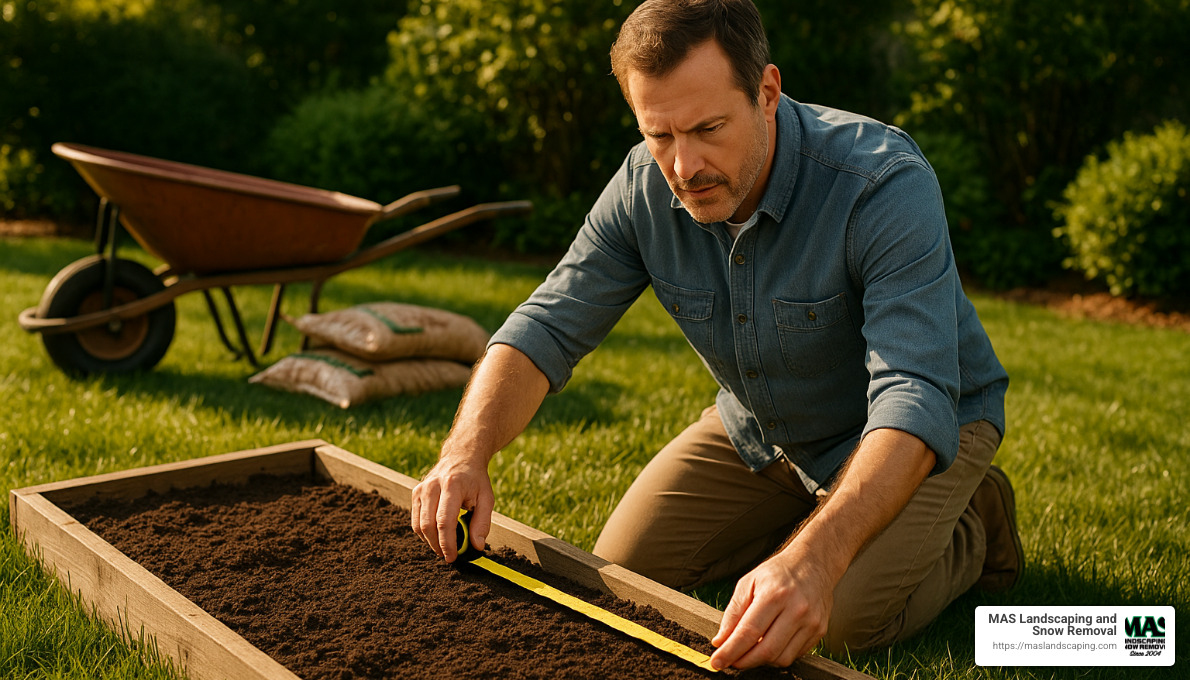
Step-by-step manual formula
Calculating your mulch needs isn’t complicated once you know the formula. For most garden beds, you’ll start by measuring the area in square feet, then factor in how deep you want your mulch layer to be.
For rectangular or square areas, simply multiply the length by the width to get your square footage. Then multiply that number by your desired depth in inches, and divide the result by 324 to convert to cubic yards. The complete formula looks like this: (Length × Width × Depth in inches) ÷ 324 = Cubic Yards.
Circular beds require a slightly different approach. Measure the radius (the distance from center to edge) in feet, square that number, and multiply by 3.14 (π). Then multiply by your desired depth in inches and divide by 324. In formula form: (π × radius² × depth in inches) ÷ 324 = Cubic Yards.
For triangular areas, measure the base and height in feet, multiply them together and divide by 2 (this gives you the area). Then multiply by your desired depth and divide by 324: (Base × Height ÷ 2 × depth in inches) ÷ 324 = Cubic Yards.
If your garden has an irregular shape, don’t worry! Just break it down into smaller rectangles, circles, or triangles, calculate each area separately, and add them together for your total.
Using online tools & phone apps
If math makes your head spin, you’re not alone! That’s why numerous online calculators and smartphone apps exist to do the heavy lifting for you.
These digital tools are wonderfully simple – just enter your bed dimensions and select your desired mulch depth (typically 2-3 inches), and voilà! The calculator provides the cubic yards needed for your project.
Many of these calculators go a step further by estimating how many bags you’d need if you’re not buying in bulk. Some even provide cost estimates based on average prices in your area, which is perfect for initial budgeting.
For our clients in Lynnfield, Malden, and throughout our service area, we’re always happy to help with these calculations during our consultation process. Sometimes having a professional eye on your measurements can catch details you might miss.
Sample project cost walk-through
Let’s walk through a real-world example to see how this works. Imagine you have a 500 square foot garden bed and want to apply mulch at the recommended 3-inch depth:
First, calculate the cubic yards needed: (500 sq ft × 3 inches) ÷ 324 = 4.63 cubic yards
Now, let’s look at different cost scenarios for how much is a cubic yard of mulch in this project:
For materials only (at $50/cubic yard), you’re looking at $231.50. If you add delivery (with a typical $100 flat fee), that increases to $331.50. With professional installation (at an all-inclusive rate of $85/cubic yard), your total would be $393.55.
If you went with bagged mulch instead, you’d need about 62.5 bags (2 cubic feet each). At $4.50 per bag, that’s $281.25 – and that doesn’t include your time, effort, or the gas for multiple trips to the garden center!
When you compare these options, professional installation often makes sense, especially for larger projects. Think about it – moving nearly five cubic yards of mulch yourself means roughly 21 wheelbarrow loads! For busy homeowners in Medford or Chelsea, the convenience of having professionals handle the heavy lifting can be well worth the modest additional cost.
More info about Mulch Delivery and Installation
Mulch Buying Tips & FAQs
Now that you understand the basics of mulch pricing and calculations, let’s explore some money-saving strategies and answer common questions about how much is a cubic yard of mulch.
Money-saving & application tips
Smart timing can save you serious money on your mulch purchases. The landscaping industry, like many others, has peak and off-peak seasons. If you can wait until late summer or fall to buy your mulch, you’ll often find prices drop significantly as demand wanes. Many of our Saugus clients have saved 15-20% just by planning their mulch refresh for September instead of May.
Another great strategy is to combine orders with neighbors. Not only does this help everyone meet minimum delivery requirements, but it can also open up volume discounts that typically kick in around 10 cubic yards. We’ve helped several neighborhood groups in Everett coordinate their orders, saving everyone money while building community spirit.
When it comes to application, more isn’t always better. A consistent 2-3 inch layer is the sweet spot for most gardens – enough to suppress weeds and retain moisture, but not so much that you risk suffocating your plants or creating fungal issues.
“The biggest mistake I see homeowners make is creating ‘mulch volcanoes’ around trees,” says our lead landscaper. “Those mounds against the trunk can cause bark rot and create a haven for pests.” Instead, pull the mulch back 3-4 inches from tree trunks, creating a slight depression rather than a mound.
For those using wood mulch, keep in mind that fresh wood chips can temporarily tie up nitrogen in the soil as they decompose. If your plants start showing yellowing leaves, a light application of nitrogen fertilizer can help balance things out until the mulch stabilizes.
FAQ #1 – How much is a cubic yard of mulch delivered?
When calculating the total cost of delivered mulch, you need to consider both the material itself and the delivery service. The material costs typically range from $30-$110 per cubic yard depending on the type you choose, with standard hardwood varieties falling in the $40-$60 range.
Delivery fees generally run between $70-$140 as a flat fee in most areas around Lynnfield and Malden. This means your total delivered cost might range from $100-$250 per cubic yard for smaller orders. However – and this is the key to saving money – the delivery cost per yard decreases dramatically with larger orders.
For example, if you order 10 yards with a $100 delivery fee, that’s only adding $10 per yard to your material cost. Order just 2 yards with the same delivery fee, and you’re adding $50 per yard!
Several factors can influence your delivery costs. Distance matters – suppliers typically have a service radius with tiered pricing. Property accessibility can affect the fee too; narrow driveways or difficult placement locations might incur additional charges. Most suppliers also have minimum order requirements, typically 3-5 cubic yards, to make delivery economically viable.
At MAS Landscaping, we understand our local neighborhoods and can often provide more accurate delivery estimates than national averages because we know exactly what to expect when delivering to homes in Chelsea, Revere, and surrounding communities.
FAQ #2 – How many bags equal one cubic yard?
The math of converting between bagged and bulk mulch is eye-opening for many homeowners. A cubic yard equals 27 cubic feet, so you’ll need:
- 13.5 bags of the standard 2 cubic foot size
- 9 bags of the larger 3 cubic foot size
- 18 bags of the smaller 1.5 cubic foot size
When you do the price comparison, the savings become obvious. At typical retail prices of $4.50 per 2 cubic foot bag, you’d spend about $60.75 for enough bags to equal one cubic yard. The same amount purchased in bulk might cost just $30-$45 – a savings of 35-50%!
This difference becomes even more dramatic for larger projects. A typical suburban property in Medford might require 10 cubic yards of mulch. Buying this amount in bags could cost $300+ more than purchasing in bulk.
Beyond the cost savings, there’s also the environmental benefit of eliminating all those plastic bags, not to mention saving yourself multiple trips to the garden center. As one of our Malden customers put it, “I can’t believe I spent years lugging those heavy bags home when I could have just had it delivered in bulk for less money!”
FAQ #3 – How often should I replace mulch?
The replacement schedule for your mulch depends largely on the type you choose and our sometimes unpredictable New England weather. Organic mulches naturally break down over time – that’s actually part of their benefit as they enrich your soil.
Shredded hardwood mulch, the most popular choice among our Saugus and Everett customers, typically needs annual refreshing (adding an inch to existing mulch) and complete replacement every 2-3 years. Pine bark nuggets tend to last a bit longer, often going 3-4 years before needing full replacement.
Cedar mulch is naturally resistant to decay thanks to its oils, so it might last 4-5 years with occasional refreshing. However, colored mulches tend to fade within a year, so if that vibrant red or black is important to your landscape design, you’ll likely want to replace it annually.
For those who’ve invested in inorganic options like rubber mulch around play areas, you can expect 7-10+ years of service, making it more cost-effective over the long term despite the higher initial investment.
Here in the Northeast, where MAS Landscaping operates, we typically recommend annual refreshing for most residential properties in Melrose and surrounding areas. Our winters can be harsh, with snow removal often displacing some mulch, and our spring rains can accelerate decomposition.
You’ll know it’s time for fresh mulch when you notice significant color fading, visible soil showing through, or increasing weed penetration. When mulch starts breaking down into the soil or becomes so compacted that water doesn’t easily penetrate, it’s definitely time for a refresh.
Regular mulch maintenance isn’t just about aesthetics – it’s protecting your soil, conserving water, and creating the optimal environment for your plants to thrive in our unique Massachusetts climate.
Conclusion
Understanding how much is a cubic yard of mulch goes far beyond just the sticker price. As we’ve explored throughout this guide, the complete picture includes the type of mulch you choose, delivery considerations, installation costs, and—perhaps most valuable—the time and effort you might save by working with professionals.
Let’s take a moment to recap what we’ve learned:
A cubic yard of mulch fills a space measuring 3′ × 3′ × 3′, giving you 27 cubic feet of material to work with. This amount typically covers about 100 square feet when spread at the recommended 3-inch depth—perfect for most garden beds and landscaping projects.
For materials alone, you can expect to pay between $30-$110 per cubic yard depending on whether you choose basic hardwood or premium options like cedar or rubber mulch. When you add delivery, most suppliers charge a flat fee between $70-$140 for residential deliveries, which becomes more economical with larger orders.
Professional installation adds approximately $20-$45 per cubic yard in labor costs, but the expertise and time savings often make this a worthwhile investment, especially for larger properties or challenging terrain.
One of the clearest takeaways? Buying in bulk saves money. When compared to purchasing the equivalent amount in bags, bulk mulch typically saves homeowners 35-40%—not to mention reducing plastic waste and multiple trips to the garden center.
For homeowners in Saugus, Everett, Lynnfield, Malden, Melrose, Medford, Revere, and Chelsea, MAS Landscaping and Snow Removal brings local expertise to every mulch project. We understand the unique soil conditions, weather patterns, and plant needs specific to our region, helping ensure your landscape not only looks beautiful today but continues to thrive season after season.
Proper mulching might be one of the most cost-effective investments you can make in your property’s appearance and plant health. A fresh layer of mulch instantly refreshes your landscape’s appearance while providing crucial benefits like moisture retention, weed suppression, and temperature regulation for your plants’ root systems.
By understanding the true cost factors and measuring your space accurately, you can make informed decisions that maximize your landscaping budget while creating beautiful, sustainable outdoor spaces that improve your property’s value and your enjoyment of it.
Ready to transform your landscape with professional mulch installation? Contact MAS Landscaping and Snow Removal today for a personalized consultation and quote custom to your property’s specific needs.
More info about our landscaping services
