



Mulch Prices 2024: Top 5 Best Deals Revealed
Understanding Mulch Prices: What You Need to Know

When planning your landscaping projects, understanding mulch prices is essential for proper budgeting. Here’s a quick overview of what you can expect to pay:
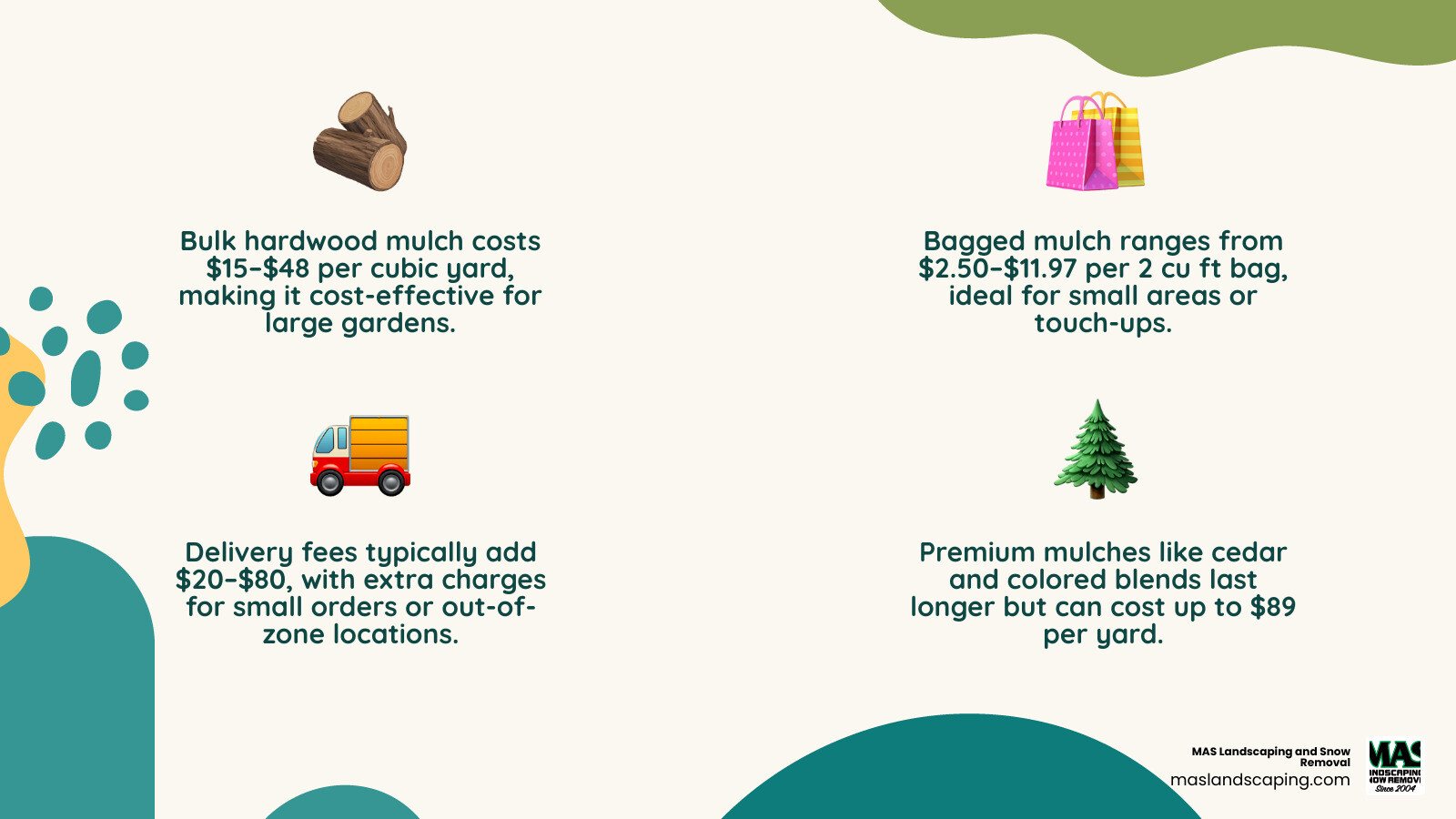
- Bulk mulch: $15-$89 per cubic yard depending on type and quality
- Bagged mulch: $2.50-$11.97 per bag (typically 2 cubic feet)
- Installation costs: Add $20-$50 per cubic yard if hiring professionals
- Delivery fees: Usually $20-$80 plus potential flat fees of $50-$100
The cost of mulch varies significantly based on several key factors that every homeowner should consider before making a purchase.
Mulch is one of those landscaping investments that offers tremendous value beyond just aesthetics. As one customer shared with us, “I was surprised that my mulch still looked great six months after installation.” Quality mulch not only improves your garden’s appearance but also provides functional benefits like moisture retention, weed suppression, and soil insulation.
Whether you’re refreshing existing beds or starting a new landscaping project, understanding the price differences between mulch types, delivery options, and purchasing methods can save you significant money. Bulk purchases typically offer the best value for larger projects, while bagged mulch provides convenience for smaller areas.
Regional differences also play a major role in pricing. For example, in the Northeast, premium mulches like those with compost blends can cost up to $60 per yard, while standard hardwood mulches might be significantly less expensive in areas with more abundant timber resources.
As you plan your garden refresh, the cheapest option isn’t always the most cost-effective in the long run. Premium mulches often last longer, maintain their color better, and provide superior benefits to your plants.
Learn more about mulch prices:
– garden mulch
– mulch yard
– boston mulch delivery
Mulch Prices 2024: Snapshot & Key Factors
The mulch market in 2024 has been shaped by everything from timber industry shifts to the price at the pump. As local landscaping professionals working throughout Greater Boston, we’ve had a front-row seat to these changes and how they affect your garden budget.
When you’re planning your next landscaping project, understanding what drives mulch prices can help you make smarter choices. Raw material availability remains a major factor—when timber production slows, hardwood and pine mulch costs tend to rise. And let’s not forget those transportation costs! With fuel prices fluctuating, delivery fees for your mulch have been along for the ride.
Timing matters too. Just like holiday shopping in December, spring mulching comes with “peak season pricing” as everyone rushes to refresh their gardens. If you’re looking at specialty options like color-improved mulches, expect to pay a premium for those extra processing steps. And where you live makes a difference—some regions simply have better access to certain mulch materials than others.
Average mulch prices per yard & per bag in 2024
When comparing mulch prices, it helps to understand both what you’ll pay upfront and what value you’ll get over time. Natural, undyed mulch typically starts around $15 per cubic yard, while premium options like cedar or redwood can reach upwards of $84 per yard.
Color-improved mulches—those rich blacks, browns, and reds that really make your plantings pop—generally fall somewhere in the middle, while specialized options like playground-certified and rubber mulches command higher prices for their safety features and longevity.
If you’re shopping by the bag (typically 2 cubic feet), you’ll find basic hardwood options starting around $2.50, with premium colored varieties running $3.78-$6.50. Cedar mulch bags tend to cost $5-$7, while rubber mulch—often sold in smaller 0.8 cubic foot bags—ranges from $7.47-$11.97.
One tip we often share with our customers: the more you buy, the more you save. A single yard of mulch might cost $60, but that per-yard price could drop to $50 when ordering 12 yards. If you’re hiring professionals for installation, factor in an additional $20-$50 per cubic yard for labor. Most crews can install about 3 cubic yards per hour, working at rates between $60-$110 hourly.
For a more precise estimate of mulch prices for your specific project, the Homewyse Calculator is a helpful resource many of our customers use before reaching out for a quote.
Regional mulch prices: Northeast vs. Midwest vs. South vs. West
Your zip code plays a surprisingly big role in what you’ll pay for mulch. Here in the Northeast (including our service areas in Everett, Lynnfield, Malden, and surrounding communities), mulch prices tend to run higher than the national average. Premium mulches with compost blends typically range from $50-$60 per yard, while color-improved options run $37-$49 per yard.
Our dense population means transportation costs more, and our higher regional labor rates affect installation pricing. But our customers appreciate that quality mulch stands up to our distinct four-season climate with its challenging freeze-thaw cycles.
The Midwest enjoys some advantages when it comes to mulch prices. With abundant timber resources nearby, hardwood mulch typically costs $20-$40 per yard—noticeably less than in our region. Their transportation costs are generally lower too, though their more extreme seasonal weather means availability can fluctuate dramatically throughout the year.
Down South, the mulching season stretches longer thanks to milder winters. Pine straw mulch—not commonly used in our region—is both popular and affordable there at $15-$30 per yard. Their hardwood mulch runs about $24-$44 per yard, with colored options ranging from $30-$50. Many Southern gardeners prioritize drought-resistant mulch varieties given their climate challenges.
Out West, mulch prices tend to be highest overall. Longer shipping distances drive up transportation costs, and limited local resources affect availability. Their focus often shifts toward water conservation, with greater use of inorganic options like stone and rubber mulch in drought-prone regions.
Climate considerations aren’t just about aesthetics—they directly impact which mulch performs best in your garden. Here in New England, we recommend mulches that can withstand our seasonal temperature swings while providing proper insulation for plant roots during our cold winters.
Bulk vs Bagged & Delivery: True Cost Comparison
One of the most significant decisions when purchasing mulch is whether to buy in bulk or in bags. This choice can dramatically impact your total project cost, especially for larger landscaping jobs.
Bulk mulch advantages:
– Significantly lower cost per cubic yard (50-70% savings over bagged)
– Less packaging waste
– Often fresher product
– Better for large projects (typically over 3 cubic yards)
Bagged mulch advantages:
– Easier to handle and transport
– No delivery fees for small quantities
– Better for small projects or hard-to-access areas
– More convenient storage if not using all at once
Let’s break down a practical comparison for a typical suburban landscape project requiring 10 cubic yards of hardwood mulch:
Bulk mulch option:
– 10 cubic yards of hardwood mulch at $35/yard = $350
– Delivery fee = $80
– Total cost = $430
– Cost per cubic yard = $43
Bagged mulch option:
– 1 cubic yard = 13.5 bags (2 cubic feet each)
– 10 cubic yards = 135 bags
– 135 bags at $3.50 each = $472.50
– No delivery fee (assuming self-pickup)
– Total cost = $472.50
– Cost per cubic yard = $47.25
While the difference may seem modest in this example, the gap widens significantly for larger projects. For properties in our service areas like Saugus, Melrose, and Medford, bulk delivery becomes increasingly cost-effective as project size increases.
Hidden delivery fees & minimums
When budgeting for mulch delivery, it’s crucial to account for potential hidden fees that can significantly impact your total cost:
Common hidden delivery charges:
- Minimum order requirements: Many suppliers require a minimum order of 3-5 cubic yards for delivery, with under-minimum fees ranging from $20-$50.
- Delivery zone surcharges: Delivery outside standard service areas may incur additional fees based on distance.
- Dump area requirements: Standard deliveries require approximately 35′ × 14′ with 20′ overhead clearance. Restricted access may require special equipment at additional cost.
- Off-driveway waivers: Deliveries beyond standard dump areas often require liability waivers and may incur extra fees.
- Weekend delivery premiums: Many suppliers charge $20-$50 extra for weekend deliveries due to higher demand.
- Cancellation or rescheduling fees: Last-minute changes can result in fees ranging from $50-$100.
- Fuel surcharges: These fluctuate with gas prices and may not be included in initial quotes.
For our clients in areas like Chelsea, Revere, and surrounding communities, we always provide transparent pricing that includes all potential delivery fees upfront. This transparency helps avoid unpleasant surprises when the final bill arrives.
Safety & specialty surfaces (playgrounds, rubber)
Specialty mulches designed for specific applications like playgrounds carry premium pricing due to their improved safety features and rigorous certification requirements.
Playground mulch considerations:
- IPEMA-certified playground mulch: $44-$60 per cubic yard
- Must meet ASTM F1292 safety standards for fall protection
- Requires minimum 8-inch depth for maximum safety
- Needs regular maintenance and topping up to maintain safety standards
- Made from virgin wood fiber rather than recycled materials to avoid contaminants
Rubber mulch considerations:
- Premium pricing: $150-$300 per cubic yard
- Significantly longer lifespan (up to 10 years versus 1-2 for organic mulch)
- Higher upfront cost but potentially lower long-term expense
- Available in various colors that resist fading
- ADA-compliant for accessibility concerns
- Environmentally controversial (made from recycled tires)
For playground installations in communities like Everett and Malden, safety-certified mulches are not just a preference but often a requirement for compliance with local regulations and insurance standards.
Budgeting, Quantity Calculations & Money-Saving Tips
Proper planning and accurate calculations are essential for avoiding the two most common mulch purchasing mistakes: buying too little (requiring a second delivery) or buying too much (wasting money).
How to calculate mulch needs:
- Measure your area: Length × width for rectangular areas; π × radius² for circular areas
- Determine desired depth: 2-3 inches for maintenance; 3-4 inches for new beds
- Calculate cubic yards: Area (in square feet) × depth (in inches) ÷ 324
For example, a 10×20-foot garden bed with a desired 3-inch depth would require:
– 10 × 20 = 200 square feet
– 200 × 3 = 600 cubic inches
– 600 ÷ 324 = 1.85 cubic yards
For our clients in Lynnfield, Saugus, and other service areas, we offer complimentary measurements and calculations to ensure you order the exact amount needed for your project.
Money-saving tips for mulch purchases:
- Coordinate with neighbors: Combine orders to meet minimum delivery requirements and share delivery fees.
- Lock in winter rates: Many suppliers offer discounted pricing during off-season months (November-February) for spring delivery.
- Consider recycled mulch: Often available at $15-$20 per yard, significantly less than premium options.
- Mix mulch types strategically: Use premium mulches for visible areas and standard mulches for less visible areas.
- Maintain proper depth: Avoid over-mulching, which wastes money and can harm plants.
- Time your purchase: Prices often peak in early spring; late spring or early summer purchases may offer better value.
- Ask about remnant loads: Suppliers sometimes offer discounts on partial loads left from larger deliveries.
For properties in Medford, Melrose, and other communities we serve, these strategies can result in substantial savings, especially for larger properties requiring significant quantities of mulch.
Frequently Asked Questions about Mulch Prices
How many bags of mulch equal a cubic yard?
The standard 2 cubic foot bag of mulch contains approximately 1/13.5 of a cubic yard. Therefore, you’ll need about 13-14 bags to equal one cubic yard. For smaller 1.5 cubic foot bags, you’ll need approximately 18 bags per cubic yard.
Is rubber mulch cost-effective in the long run?
While rubber mulch has a significantly higher upfront cost ($150-$300 per cubic yard compared to $30-$60 for organic mulch), its longevity can make it cost-effective for certain applications. Rubber mulch typically lasts 7-10 years, while organic mulch needs replacement every 1-2 years. For a 10-year period, rubber mulch might cost $300 once, while organic mulch might cost $60 × 5 replacements = $300, plus the labor for repeated installation.
How often should mulch be replaced?
Organic mulches typically need replacement or topping up every 1-2 years, depending on several factors:
– Hardwood and bark mulches: 1-2 years
– Pine straw: 6-12 months
– Cedar mulch: 1-2 years
– Color-improved mulch: 1-2 years (color fades before decomposition)
Signs that mulch needs replacement include:
– Visible thinning to less than 1 inch depth
– Significant color fading
– Increased weed growth
– Visible decomposition into soil
What’s the difference between premium and economy mulches?
Premium mulches typically feature:
– Consistent sizing and texture
– Improved coloring that resists fading
– Double or triple processing for finer texture
– Higher quality raw materials
– Better weed suppression
– Longer-lasting appearance
Economy mulches may contain:
– Variable sizing and inconsistent texture
– Minimal or no color improvement
– Single processing
– Mixed wood sources
– Faster decomposition rate
The price difference can range from $10-$30 per cubic yard between economy and premium options.
Should I remove old mulch before adding new mulch?
It depends on the current condition:
– If old mulch is less than 3 inches deep and not decomposed, you can add a new layer.
– If total depth would exceed 4 inches, remove some old mulch first.
– If old mulch shows signs of mold, fungus, or pests, complete removal is recommended.
– For color-improved mulch, removing old faded layers produces the best aesthetic result.
Are there any environmental concerns with different mulch types?
Several environmental considerations affect mulch prices and selection:
– Dyed mulches use colorants that may contain chemical compounds
– Rubber mulch is made from recycled tires but doesn’t biodegrade
– Cypress mulch comes from wetland forests (sustainability concerns)
– Local, recycled mulches have the lowest carbon footprint
– Organic mulches improve soil health as they decompose
What’s the best time of year to buy mulch?
From a pricing perspective:
– Late fall/winter: Often lowest prices but limited selection
– Early spring: Highest prices due to peak demand
– Late spring/early summer: Moderate prices with good availability
– Late summer/early fall: Potential clearance pricing
For our clients in communities like Chelsea and Revere, we often recommend placing orders in late winter for early spring installation to balance availability with competitive pricing.
Conclusion
Understanding mulch prices is more than just comparing numbers—it’s about making smart investments in your property’s beauty, health, and value. Whether you’re refreshing your garden beds this spring or planning a complete landscape change, choosing the right mulch at the right price point can make all the difference.
At MAS Landscaping and Snow Removal, we’ve helped countless homeowners throughout Everett, Lynnfield, Malden and surrounding communities transform their outdoor spaces with the perfect mulch solutions. We’ve seen how the right choices can dramatically improve both the appearance and functionality of any landscape.
When making your mulch decisions, bulk options typically offer the best value for medium to large projects. While bagged mulch provides convenience, the savings from bulk purchases can be substantial—often 50-70% less per cubic yard. That’s money you can reinvest in other aspects of your landscape!
Don’t forget to factor in all costs when budgeting for your project. The sticker price is just the beginning; delivery fees, installation labor, and long-term maintenance all contribute to the true cost of your mulch choice. A slightly higher investment in premium mulch might actually save you money over time if it means less frequent replacement.
We’ve seen many homeowners make the mistake of eyeballing their mulch needs, only to end up with too much or too little. Accurate measurements and calculations save both money and headaches. Remember our simple formula: area (in square feet) × depth (in inches) ÷ 324 = cubic yards needed.
Smart timing can also stretch your landscaping budget. Consider placing orders during off-peak seasons when suppliers often offer significant discounts. Many of our clients in Medford and Chelsea have saved 15-20% simply by ordering their spring mulch during winter months.
The difference between economy and premium mulches goes beyond just price. Premium options often deliver better weed suppression, longer-lasting color, and more consistent texture. For visible front yard areas, the upgrade to premium mulch often delivers value well beyond its modest additional cost.
Your landscape deserves thoughtful care and attention to detail. The right mulch does more than just look good on day one—it contributes to healthier plants, reduces your ongoing maintenance needs, and improves your enjoyment of your outdoor spaces year-round.
Ready to make the most of your mulch investment? Our team at MAS Landscaping and Snow Removal is here to help with personalized advice custom to your specific property and needs. We understand the unique soil and climate conditions of Greater Boston, and we’re committed to helping you create beautiful, functional outdoor spaces that add value to your home and joy to your life.
Learn more about our landscaping services:
– Landscaping services
– Mulch delivery and installation
– Cost for mulching
