




Snow Clearing Contract: Top 5 Essential Tips!
Why Every Property Owner Needs a Snow Clearing Contract
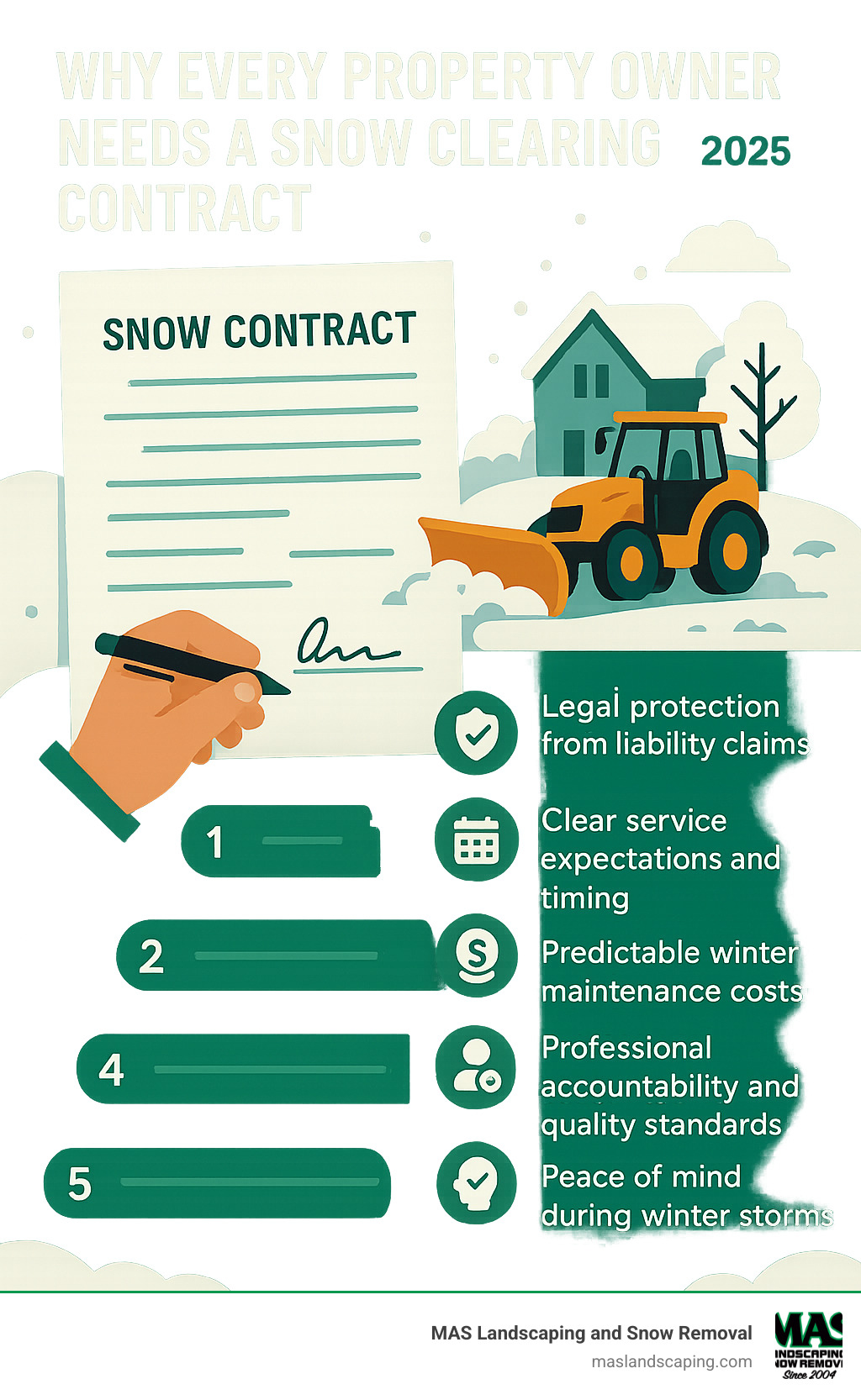
A snow clearing contract is a legally binding agreement between a property owner and a contractor, outlining services, pricing, and liability for winter maintenance. It protects both parties by setting clear expectations for snow events.
Key Elements of a Snow Clearing Contract:
- Service scope – What areas will be cleared (parking lots, sidewalks, entrances)
- Trigger threshold – When service begins (typically 2-4 inches of accumulation)
- Pricing structure – Per-event, seasonal flat rate, or full-service
- Response time – How quickly service must begin after snowfall
- Insurance requirements – Liability coverage and additional insured status
- Ice management – De-icing and salting protocols
Snow removal is inherently risky, from below-freezing work to icy road conditions. A written contract is not just recommended—it’s essential. Without one, property owners face potential slip-and-fall lawsuits, unclear service expectations, and payment disputes, while contractors risk non-payment and liability exposure.
Contracts range from simple per-event agreements to comprehensive seasonal packages. Commercial properties usually need more detailed contracts than residential ones, specifying response times and liability protections. Whether you manage a property in Malden or across Greater Boston, understanding contract basics protects your investment and ensures reliable winter service.
Snow clearing contract vocabulary:
- commercial snow clearing
- how much does commercial snow plowing cost
- commercial snow and ice management
Why a Formal Snow Contract is Non-Negotiable
Imagine it’s 6 AM on a snowy Tuesday. Your commercial property is covered, employees and customers are arriving, but the snow removal service you hired on a handshake is nowhere to be found. You have no written agreement to enforce. This scenario is why a formal snow clearing contract is essential for any property owner to protect their business, budget, and peace of mind.
A formal agreement provides risk mitigation and liability protection, shielding you from costly slip-and-fall lawsuits and property damage claims. It also creates financial predictability, so you know your costs upfront instead of facing surprise bills after a heavy snow year. Most importantly, a contract ensures timely service by establishing clear response times and trigger thresholds, eliminating miscommunication when you need reliability most.
For comprehensive protection beyond just snow removal, consider reviewing Commercial Snow Plow Insurance options that work hand-in-hand with your contract.
The Dangers of a Handshake Deal
Handshake deals for snow removal are a recipe for disaster. They often lead to:
- Miscommunication: You think the entire lot will be cleared; the contractor thinks only the entrance. Without written terms, these misunderstandings become major problems during a storm.
- Payment Disputes: Your contractor may bill for multiple “events” during one storm, while you expected a single fee. A contract defines what constitutes a billable event.
- Service Ambiguity: Does the service include salting? Sidewalks? Return trips? A handshake deal leaves these critical questions unanswered until it’s too late.
- Legal & Liability Exposure: If someone is injured on your property due to inadequate clearing, you could face a lawsuit. Without a contract outlining responsibilities and insurance, you may be held personally liable. A contract also clarifies who is responsible for repairing any property damage caused by plows.
Benefits for Property Owners vs. Contractors
A well-crafted snow clearing contract is a win-win for both parties, creating a strong professional relationship.
For Property Owners:
- Guaranteed Service & Peace of Mind: No more wondering if your contractor will show up.
- Clear Expectations & Accountability: The scope of work, timing, and quality standards are defined.
- Secured Budgeting: Predictable costs make financial planning easier.
For Contractors:
- Secured Revenue: Seasonal contracts allow for investment in better equipment and staff.
- Defined Scope: Prevents scope creep and allows for fair, accurate pricing.
- Professional Credibility: Detailed contracts demonstrate a commitment to quality and professionalism.
When both parties understand their roles, the result is smoother operations and safer properties. For guidance on selecting a professional contractor, see Your Guide to Choosing the Right Commercial Landscape Service Nearby.
Decoding the Different Types of Snow Removal Contracts
Choosing the right snow clearing contract requires matching the agreement to your property’s needs, budget, and risk tolerance. Each contract type offers a different balance of cost, predictability, and service level, ensuring there’s a fit for properties from a small office in Malden to a large retail center in Everett.
Here’s how the main contract types stack up:
| Contract Type | Cost Structure | Predictability | Ideal Property Type |
|---|---|---|---|
| Per-Event | Variable | Low | Small properties, areas with mild winters |
| Seasonal | Fixed | High | Most commercial properties, budget-conscious owners |
| Full-Service | Fixed (Premium) | High | High-traffic commercial, healthcare, retail |
Per-Event, Per-Push, or Per-Inch Contracts
These are “pay-as-you-go” agreements where you only pay when service is rendered. This variable cost structure is appealing for those anticipating a mild winter.
- Per-event contracts charge a flat fee each time the trigger depth (e.g., 2-4 inches) is met.
- Per-push agreements charge each time the contractor moves snow.
- Per-inch contracts tie costs directly to snowfall depth.
The main drawback is the lack of cost predictability; a heavy snow year can quickly exhaust your budget. It’s vital that the contract precisely defines a “snow event” to avoid billing surprises. These contracts are often best for properties in areas with historically light or infrequent snowfall. For detailed pricing insights, check out How Much Does Commercial Snow Plowing Cost?.
Seasonal (Fixed-Rate) Contracts
For those who prefer predictable budgeting, seasonal contracts are ideal. You pay one fixed price for the entire winter season (e.g., November 1st to March 31st), regardless of snowfall amounts. This provides peace of mind and simplifies financial planning. Many contractors offer multi-year agreements to lock in rates and ensure service continuity.
While you might feel you’ve overpaid in a mild winter, the protection against high costs during a severe winter makes this a cost-effective choice for most property owners. Contractors base these rates on historical weather data, creating fair pricing. Explore seasonal options at View our Commercial Snow Removal Contracts.
Full-Service or All-Inclusive Contracts
This is the premium option, offering comprehensive coverage that leaves nothing to chance. These agreements extend beyond basic plowing to include extensive de-icing, pre-treatment, and ongoing site monitoring. They are perfect for high-traffic commercial properties like medical facilities, retail centers, and corporate campuses where safety and accessibility are paramount.
Many full-service contracts include zero-tolerance policies, meaning the contractor proactively manages the site to keep it clear at all times. While this premium service comes at a higher cost, it minimizes liability and ensures your business remains fully operational, changing winter weather from a reactive problem into a managed system. Learn more at Learn about our Commercial Snow and Ice Management.
Anatomy of an Ironclad Snow Clearing Contract: Key Clauses to Include

Think of a well-crafted snow clearing contract as your winter insurance policy. It’s not just paperwork – it’s the foundation that protects your property, your budget, and your peace of mind when Mother Nature decides to dump snow on Massachusetts.
The best contracts leave nothing to chance. Every detail matters, from exactly where snow gets plowed to who pays if something goes wrong. While we can’t give legal advice, we’ve seen enough contracts over the years to know what works and what doesn’t. A solid template can save you hours of headaches, and resources like the basic contract template can help you get started on the right foot.
Defining the Scope of Service (What, Where, and When)
This section is the heart of your snow clearing contract. Get this wrong, and you’ll be dealing with confusion, frustration, and possibly angry phone calls at 6 AM during a snowstorm.
What services are included? Be crystal clear about this. Will your contractor be plowing parking lots, shoveling walkways, or both? Does the service include hauling away snow piles when they get too high? What about applying ice melt or sand? Don’t assume anything is obvious – spell it out.
Where exactly will work be done? This is where a property map becomes your best friend. Mark every area that needs service: parking lots, sidewalks, building entrances, loading docks, and emergency exits. Just as important is marking excluded areas where snow shouldn’t be piled or where no service is needed. Maybe you have a section of decorative landscaping that can’t handle heavy snow piles, or a tenant area that handles their own walkways.
For commercial properties, our Commercial Sidewalk Snow Removal services cover all pedestrian areas, but your contract should spell out exactly which sidewalks and walkways are included.
When does service kick in? The trigger threshold is crucial – typically 2 to 4 inches of accumulation before service begins. Some contracts specify 3 inches, while others might start at just 2 inches for high-traffic areas. The Town of Canton, for example, often triggers operations at 2 inches of anticipated snowfall.
Service timing is equally important. If you run a business, you probably need parking lots cleared by 7 AM so employees and customers can get in safely. For ongoing storms, your contract should outline how often the contractor will return to keep areas clear.
Ice Management and De-Icing Protocols
Here’s where things get slippery – literally. Ice is often more dangerous than snow, and your snow clearing contract needs to address it head-on.
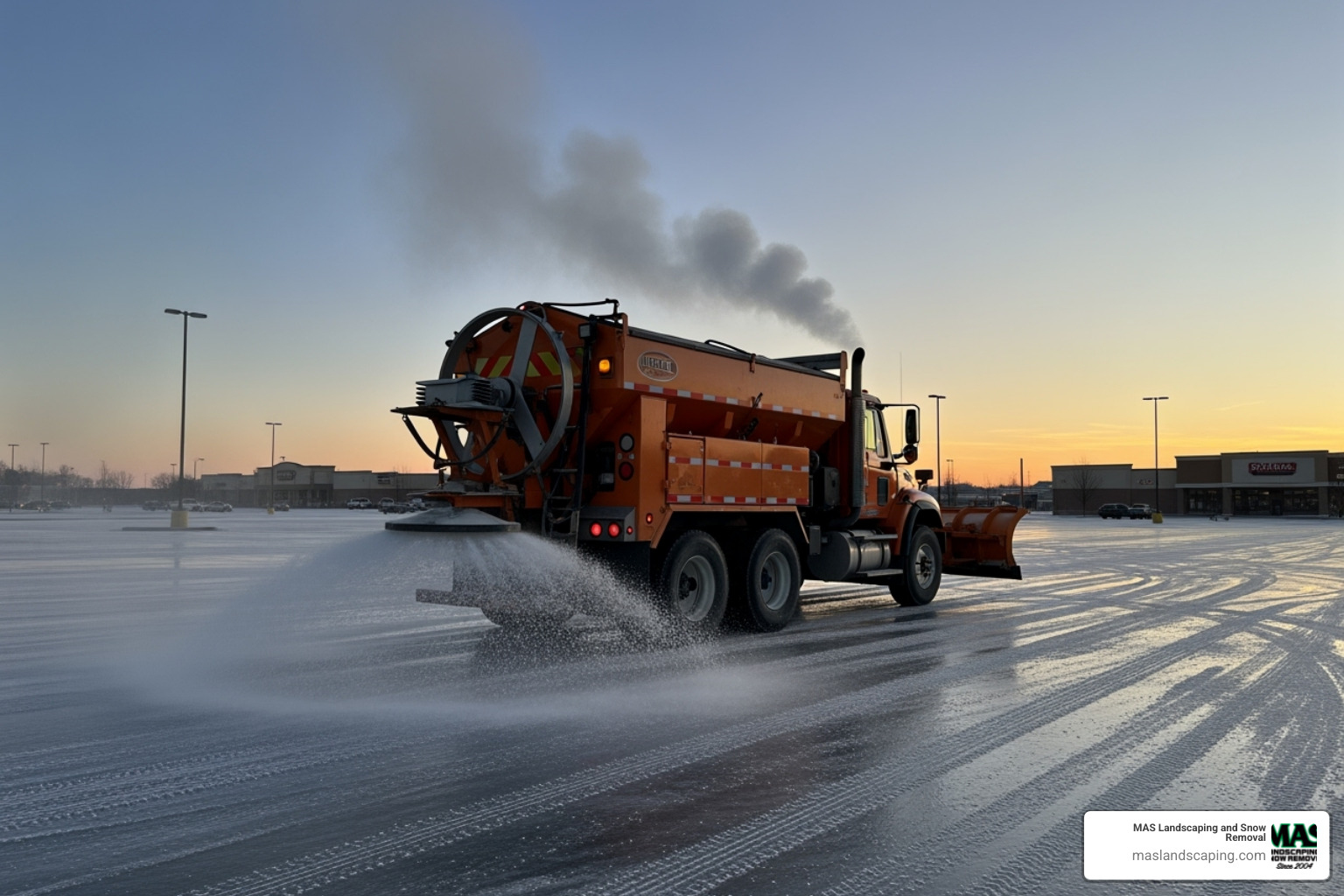
Material choices matter more than you might think. Traditional rock salt works well but can damage plants and concrete over time. Liquid de-icers are gentler on landscaping but cost more. Some properties need pet-friendly or environmentally safe options. Your contract should specify exactly what materials will be used and why.
Application timing can make or break your ice management strategy. Pre-treatment before a storm prevents ice from bonding to pavement. Post-treatment after plowing keeps cleared areas safe. Some properties need continuous monitoring during freezing rain events.
Who decides when to apply de-icing materials? Some contracts give contractors full discretion based on weather conditions and professional judgment. Others require property owners to request applications. If you want control over when and where ice melt gets applied, make sure your contract spells out how to make those requests and any time limits involved.
De-icing products aren’t magic – they won’t instantly eliminate all ice. Setting realistic expectations in your contract helps avoid disputes later.
Insurance, Liability, and Indemnification
This section is your legal safety net. It’s critical for protecting you when things go wrong.
- Proof of Insurance: Your contractor must provide current certificates showing adequate coverage. For commercial properties, general liability limits of $1,000,000 per occurrence and $2,000,000 aggregate are common starting points.
- Automobile Liability: This protects you if the contractor’s vehicle causes an accident. A minimum of $1,000,000 is typical.
- Workers’ Compensation: This ensures you’re not liable if a contractor’s employee is injured on your property.
- Additional Insured: Ensure your property is named as an additional insured on the contractor’s general liability policy. This means their insurance responds first to claims arising from their work.
- Hold Harmless Clause: Also called indemnification, this clause specifies that the contractor will protect you from legal claims arising from their work.
- Damage Responsibility: Your contract should clearly state who pays for repairs if equipment damages curbs, landscaping, or other property, and how that damage is reported.
Pricing, Responsibilities, and Legal Fine Print
The financial terms, responsibilities, and legal details of a snow clearing contract are critical. These elements form the foundation of a successful service agreement and prevent issues during the winter season.
How Snow Removal Prices Are Determined
Understanding cost factors helps you evaluate quotes. Pricing is influenced by:
- Property Size and Layout: A large, complex property with tight corners and multiple access points requires more time and maneuvering than a simple, open lot.
- Complexity of Service: Basic plowing is less expensive than a comprehensive plan that includes sidewalks, entrances, and multiple de-icing applications. Premium timing, like pre-business-hours clearing, also affects the price.
- Equipment and Labor: The cost reflects the contractor’s investment in commercial plows and salt spreaders. Labor is also a key factor; according to the Bureau of Labor Statistics, grounds maintenance workers earn a median of $17.05/hr, with specialized snow equipment operators commanding higher rates.
- Geographic Location: Local historical snowfall patterns influence pricing.
Note: Any pricing information you find online represents average costs and not actual costs for MAS Landscaping. We provide custom quotes based on your property’s specific needs. For more on this topic, see How to Bid Commercial Snow Plowing.
Differentiating Commercial vs. Residential Contracts
Commercial and residential agreements have key differences:
- Contract Length: Commercial contracts are often annual or multi-year for budget stability, while residential contracts are typically seasonal or monthly.
- Service Urgency: Commercial properties (retail, medical, offices) require pre-business clearing to ensure safety and access, a high priority for any client type like a property manager. Residential timing is generally more flexible.
- Liability Concerns: Higher foot traffic at commercial sites means greater slip-and-fall risk, making detailed insurance and indemnification clauses essential.
- Equipment Scale: Commercial jobs require heavy-duty equipment, while residential services use smaller plows and snow blowers.
- Negotiation: Commercial contracts are often negotiated with property managers or associations like the Building Owners and Managers Association, which have specific legal and operational frameworks.
Mitigating Common Disputes and Challenges
Proactive planning can prevent most common contract problems.
- Communication Protocols: Establish a primary contact, a process for service confirmations, and a method for reporting issues.
- Pre-Season Site Inspection: Walk the property with your contractor before winter to identify obstacles, plan snow piling locations, and note special requirements.
- Document Pre-Existing Damage: Take photos or videos of curbs, landscaping, and pavement to prevent disputes over new damage.
- Performance Metrics: Clearly define what “cleared” means (e.g., bare pavement), required completion times, and standards for snow placement.
- Termination Clause: Outline the conditions for ending the contract, including notice periods (e.g., 30 days) and any penalties.
- Dispute Resolution: Include a clause that favors mediation or arbitration over litigation.
- Contingency Planning: Address how to handle extreme weather, equipment breakdowns, or other unforeseen events.
Frequently Asked Questions about Snow Clearing Contracts
Property owners often have questions about snow clearing contracts. Here are answers to the most common concerns.
What is a “snow event” and how is it defined in a contract?
A “snow event” is the trigger that activates your snow removal service, typically defined as a specific amount of snowfall. Most contracts set this threshold between 2 to 4 inches of accumulation, but this is negotiable.
For clarity and to prevent billing disputes, the contract must specify how accumulation is measured and what happens during prolonged, light snowfall or back-to-back storms. In per-event pricing, this definition is crucial, as each time the threshold is met, a charge is incurred.
Who is responsible if someone slips and falls on my property?
While property owners hold primary responsibility for maintaining safe premises, a well-written contract can transfer some liability to the snow removal contractor. The contract must clearly define each party’s duties regarding monitoring conditions, applying de-icing treatments, and meeting clearance deadlines.
If a contractor’s failure to meet their contractual obligations leads to an injury, they may be held liable. Indemnification clauses, which require the contractor to “hold you harmless” from claims arising from their negligence, are critical. This, combined with proof of insurance and being named as an “additional insured” on their policy, provides essential layers of protection.
Can I terminate my snow clearing contract early?
Most snow clearing contracts include a termination clause outlining your options.
Termination is typically possible for a material breach, such as a contractor consistently failing to provide service as agreed. Most contracts require advance written notice (usually 30-90 days) for termination. Some may also include a “termination for convenience” clause that allows either party to end the agreement without cause, though this may involve a penalty.
Before signing, carefully review the termination section to understand your exit options, final payment obligations, and any rules for ending a seasonal contract mid-season.
Conclusion
A Massachusetts winter can be unpredictable, making a snow clearing contract essential. This guide provides a roadmap to a safer, worry-free season.
The key takeaway is that a detailed, well-crafted contract is not optional—it’s your primary tool for risk management. By understanding the different contract types (per-event, seasonal, full-service), defining a clear scope of work, and ensuring liability protections are in place, you protect your property, budget, and peace of mind. Don’t rely on a handshake deal when the safety of your customers and employees is at stake.
At MAS Landscaping, we understand the importance of a solid contract in creating a successful partnership. We are proud to serve businesses throughout Saugus, Revere, Malden, and surrounding Massachusetts communities with our professional and reliable snow management services. Our approach ensures your property remains safe and accessible all winter.
Invest the time now to get your snow clearing contract right. With the right preparation and the right partner, you can be confident that your property is protected, no matter what Mother Nature delivers.
