



What Does Lawn Mowing Cost Per Hour in 2026?
Understanding the cost per hour lawn mowing services charge can save you from overpaying — or from hiring someone who won’t stick around.
Here’s a quick snapshot of what homeowners typically pay based on internet data (not MAS Landscaping pricing):
| Pricing Tier | Hourly Rate Range |
|---|---|
| Budget / entry-level | $30 – $45 per hour |
| National average range | $50 – $90 per hour |
| Complex or premium properties | $100 – $270+ per hour |
Quick answer: Most homeowners pay between $50 and $90 per hour for professional lawn mowing, based on national averages. Rates vary widely depending on location, lawn size, grass condition, and the type of pricing model used.
Getting your lawn mowed looks simple from the outside. But the price on your invoice reflects a lot more than just the time someone spends pushing a mower.
Labor, equipment wear, fuel, insurance, travel time — it all adds up. And in the Greater Boston area, where growing seasons are shorter and skilled labor costs more, the numbers look different than they do in Florida or Texas.
Whether you’re comparing quotes, budgeting for the season, or just trying to figure out if you’re getting a fair deal, this guide breaks it all down clearly.
Understanding the Average Cost Per Hour Lawn Mowing Rates in 2026
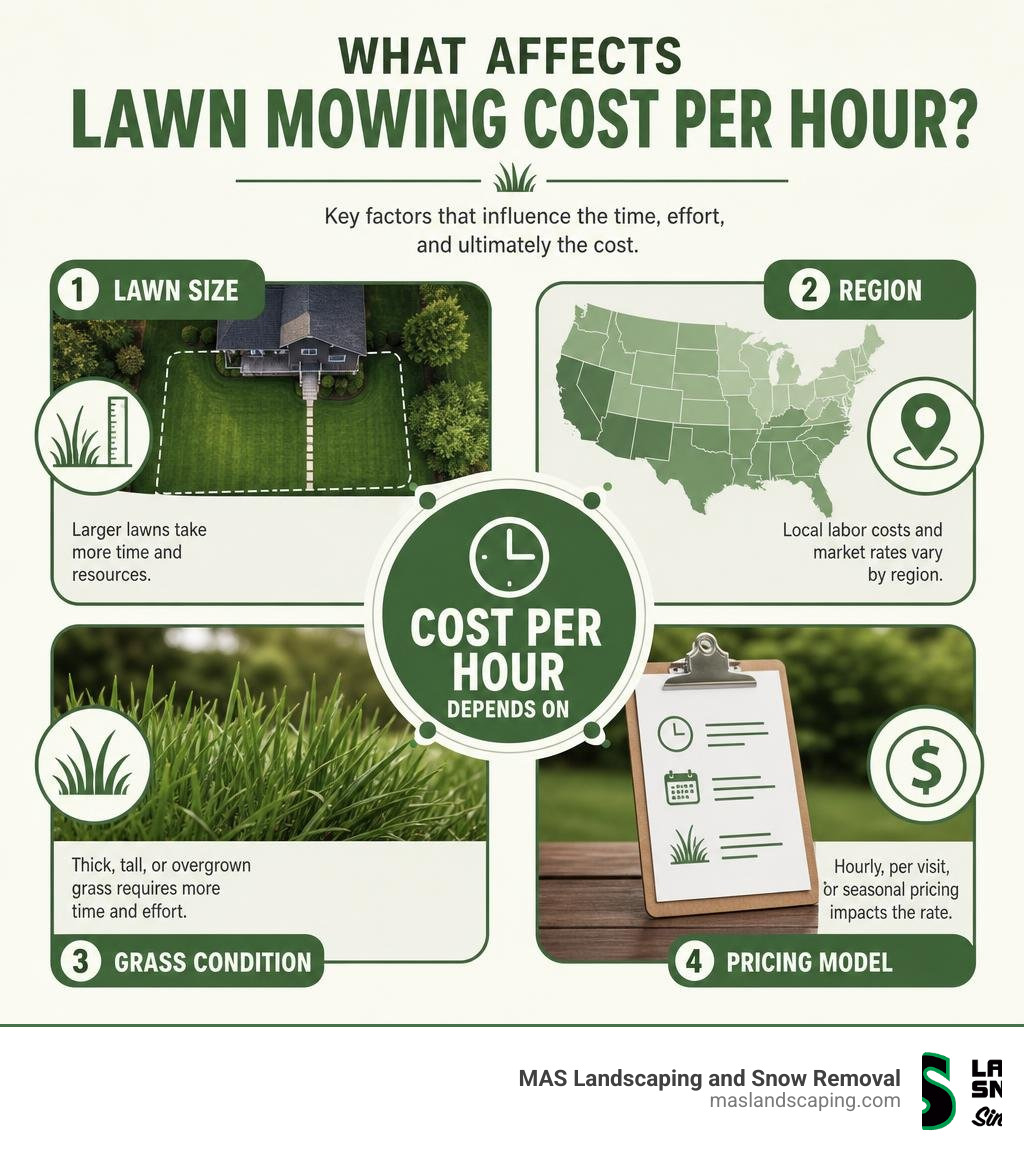
When you start researching how much it costs to keep your grass looking pristine, you will quickly find that the cost per hour lawn mowing operators charge is highly variable. Nationally, internet data indicates that the average rate for professional lawn mowing services in 2026 hovers between $50 and $90 per hour. However, depending on the complexity of the property and regional labor markets, homeowners might see a wide price range starting as low as $30 per hour for budget operators and climbing up to $270 per hour or more for specialized, high-end residential estates.
Please note: These figures are average costs compiled from national internet data and do not represent the actual pricing or service rates of MAS Landscaping.
To understand why these rates fluctuate so much, it helps to look at how lawn care professionals structure their labor rates. Industry polls show a clear breakdown of what professional lawn care providers aim to charge per hour per crew member:
- 78% of lawn care professionals charge at least $60 per man-hour (which equates to the popular “$1 per minute” rule of thumb).
- 12% of professionals charge an average of $50 per man-hour.
- 10% of professionals charge $40 per man-hour or less.
When you hire a professional crew for lawn care and maintenance, you are paying for efficient, commercial-grade speed. A two-person crew charging a combined rate of $120 per hour might only need 20 minutes to complete a job that would take a solo homeowner two hours with residential equipment. According to comprehensive market research on Lawn Mowing Cost: Average Prices by Size & Region (2026), the typical flat-rate cost per visit nationwide averages around $55, with most standard residential cuts landing in a range of $42 to $68 per visit.
Key Factors That Influence Hourly Lawn Care Rates

No two lawns are exactly alike, which is why a reputable lawn care company will rarely give you a binding hourly quote without looking at your property first. When a professional assesses your yard, they aren’t just looking at how much grass there is to cut; they are scanning for specific variables that dictate how long the job will take.
Some of the most common factors that influence the hourly rate or the total time spent on your property include:
- Grass Height and Condition: If your grass is maintained weekly, a commercial mower can glide through it at maximum speed. If the lawn has been neglected and is over 6 to 12 inches tall, the crew must slow down, double-cut the property, or bag the clippings to avoid choking the turf. This extra time and effort will instantly drive up the effective hourly rate.
- Turf Density and Grass Type: Thick, healthy, and lush turf (like well-fertilized Kentucky Bluegrass or Tall Fescue) requires more power and slower mowing speeds than thin, patchy lawns.
- Property Accessibility: Can the crew easily get their large zero-turn mowers into your backyard? If you have a fenced yard with a narrow gate — such as a 36-inch gate restriction — the team is forced to use smaller, walk-behind mowers or manual push mowers. This drastically increases the time required to complete the job.
- Yard Layout and Obstacles: A wide-open, flat rectangular lot is highly profitable and quick to mow. A yard packed with flower beds, trees, playsets, patio furniture, and tight corners requires constant stopping, reversing, and delicate string trimming, which adds significant time to the visit.
How Property Size and Terrain Affect the Cost Per Hour Lawn Mowing
The actual acreage of your property is the most obvious pricing factor, but how that acreage is laid out matters just as much. Lawn care professionals often refer to “property friction” — the collective elements of a yard that slow down a mower.
Steep slopes are a major source of property friction. Mowing a 30-degree grade is not only slower but also presents safety hazards that require skilled operators and specialized walk-behind or stand-on machinery. If your property in towns like Lynnfield or Reading has rolling hills or retaining walls, the extra care required will be reflected in the quote.
According to local data from Lawn Mowing in Lynnfield, MA – Costs 04 / 2026, lawn size tiers generally dictate the time on-site:
- Under 1/4 Acre: Usually takes 20 to 30 minutes.
- 1/4 to 1/2 Acre: Typically takes 30 to 45 minutes.
- 1/2 to 1 Acre: Often takes 45 to 60 minutes.
- 1 to 2 Acres: Can take 1.5 to 2 hours or more depending on obstacles.
If you are looking for a reliable grass cutting service near me, even a tiny yard under 5,000 square feet usually carries a minimum service fee (often around $30 to $50 per visit) to cover the crew’s travel time and overhead, regardless of how few minutes they spend cutting the grass.
Regional Climate and Growing Season Variations
Where you live has a massive impact on the cost per hour lawn mowing services demand. In the southern United States, the growing season can last up to 48 weeks a year. Because work is steady and year-round, hourly rates are often lower due to high competition.
In the Northeast — including our local service areas like Andover, Saugus, Malden, and Everett — we experience a much shorter, highly compressed growing season that typically lasts only 22 to 28 weeks. Because local lawn care companies must generate their annual revenue in a shorter window, and because cool-season grasses grow incredibly fast during the spring and fall “flushes,” hourly rates in New England are naturally higher than the national average.
For example, when looking at regional reports like the Andover, MA lawn care service starting at $19 index, you will find that while basic, low-end entry points exist for tiny townhome lots, comprehensive professional services in our region reflect the higher cost of living, strict insurance requirements, and short seasonal window of the Northeast. Cool-season grasses like Bentgrass, Ryegrass, and Fescues require precise cutting heights and consistent weekly maintenance to remain healthy and weed-free during our humid summers.
Comparing Lawn Care Pricing Models: Hourly vs. Flat-Rate
When hiring a lawn care company, you will generally encounter three different pricing structures. Understanding how these models compare can help you choose the best fit for your budget and property needs.
| Pricing Model | How It Works | Best For | Pros | Cons |
|---|---|---|---|---|
| Hourly Rate | You pay a set rate per hour, per worker on-site. | One-time cleanups, overgrown yards, or highly unpredictable properties. | You only pay for the exact time spent working. | Rates can vary from week to week; no price certainty. |
| Flat-Rate (Per Visit) | A fixed price is quoted for the entire job, regardless of how long it takes. | Standard, recurring weekly or bi-weekly residential maintenance. | Absolute price predictability; easy to budget annually. | If the crew finishes incredibly fast, the effective hourly rate is high. |
| Per Square Foot | Pricing is calculated based on the total mowable square footage of the lot. | Large acreage, commercial properties, or initial remote quoting. | Highly objective and standardized pricing. | Doesn’t always account for yard complexity or gate restrictions. |
When Does a Cost Per Hour Lawn Mowing Model Make Sense?
While recurring customers almost always prefer a flat-rate model, there are specific scenarios where paying a straight cost per hour lawn mowing rate is the fairest option for both you and the provider.
Hourly billing is highly practical for:
- Severely Overgrown Lawns: If a lawn has gone uncut for a month, it’s impossible to predict exactly how long it will take to restore.
- First-Cut Surcharges: Many companies charge an hourly rate or a flat surcharge (typically $25 to $75) for the very first visit of the season to account for winter debris cleanup and initial lawn shaping.
- One-Time Cleanups: Fall leaf removal, spring dethatching, and brush clearing are highly variable tasks that are best billed by the hour.
If you are searching for the best lawn mowing services near me, you can use the industry’s “$1-per-minute” rule of thumb as a quick mental gut check. If a solo operator takes 45 minutes to trim, mow, edge, and blow clean your property, a fair price should land around $45. For a detailed breakdown of how professional companies calculate these numbers internally to remain profitable, you can read How to Price Mowing Lawns [The 2024 Profitability Guide].
The Pros and Cons of Fixed Per-Visit Pricing
For standard, weekly residential maintenance, we highly recommend agreeing on a fixed per-visit price. This eliminates any awkwardness or disputes over how fast or slow a crew works on a given day.
The Pros of Fixed Pricing:
- Budget Predictability: You know exactly what your monthly lawn care expense will be.
- Efficiency Incentive: It encourages the lawn care crew to invest in high-end, faster commercial equipment to get the job done quickly and professionally.
- No “Slow-Rolling” Suspicions: You never have to worry that a worker is dragging their feet just to run up the hourly clock.
The Cons of Fixed Pricing:
- Weather Fluctuations: During a mid-summer drought when the grass barely grows, you still pay the same flat rate for the crew to show up, tidy the edges, and blow away debris.
- Overgrowth Penalties: If you skip a week or switch to a bi-weekly schedule, the grass will be twice as long, but the flat rate may no longer cover the extra labor required. This is why bi-weekly lawn maintenance rates are typically 20% to 50% higher per visit than weekly rates.
The Real Business Overhead Behind Professional Rates

It is common for homeowners to look at a $60 hourly quote and think, “Wow, my landscaper is making a fortune!” However, the gap between what a lawn care company charges and what the business owner actually takes home as profit is massive.
Running a legitimate, licensed, and insured lawn care business in Massachusetts involves significant overhead costs that must be factored into the hourly rate:
- Equipment Depreciation and Maintenance: Commercial zero-turn mowers cost anywhere from $10,000 to $18,000+ and only last a set number of operational hours. When you add in walk-behind mowers, commercial string trimmers, leaf blowers, and the cost of constantly sharpening blades and replacing belts, equipment alone costs between $8 and $13 per field hour to run.
- Fuel and Consumables: Truck fuel, mower gas, and two-stroke oil add up rapidly, especially during peak season.
- Commercial Liability Insurance: Legitimate companies carry robust liability insurance to protect your property in case a mower kicks up a rock and shatters a double-pane window or damages a vehicle.
- Labor Burden and Workers’ Comp: Hiring reliable, professional crew members requires paying competitive wages, plus payroll taxes, administrative costs, and expensive workers’ compensation insurance (which can add $8 to $12 per billable hour in high-risk industries).
- Non-Billable Drive Time: A lawn care crew only makes money when their mowers are spinning on a client’s lawn. Drive time between properties, loading and unloading equipment, and refueling at the pump represents 25% to 40% of a typical workday. This unpaid travel time must be built into the active working rates.
When you hire a cheap, uninsured “guy with a mower” who charges bare-minimum rates, they are likely skipping these crucial business protections — leaving you personally liable if an injury or property damage occurs on your yard.
Frequently Asked Questions about Lawn Mowing Costs
How often should my lawn be mowed during the growing season?
For optimal turf health, we recommend mowing your lawn once per week during the peak growing season (typically late April through October in Massachusetts).
Weekly mowing allows you to follow the one-third rule: you should never cut off more than one-third of the grass blade length at any single time. Cutting too much of the blade shocks the plant, weakens the root system, and makes your lawn highly susceptible to weeds, crabgrass, and summer drought stress. During the hot, dry weeks of mid-summer, growth may slow down, allowing you to transition to once every ten days or two weeks, but consistent weekly cuts keep the lawn thick and naturally weed-resistant.
What is typically included in a standard professional mowing service?
A standard, professional lawn mowing visit is a comprehensive service designed to leave your property looking completely manicured. It typically includes:
- Mowing: Cutting all turf areas to the ideal height for your specific grass type (usually 3 to 3.5 inches for local cool-season lawns).
- String Trimming (Weed Whacking): Trimming grass around trees, fence posts, garden beds, and areas the mowers cannot reach.
- Perimeter Edging: Creating clean, vertical lines along concrete driveways, sidewalks, and walkways.
- Debris Blowing: Using high-powered blowers to clear all grass clippings off your driveway, patio, walkways, and landscaping beds.
Note: Bagging and hauling away clippings is generally not included in a standard service and carries an extra charge. Leaving mulched clippings on the lawn is actually highly beneficial, as they decompose quickly and return valuable nitrogen back into the soil.
What are the red flags of an hourly rate quote that is too low?
If a lawn care quote sounds too good to be true, it almost always is. Homeowners should watch out for these common red flags when evaluating lowball bids:
- Lack of Insurance: If the operator cannot instantly produce a current certificate of commercial liability and workers’ compensation insurance, you are taking on massive financial risk.
- Unreliable Scheduling: Low-cost operators often treat lawn care as a side hobby. If they get busy, experience a minor equipment breakdown, or encounter bad weather, your lawn may go uncut for weeks.
- Subpar Equipment: Cheap residential mowers leave uneven cuts, tear the grass blades instead of slicing them (which turns the tips of your grass brown), and lack the power to handle thick spring growth.
- The “Ghost” Contractor: Operators who price their services below their actual operating costs quickly realize they are losing money and will often abandon their routes mid-season without warning.
Conclusion
Determining a fair cost per hour lawn mowing rate comes down to balancing your budget with the level of professionalism, reliability, and quality you expect for your home. While cheap, unestablished cut-rate services might save you a few dollars in the short term, investing in a professional, fully insured team guarantees that your lawn remains healthy, vibrant, and beautiful all season long.
At MAS Landscaping and Snow Removal, we pride ourselves on delivering top-tier, reliable, and highly professional property maintenance. Based in Saugus, MA, our team brings local expertise and personalized care to homeowners throughout Essex and Middlesex Counties — including Everett, Lynnfield, Malden, Melrose, Stoneham, and Wakefield. We understand the unique demands of New England’s cool-season turf and work hard to keep your curb appeal looking spectacular week after week.
Ready to take back your weekends and hand your lawn care over to the local experts? Contact us today to request a personalized quote for your property, and let us show you why we are the premier choice for grass cutting near me!
