

Cost of putting in a new lawn: Ultimate 2025 Guide
Understanding the True Investment in a New Lawn
The cost of putting in a new lawn depends on the method you choose and the size of your property. Here’s what you need to know:
Quick Cost Overview:
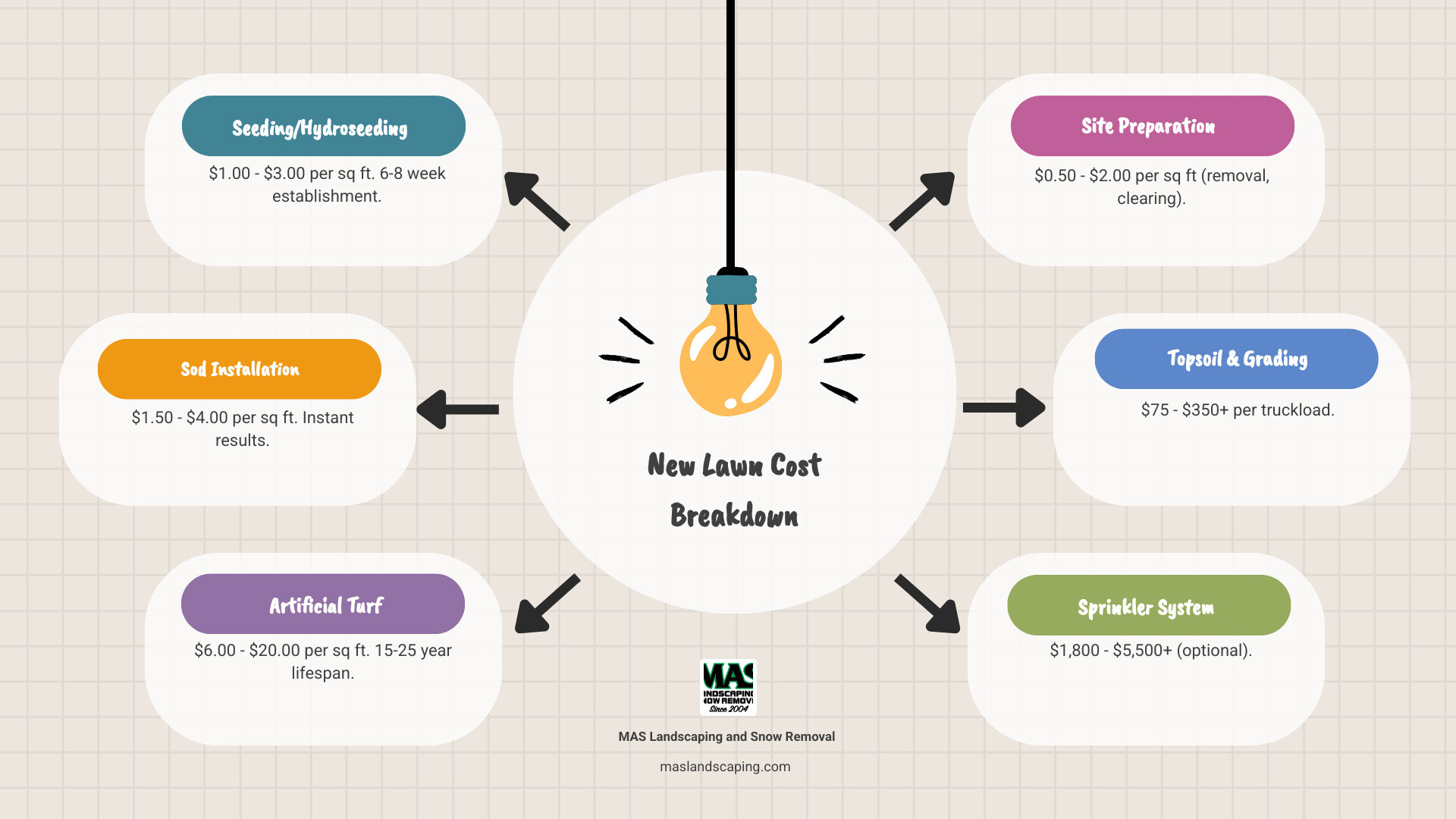
- Seeding/Hydroseeding: $1.00 – $3.00 per square foot
- Sod Installation: $1.50 – $4.00 per square foot
- Artificial Turf: $6.00 – $20.00 per square foot
- Average 5,000-10,000 sq ft lawn: $7,500 – $22,500 total
Note: These are average costs based on internet data and not actual pricing for MAS Landscaping services.
Looking at your yard with disappointment? You’re not alone. Whether you’re dealing with patchy grass, bare spots, or a lawn that’s more weeds than green, putting in a new lawn can transform your property overnight.
But here’s the thing – the grass itself is just one piece of the puzzle. The final cost depends on multiple factors: your chosen installation method, property size, soil condition, and site preparation needs. Some homeowners spend as little as a few hundred dollars on a small seeding project, while others invest tens of thousands in a complete property change with sod and irrigation.
The national average for a new lawn installation sits around $2,380, but this number varies widely. A 1,500 square foot lawn might cost $2,700 for DIY sod installation, while a professionally installed 10,000 square foot lawn with full site preparation can run $22,500 or more.
Understanding these costs upfront helps you make smart decisions about your lawn project – whether you’re trying to boost curb appeal before selling your home or simply want to enjoy a lush, green yard that doesn’t embarrass you in front of the neighbors.
Basic cost of putting in a new lawn glossary:
Lawn Installation Methods: A Cost and Benefit Analysis
Choosing how to install your new lawn is like picking between three different routes to the same destination – they’ll all get you there, but the journey (and price tag) varies dramatically. Let’s break down your options so you can make the right choice for your property and budget.
Note: All prices mentioned are national averages based on internet data and can vary significantly depending on your location and project specifics. These are not actual costs for MAS Landscaping services.
Sod Installation: The Instant Lawn
Picture this: you wake up to a muddy, patchy yard on Saturday morning, and by Sunday afternoon, you’re looking at a lush, green carpet of grass. That’s the magic of sod.
Sod installation means laying down pre-grown rolls or squares of grass – roots, soil, and all – directly onto your prepared ground. It’s the closest thing to instant gratification you’ll find in landscaping. One day you have bare dirt, the next day you have a lawn that looks like it’s been there for months.
The process starts with assessing your property and preparing the soil. Once everything’s ready, fresh sod gets delivered and installed in a single day. Beyond the immediate wow factor, sod has another major advantage: it acts like a living mulch blanket, preventing weeds from getting established and stopping soil erosion right away.
The cost of putting in a new lawn with sod typically ranges from $1.50 to $4.00 per square foot for installation, though premium varieties or challenging installations can push that to $10.00 or more per square foot. The sod material itself usually runs $0.30 to $0.80 per square foot, or about $150 to $450 per pallet. Residential projects often average $1.70 to $3.50 per square foot, while larger commercial installations might come in around $0.75 per square foot – though every project is unique.
Not all sod is created equal. Here in Massachusetts, we typically work with cool-season grasses that thrive in our climate:
| Sod Type | Average Cost (per sq ft, sod only) | Sun/Shade Tolerance | Maintenance Needs | Characteristics |
|---|---|---|---|---|
| Kentucky Bluegrass | $0.40 – $0.95+ | Full sun | Moderate to high (watering, fertilization) | Fine texture, dense, deep green, tolerates cold |
| Fescue (Tall/Fine) | $0.35 – $0.85+ | Sun to partial shade | Low to moderate (drought-tolerant, less fertilization) | Coarse to fine texture, good wear resistance, tolerates some shade |
| Ryegrass (Perennial) | $0.30 – $0.70+ | Full sun | Moderate (quick establishment, good for overseeding) | Fine texture, fast germination, often used for sports fields |
| Bermuda Grass | $0.40 – $1.00+ | Full sun | High (thrives in heat, needs regular watering and fertilization) | Coarse texture, very heat and drought tolerant, not for cold climates |
Note: Bermuda Grass is a warm-season variety that’s less common in our Massachusetts climate but included for comparison.
The beauty of sod is that you can walk on it within a couple of weeks and enjoy a fully established lawn much faster than any other method. For homeowners who want results now and have the budget for it, sod is hard to beat.
More info about our landscape design services
Seeding: The Budget-Friendly Approach
If you’re patient and budget-conscious, seeding might be your best bet. This traditional method involves spreading grass seeds over prepared soil and waiting for nature to work its magic. It takes longer than sod, but your wallet will thank you.
You’ve got two main seeding options. Hand seeding is the old-school approach where seeds are manually spread across your lawn. It’s the most economical choice, typically costing $400 to $1,600 for an average project, or about $0.10 to $0.20 per square foot for materials. The downside? It requires more effort, and success depends heavily on weather conditions and proper watering.
Hydroseeding is the modern upgrade. This technique sprays a slurry of seed, mulch, fertilizer, and water onto your soil in one go. The mulch protects the seeds and locks in moisture, giving you much better germination rates than hand seeding. Hydroseeding generally runs $500 to $4,000 per project, or $0.50 to $1.00 per square foot.
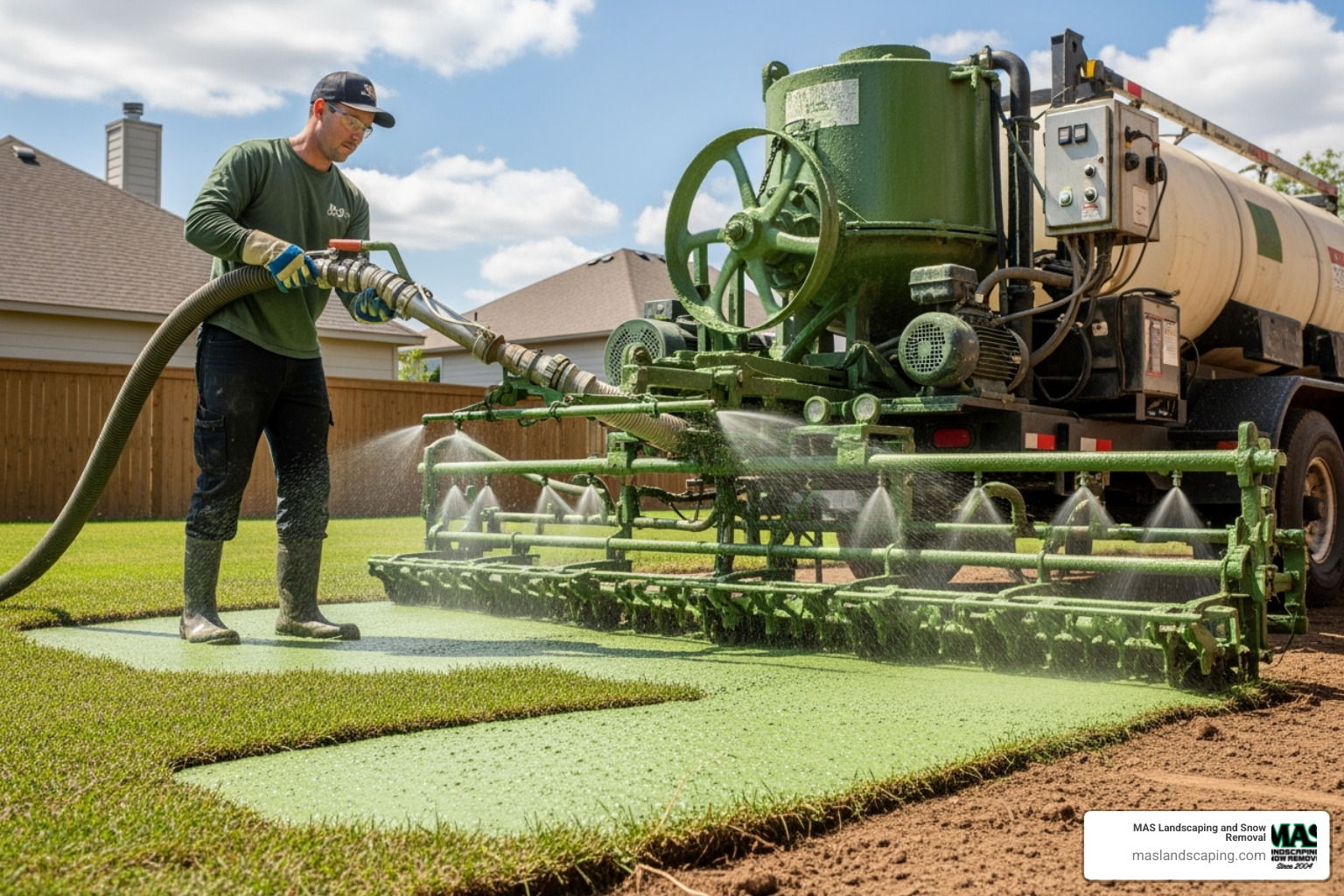
Here’s the reality check: seeded lawns take time. You’re looking at several weeks for germination and potentially a full season or more before your lawn reaches its full potential. During that time, you’ll need to keep foot traffic and pets off the grass, which can be challenging if you have kids or dogs.
Timing matters significantly with seeding. Spring and fall are your best windows when temperatures are moderate and natural rainfall helps with consistent moisture. Seeding in the extreme heat of summer or the cold of winter is asking for trouble.
The overall cost of putting in a new lawn through seeding typically ranges from $1.00 to $3.00 per square foot, though extensive soil preparation and premium seed blends can push that to $5.00 or more. While seeded lawns might look a bit rough at first, they often develop into more robust, disease-resistant turf than sod because they typically use a blend of grass varieties rather than a single type.
More info about our landscape maintenance services
Artificial Turf: The Low-Maintenance Alternative
Imagine never mowing your lawn again. No more weekend chores with the push mower, no watering during droughts, no fertilizing schedules to remember. That’s the promise of artificial turf – a lawn that looks pristine 365 days a year with virtually zero maintenance.
Artificial turf has come a long way from the plasticky-looking stuff you might remember from old sports fields. Modern synthetic grass looks remarkably realistic and feels comfortable underfoot. It’s perfect for areas with water restrictions, for homeowners who travel frequently, or for anyone who’d rather spend their weekends doing literally anything other than lawn care.
The installation process is more involved than you might think. Proper artificial turf installation requires careful base preparation, usually involving a layer of crushed rock to ensure good drainage and a stable, level surface. Get this foundation wrong, and you’ll have problems down the road.
The catch? The upfront investment is substantial. Artificial turf installation averages $6.00 to $20.00 per square foot, but premium materials, intricate designs, or specialized applications can easily push that to $30.00 per square foot or more. Putting greens, for instance, often run around $14 per square foot due to the specialized turf required.
But here’s the long-term perspective: quality artificial turf lasts 15 to 25 years. Over that time, you’ll save significantly on water bills, fertilizer, lawn care equipment, and professional maintenance. For many homeowners, especially in areas where water is expensive or restricted, the math works out favorably over the long haul.
The cost of putting in a new lawn with artificial turf is undeniably the highest of the three options, but it’s a one-time investment that essentially eliminates ongoing lawn care costs for decades.
More info about our hardscaping installation services
What is the Total Cost of Putting in a New Lawn?
Here’s something that surprises most homeowners: the cost of putting in a new lawn isn’t just about the grass. In fact, the sod or seed might be the smallest line item on your final invoice. Think of it like baking a cake – you can’t just slap frosting on a table and call it done. You need layers, preparation, and the right foundation.
The real investment comes from everything that happens before the first blade of grass touches your property. And honestly? That’s where the magic happens. Skip these steps, and you’ll end up with a lumpy, patchy lawn that drains poorly and struggles to grow.
The Cost of Site Preparation
Before we can give you that gorgeous green carpet you’re dreaming of, we need to deal with what’s already there. Your current sad excuse for a lawn? It’s got to go.
Removing your old lawn is typically the first step, and it’s not as simple as just scraping it off. We’re talking about removing grass, roots, and often years of compacted soil. This process usually costs between $0.50 and $2.00 per square foot, though challenging removals can push costs higher. For a typical property, you might be looking at $1,000 or more just for this step.
Note: These are average costs based on internet data and not actual pricing for MAS Landscaping services.
Now, here’s where smart homeowners get ahead of the game: soil testing. For anywhere from $10 to $150, you can find out exactly what your soil needs. Is it too acidic? Missing key nutrients? Compacted beyond belief? A soil test tells you everything, and it’s the best money you’ll spend on your lawn project. Trust us – it’s a lot cheaper than replanting a failed lawn next year.
Once the old stuff is gone and we know what we’re working with, the ground needs tilling to break up compaction and create a welcoming home for new roots. Light tilling might run $50 to $100 minimum, while more intensive work can add $0.10 to $0.65 per square foot. And if your yard is hiding any surprises – rocks, old landscaping materials, construction debris from that deck you built five years ago – clearing that out will cost anywhere from $100 to $300 or more.

The Cost of Soil and Grading
You know what kills more new lawns than anything else? Bad drainage and poor soil. You can lay the most expensive sod money can buy, but if it’s sitting on garbage soil or in a puddle, it’s toast.
Adding quality topsoil isn’t optional – it’s essential. This nutrient-rich foundation gives your new grass everything it needs to thrive. Topsoil costs typically range from $12 to $30 per cubic foot, and delivery usually runs between $15 and $200. For a delivery of 5 cubic yards, expect to pay $75 to $350 depending on your location. A typical 1,500 square foot lawn might need around $1,500 worth of topsoil, though this varies based on your existing soil condition.
Then there’s grading – the secret weapon against standing water and uneven lawns. Proper grading means reshaping your yard so water flows away from your house and doesn’t create swampy spots where your grass drowns. Professional regrading typically costs between $0.40 and $2.00 per square foot, with total project costs ranging from $1,000 to $3,000 for most residential properties. Complex terrain or significant reshaping can push costs higher.
The goal is a gentle 2% slope for proper drainage – not so steep you’re mowing on a mountainside, but enough that water knows where to go. Get this right, and you’ll thank yourself every time it rains.
More info about our bobcat services for grading
Additional Features and Long-Term Costs
Okay, so your new lawn is in. Beautiful. But here’s the thing – keeping it that way requires some ongoing investment. And if you’re smart, you’ll think about these things before installation, not after.
A sprinkler system is the difference between a lawn that survives and one that thrives, especially during those brutal New England summers. Installing irrigation before your new lawn goes in is infinitely easier than tearing up your grass to add it later. Professional sprinkler system installation typically runs between $1,750 and $3,550, though more sophisticated systems can cost $2,500 to $4,000 or more. Some installations are priced around $2 per square foot for turf areas.
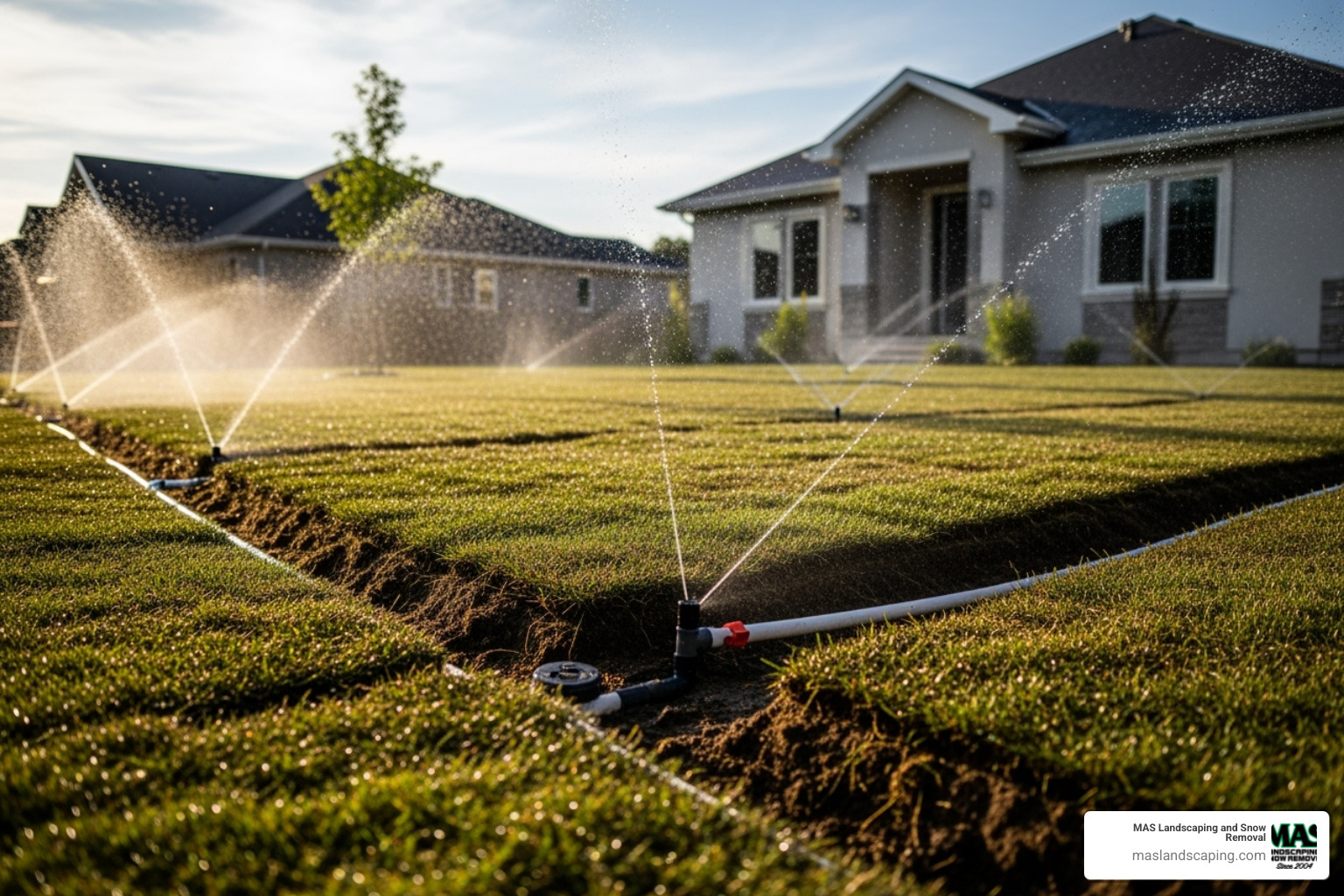
Once your lawn is established, it’ll need regular care to stay healthy and beautiful. Fertilization keeps your grass fed and happy, typically costing $65 to $100 per application or $80 to $380 for a full season of treatments. Aeration prevents soil compaction and runs between $75 and $250 per session. And of course, there’s mowing and edging – if you’re hiring professionals, expect to pay around $30 to $40 per visit for a small suburban lot.
These maintenance costs aren’t part of the initial installation, but they’re worth budgeting for. A beautiful lawn isn’t a “set it and forget it” deal – it’s an investment that pays dividends when you care for it properly.
Note: These are average costs based on internet data and not actual pricing for MAS Landscaping services.
Frequently Asked Questions about New Lawn Costs
When is the best time to install a new lawn?
If you’re planning a new lawn, timing can make all the difference between success and frustration. The sweet spot for both sod and seeding? Spring and fall, hands down.
These seasons offer the perfect conditions for grass establishment. The temperatures are moderate, which means your new grass isn’t fighting extreme heat or bitter cold while trying to develop roots. Spring brings gentle rains and warming soil, creating an ideal environment for grass to wake up and grow. Fall might actually be even better – the air cools down while the soil stays warm from summer, encouraging deep root growth before winter dormancy.
For seeding specifically, you’ll want to pay attention to germination periods. Cool-season grasses (which thrive in our Massachusetts climate) germinate best when soil temperatures are between 50 and 65 degrees Fahrenheit. This typically happens in early spring or late summer to early fall.
Sod is a bit more forgiving with timing. While spring and fall are still optimal, sod can be installed during summer if you’re willing to be diligent about watering. The key is keeping those roots consistently moist until they establish. If you do install during warmer months, choose cooler parts of the day and have your hose ready – that sod will need immediate and frequent watering to prevent it from drying out and dying.
One timing tip we always share: avoid laying sod right before a heavy rainstorm. All that carefully leveled topsoil can wash away, leaving you with an uneven mess.
Is it cheaper to repair a lawn or replace it?
This is the million-dollar question – or, more accurately, the several-thousand-dollar question. And honestly? The answer depends on what your lawn is trying to tell you.
For minor damage, patching is almost always your best bet. A few bare spots here and there? Some thin areas where the dog likes to run? These are perfect candidates for repair. Patching small sections with seed or sod typically costs much less than a full replacement, and you can often tackle these projects yourself if you’re handy.
Note: Repair costs are average costs based on internet data and not actual pricing for MAS Landscaping services.
But here’s where it gets interesting. Sometimes what looks like a simple problem is actually a symptom of bigger issues. If you’re dealing with widespread weed infestation, persistent disease problems, or significant drainage issues, those patch jobs might just be throwing good money after bad.
Signs that replacement is the smarter investment include extensive dead patches covering more than 40-50% of your lawn, uncurable lawn diseases that keep coming back, frequent standing water that won’t drain properly, or having the wrong grass type entirely for our New England climate. If you’ve got a warm-season grass struggling through Massachusetts winters, no amount of patching will fix that fundamental mismatch.
Poor soil condition is another red flag. If your lawn is struggling because the soil beneath is compacted, nutrient-depleted, or just plain terrible, you’re fighting an uphill battle. A full replacement lets you address the soil quality from scratch, setting up your new lawn for long-term success.
Think of it this way: patching is like putting a bandage on a wound, while replacement is like surgery. Sometimes you need the bandage, but sometimes you need to fix the underlying problem once and for all. While the cost of putting in a new lawn completely might seem steep initially, it can actually save you money over time by eliminating the cycle of constant repairs.
How should I care for my new lawn after installation?
You’ve just invested in a beautiful new lawn – congratulations! Now comes the crucial part: keeping it alive and thriving. Don’t worry, it’s not rocket science, but it does require some attention, especially in those first few weeks.
Watering is absolutely critical. We can’t stress this enough. For the first week after installation, your new lawn needs water once or twice daily. Yes, daily. This keeps the soil consistently moist while roots establish. During weeks two and three, you can ease back to every other day. After that initial establishment period, transition to a regular schedule of two to three times per week, depending on rainfall and temperature.
The best time to water? Early morning, ideally between 6 and 10 AM. This gives the grass blades time to dry before nightfall, which helps prevent fungal diseases from taking hold. For seeded lawns, you’ll need to maintain consistent moisture for about eight weeks – that’s how long it takes for those baby grass plants to develop strong enough roots.
Your first mow is a milestone, but don’t rush it. For sod, wait at least two weeks to ensure the roots have grabbed hold of the soil beneath. You can do a simple tug test – if the sod lifts easily, it’s not ready. For seeded lawns, patience is even more important. Wait until the grass reaches 4 to 6 inches tall, usually around four to six weeks after you first see those green shoots appear.
When you do mow, follow the one-third rule: never cut more than one-third of the grass blade length at a time. Cutting more stresses the grass and can set back its development. Keep your mower blade sharp for clean cuts that heal quickly, rather than ragged tears that leave your grass vulnerable to disease. For most cool-season grasses in Massachusetts, maintaining a mowing height of 2.5 to 3.5 inches is ideal.
Fertilizing comes later, not immediately. Both sod and seeded lawns benefit from a starter fertilizer application after four to six weeks of establishment. This gives them the nutrients they need for robust growth without overwhelming tender young roots.
One last tip: avoid heavy foot traffic on your new lawn during the establishment period. We know it’s tempting to show off your beautiful new grass, but give it time to settle in before hosting that backyard barbecue.
How to properly mow your new lawn
Get Your Dream Lawn with Professional Installation
Putting in a new lawn is more than just a weekend project—it’s an investment in your home’s beauty, your family’s enjoyment, and your property’s value. Throughout this guide, we’ve walked through the many factors that influence the cost of putting in a new lawn, from choosing between sod, seed, or artificial turf to understanding the crucial behind-the-scenes work like site preparation, grading, and soil amendments.
Here’s what we hope you’ll take away: the grass itself is only part of the story. A beautiful, lasting lawn requires proper foundation work, thoughtful planning, and attention to detail. Whether you’re budgeting for a simple seed project or a complete property change with sod and irrigation, understanding these costs upfront helps you make informed decisions that you’ll be happy with for years to come.
You might be tempted to tackle this as a DIY project to save money. We get it—who doesn’t love saving a few bucks? But here’s the reality: lawn installation involves heavy equipment, precise grading for drainage, soil expertise, and timing considerations that can make or break your results. Many homeowners find that the “savings” from DIY quickly evaporate when they need to rent equipment, buy materials twice, or fix grading mistakes that cause water pooling. Professional installation often proves more cost-effective in the long run, not to mention far less stressful.
For homeowners in Saugus, MA, and the surrounding communities—including Everett, Lynnfield, Malden, Melrose, Medford, Revere, and Chelsea—MAS Landscaping and Snow Removal brings local expertise and personalized service to every lawn installation project. We understand Massachusetts soil, climate, and the specific challenges our region presents. More importantly, we take pride in creating outdoor spaces that match your vision and lifestyle, not just following a cookie-cutter approach.
Your lawn should be a source of pride, not frustration. Whether you’re dreaming of a lush green carpet for your kids to play on, hoping to boost your home’s curb appeal before listing it for sale, or simply tired of looking at that patchy, weed-filled yard, we’re here to help you make it happen.
Ready to transform your outdoor space? Let’s talk about your vision and create a plan that fits your property, your budget, and your timeline.
Contact us today for a personalized quote for your new lawn!