




Commercial Snow Removal Cost: Top 10 Expert Tips 2025
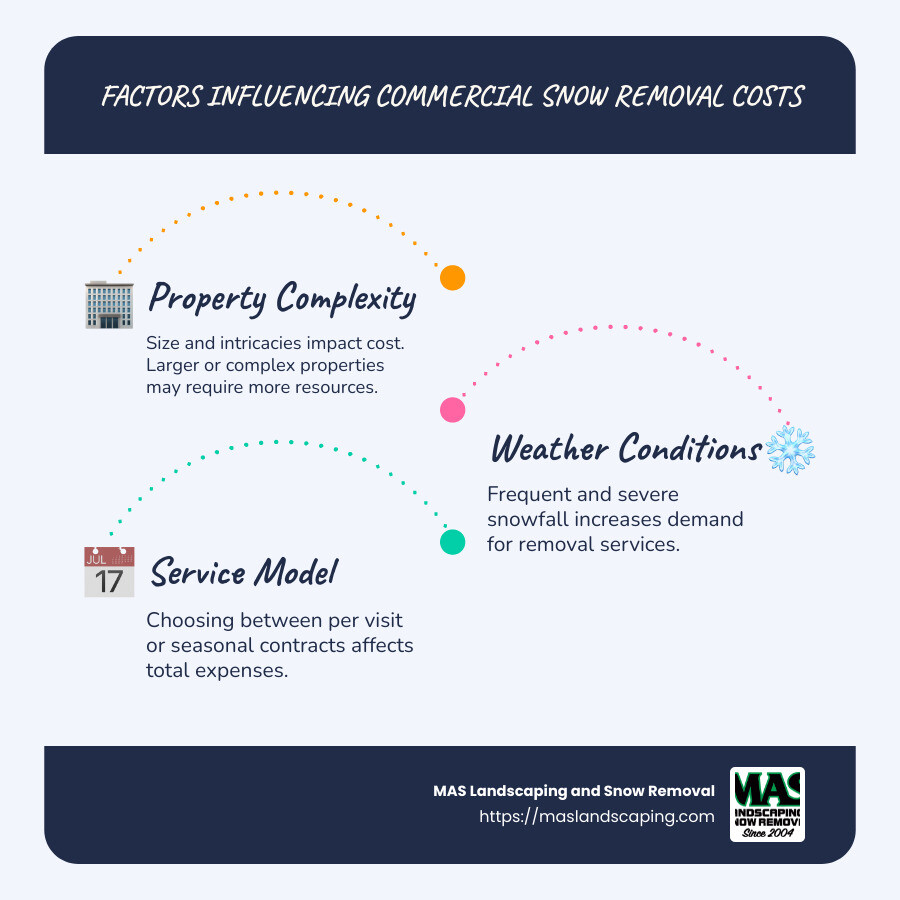
Understanding commercial snow removal cost is crucial for businesses in snow-prone areas. It ensures they stay open, safe, and accessible during winter storms. For those who want a quick insight into what influences these costs, here’s a brief overview:
- The size and complexity of the property
- Frequency and severity of snowfall
- Equipment and labor costs
- Choice between different service models (e.g., per visit or seasonal contracts)
- Liability and insurance considerations
Commercial snow removal is more than just clearing snow; it’s about providing a safe environment for customers and employees. In the Greater Boston area, businesses rely on services like MAS Landscaping and Snow Removal to maintain their properties’ safety and aesthetics no matter the season.
These services are integral to sustaining operations during harsh winters, keeping pathways clear, and ensuring no accidents occur due to unattended snow and ice. Whether your business requires regular snow plowing for expansive parking lots or specialized care for intricate roof designs, understanding the cost factors and getting expert help becomes essential.
Commercial snow removal cost word roundup:
– commercial snow and ice management
– commercial snow removal contracts
– how to bid commercial snow plowing
Understanding Commercial Snow Removal Costs
Key Factors Influencing Costs
When it comes to commercial snow removal cost, several key factors come into play. Each element can significantly impact your overall expenses, so it’s crucial to understand them clearly.
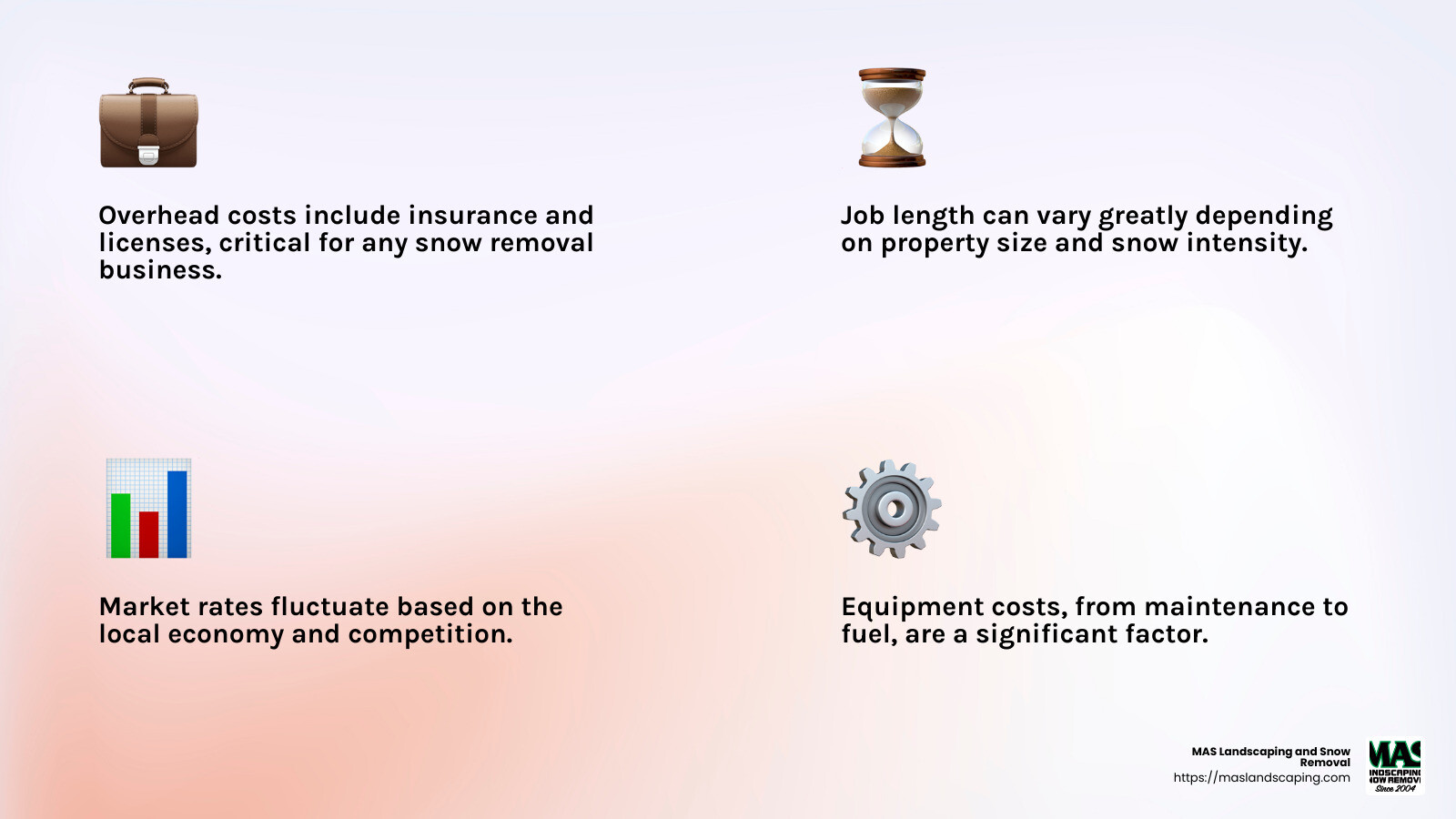
Overhead Costs: These are the expenses that keep the business running, regardless of the number of snow events. Think insurance, business licenses, and facility maintenance. They form the backbone of your pricing strategy.
Job Length: The duration of a snow removal task depends on the size and complexity of the property, as well as the intensity of the snowfall. Longer jobs mean higher labor costs, so accurate time estimation is vital.
Market Rates: Your local market influences pricing. Wealthier areas might bear higher costs, while less affluent regions require more competitive pricing. Understanding your market ensures you stay competitive.
Insurance: Liability and equipment insurance protect your business but add to costs. This is a critical factor, especially in regions with heavy snowfall, where accidents are more likely.
Equipment: The type and number of machines used, from snow blowers to plow trucks, affect costs. Maintenance, fuel, and depreciation of these machines are ongoing expenses that must be factored into pricing.
Labor Costs: Labor is typically the most significant expense. It varies with the number of workers and their hourly rates. Efficient workforce management can help control these costs.
Common Pricing Models
Once you understand the key factors influencing costs, the next step is to choose a pricing model that aligns with your business needs and market expectations. Here are some common models used in the industry:
Per Hour: This model charges clients based on the number of hours worked. It’s straightforward and works well for properties where job length can vary significantly from one snow event to another.
Per Event: Ideal for properties with predictable snow removal needs. Clients pay a fixed rate for the entire snow event, which can include multiple visits if needed.
Per Visit: Similar to per event, but charges are based on each individual visit. This model is suitable for properties requiring frequent but brief snow clearing sessions.
Per Season: A flat rate covers all snow removal services for the winter season. It offers predictability for both the service provider and the client, but requires careful estimation of average snowfall and service frequency.
Per Inch: Charges are based on the amount of snowfall. This model can be appealing in regions with variable snowfall, allowing costs to scale with the severity of each snow event.
Choosing the right pricing model depends on your business structure, client needs, and regional weather patterns. Each model has its pros and cons, so understanding your market and client expectations is key to setting a fair and competitive price.
In the next section, we’ll dig into how to calculate these costs effectively, ensuring that your business remains profitable while meeting client expectations.
How to Calculate Commercial Snow Removal Cost
When calculating commercial snow removal cost, having a clear pricing formula is essential. This ensures you cover all expenses while offering competitive rates. Here’s a step-by-step guide to help you understand the process.
Example Calculation
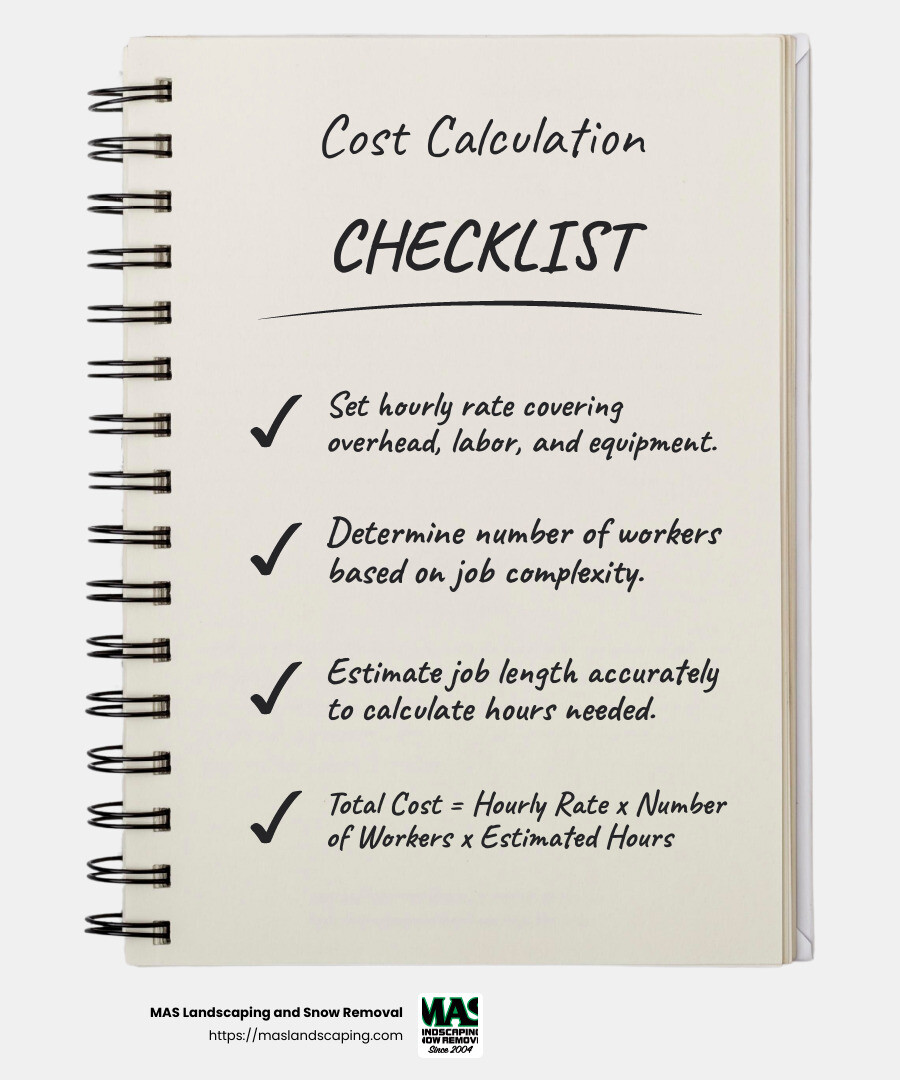
1. Determine Your Hourly Rate
Start by setting an hourly rate for your services. This rate should cover your overhead costs, labor, and equipment expenses. For instance, if your overhead and labor costs amount to $200 per hour, this becomes your base rate.
2. Calculate the Number of Workers Needed
Next, assess the size and complexity of the job to determine how many workers are required. For larger properties, you might need more personnel to ensure timely completion. Suppose a commercial parking lot requires three workers.
3. Estimate the Number of Hours
Accurately estimating the job length is crucial. Consider factors like the size of the property and the average time it takes to clear snow from similar areas. For example, clearing a parking lot might take approximately 4 hours.
Putting It All Together
Here’s how you calculate the total cost:
- Hourly Rate: $200
- Number of Workers: 3
- Estimated Hours: 4
The formula is simple:
Total Cost = Hourly Rate x Number of Workers x Estimated Hours
So, in this example:
Total Cost = $200 x 3 x 4 = $2,400
This calculation ensures you cover your expenses while providing a clear and fair price to your clients.
By using this formula, you can confidently present a detailed and transparent quote to your clients, addressing their needs while maintaining your business’s profitability.
Tips for Accurate Snow Removal Pricing
Accurate pricing in snow removal is crucial to profitability. Let’s break down how to achieve this with a focus on estimating job length, understanding your market, effective sales strategies, and leveraging digital marketing.
Estimating Job Length
To begin, accurately estimating job length is key. This involves calculating the labor and equipment needs for each job. Think about how long it would take one worker to clear a specific area. Then, divide that time by the number of workers you plan to use. This simple method helps ensure you don’t underestimate or overestimate job duration.
For example, if one person takes 4 hours to clear a parking lot, and you plan to use two workers, the job should take about 2 hours. Proper equipment also plays a crucial role. Choose the right tools for the job—snow blowers for tight spaces and plows for open areas—to improve efficiency.
Knowing Your Market
Understanding your market is another critical factor. Each area has different expectations and rates. Wealthier communities might be willing to pay more for premium services, while less affluent areas may require more competitive pricing.
Research local rates and adjust your pricing accordingly. This ensures you remain competitive while meeting client expectations. Don’t hesitate to check what other companies are charging, as this can provide valuable insights into market standards.
Effective Sales Strategies
Whether you’re out in the field or managing from the office, having a sales strategy is essential. If you’re not a natural salesperson, consider hiring someone who is. A good salesperson can communicate effectively with clients, understand their needs, and build strong relationships.
Client communication is key. Be clear about your services and pricing, and follow up regularly. This builds trust and can lead to repeat business.
Leveraging Digital Marketing
Having an online presence is vital. Start with your Google Business page. Ensure it has up-to-date information, including your phone number, hours, and a photo of your business. Respond to reviews to show potential clients you’re engaged and care about feedback.
A simple, informative website is also crucial. It should clearly outline your services and provide easy ways for clients to contact you. Positive reviews and testimonials can further improve your reputation and attract new clients.
By focusing on these areas, you can create a pricing strategy that meets your business needs while satisfying your clients. Next, we’ll explore the factors affecting snow removal costs, such as removal versus plowing and different contract types.
Factors Affecting Snow Removal Costs
When it comes to commercial snow removal cost, understanding the factors that influence pricing is crucial. Let’s dig into some key elements, such as removal vs. plowing, seasonal contracts vs. individual visits, and how property size and special conditions play a role.
Removal vs. Plowing
The decision between snow removal and plowing can significantly impact costs. Plowing involves pushing snow to a designated area, whereas removal involves transporting the snow offsite. Removal is typically more expensive due to the additional labor and equipment required. However, in areas prone to heavy snowfall, removal might be necessary to keep spaces accessible and safe.
Snow blowing is another method, often used for smaller or tighter areas like sidewalks. While it operates at a similar price point to plowing, blowing is ideal for spaces where larger plows can’t reach. Choosing the right method depends on the property’s layout and the client’s needs.
Seasonal Contract vs. Individual Visit
Choosing between a seasonal contract and paying per visit can also affect costs. A seasonal contract provides a fixed price for snow removal services throughout the winter. This option offers predictability and can be cost-effective if your area experiences frequent snowstorms.
On the other hand, paying per individual visit might be more economical in regions with milder winters. This approach allows you to pay only for services rendered, which can save money if snow events are infrequent. However, it can lead to unpredictable expenses during heavy snowfall seasons.
Property Size and Special Conditions
The size of the property is a straightforward factor affecting snow removal costs. Larger areas require more time and resources to clear, leading to higher costs. For instance, the length and width of parking lots or pathways can determine the amount of labor and equipment needed.
Special conditions can also influence pricing. Properties with numerous obstacles, such as curbs or landscaped areas, may require more careful navigation and specialized equipment, increasing costs. Additionally, properties in rural areas might incur extra charges due to travel distance and accessibility issues.
Finally, response time is a critical factor. Clients may request faster service during heavy snowfalls to ensure safety and accessibility, which can affect pricing. Prioritizing rapid response times might involve additional staffing or equipment, impacting the overall cost.
Understanding these factors helps businesses like MAS Landscaping and Snow Removal tailor their services to meet client needs while maintaining profitability. Next, we’ll explore pricing for different commercial properties, including parking lots, sidewalks, and roofs.
Pricing for Different Commercial Properties
When it comes to commercial snow removal cost, pricing varies depending on the type of property and the specific services required. Let’s break down the pricing for parking lots, sidewalks, and roofs.
Parking Lots
Parking lots are one of the most common areas requiring snow removal. The cost for clearing these spaces often depends on hourly rates and the size of the lot. Larger lots require more time and equipment, which can increase costs.
Additional services, such as applying rock salt or sand, can also affect pricing. These services help prevent ice formation and improve safety, but they come at an extra cost. It’s crucial to discuss these options with clients to ensure their needs are met.
Sidewalks and Pathways
Snow removal from sidewalks and pathways can be priced using a flat rate or an hourly fee. The choice between these pricing models often depends on the length and complexity of the pathways.
In some areas, regulations require prompt snow removal from sidewalks to avoid fines. This urgency can influence pricing, as it may require more immediate and frequent service. Clients should be aware of local laws to ensure compliance and avoid penalties.
Roof Snow Removal
Removing snow from roofs is essential to prevent damage from excessive weight. Standard roofs typically cost less to clear than complex roofs, which may have steep pitches or multiple levels. These complex structures require more time and specialized equipment, leading to higher costs.
For safety and effectiveness, remove snow before it accumulates beyond six inches. This proactive approach can prevent costly repairs and ensure the integrity of the building.
In emergency areas, such as hospitals, the speed of service is crucial. These properties may require prioritized snow removal, which can affect pricing. Ensuring clear access is vital for safety and operational efficiency.
Understanding these pricing factors helps businesses like MAS Landscaping and Snow Removal provide custom solutions for each property type. Next, we’ll address frequently asked questions about commercial snow removal cost.
Frequently Asked Questions about Commercial Snow Removal Cost
How do you calculate commercial snow plowing?
Calculating commercial snow plowing costs involves a few key factors. Start with the hourly rate, which often ranges based on local market conditions. For instance, many snow removal contractors charge between $50 and $160 per hour for parking lots.
Next, consider the number of hours needed to complete the job. This depends on the size of the area and the complexity of the terrain. Use the formula:
Hourly Rate x Number of Hours = Base Cost
Don’t forget to include overhead costs like insurance and equipment maintenance. Then, add any costs for materials like deicer or sand. Finally, apply a markup to ensure profitability.
How much does snow removal cost in the MAS Landscaping service area?
In the MAS Landscaping service area, snow removal costs can vary based on the service type and property size. Typically, hourly rates range from $30 to $65. This rate might change based on specific conditions like heavy snowfall or difficult-to-access areas.
Remember to consider any additional services that might be needed, such as salt application or specialized equipment for larger or more complex properties.
How do I budget for snow removal?
Budgeting for snow removal involves planning for snow events and understanding your property’s specific needs. Start by estimating the number of snow events in a typical season for your area. Then, calculate expected costs using the hourly rate and anticipated hours of work.
Number of Snow Events x Estimated Cost per Event = Seasonal Budget
Include a buffer for unexpected storms and additional services like salting or sanding. This ensures you’re prepared for the season and avoids surprises.
By understanding these factors, you can plan effectively and ensure you’re getting the most value from your snow removal services.
Conclusion
In summary, commercial snow removal cost is influenced by many factors, including labor, equipment, and the specific needs of each property. Whether you’re managing a large parking lot or a series of sidewalks, understanding these costs is crucial for effective budgeting and planning.
At MAS Landscaping and Snow Removal, we bring our local expertise and commitment to professionalism to every job. Serving areas like Everett, Lynnfield, and Malden, we are dedicated to providing personalized snow management solutions that ensure safety and accessibility during the harsh winter months. Our focus is not only on delivering efficient services but also on building lasting relationships with our clients.
If you’re ready to improve your commercial property’s winter readiness, contact us today to learn more about our comprehensive snow management services. Let MAS Landscaping and Snow Removal help you steer the challenges of winter with confidence and peace of mind.
