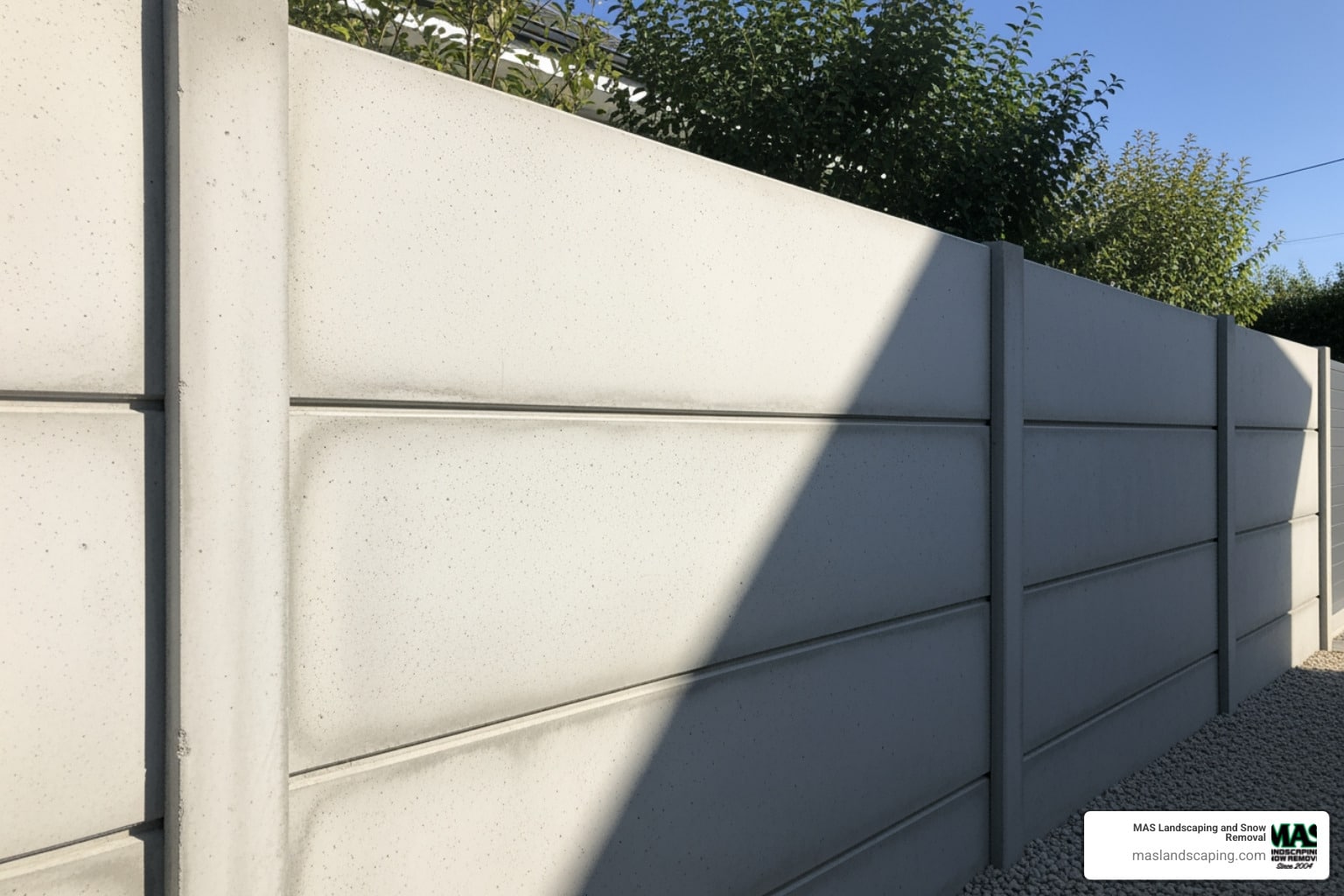



Concrete Wall Fence Cost: 5 Expert Tips for 2025
Why Understanding Concrete Wall Fence Costs Matters Before You Build
Planning a permanent, maintenance-free concrete fence is an excellent investment in your property’s security and privacy. However, the biggest question is often whether it fits the budget. The concrete wall fence cost can vary dramatically, typically ranging from $80 to $650+ per linear foot for a standard 6-8 foot tall fence, based on internet averages and not MAS Landscaping quotes.
Quick Cost Overview:
- Poured concrete walls: $80-$650 per linear foot
- Precast concrete panels: $120-$700 per linear foot
- Concrete block walls: $10-$90 per square foot
- Average 100-foot fence: $10,000-$90,000+ total project cost
Note: These are average costs based on internet data, not MAS Landscaping quotes. Your actual project cost will depend on many factors specific to your property.
The same 100-foot fence could cost $10,000 or well over $90,000 depending on the wall type, site conditions, and finishes you select. This guide breaks down what you’ll pay for each component of your project, helping you learn which factors have the biggest impact on your final bill.
Understanding these costs upfront allows you to make informed decisions, avoid budget surprises, and plan a project that delivers long-term value, whether it’s a simple property line fence or a complex retaining wall system.
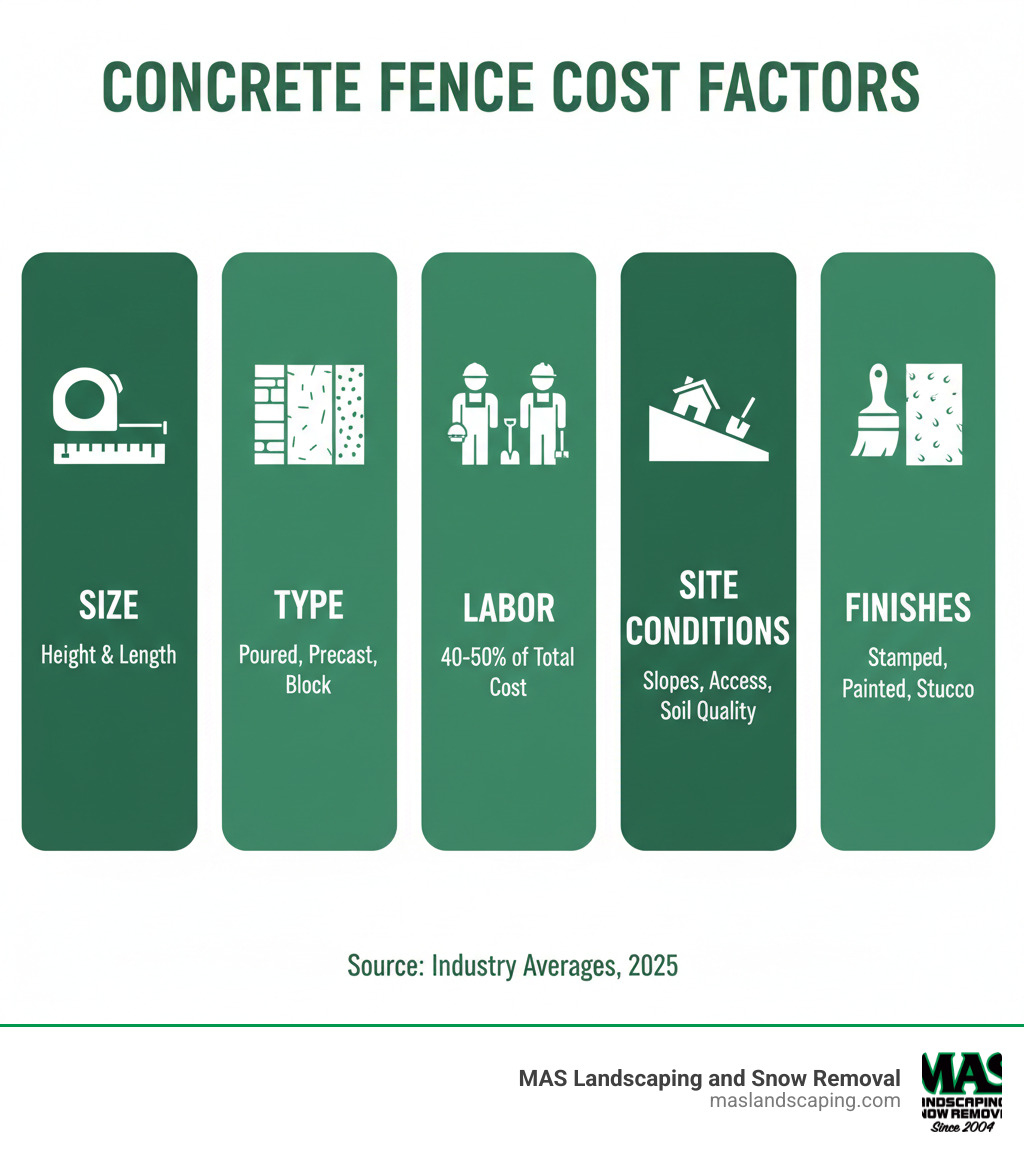
Breaking Down the Basic Cost of a Concrete Fence
When reviewing quotes for a concrete fence, you’ll encounter pricing “per linear foot” or “per square foot.” Understanding these terms is key to realistic budgeting.
Linear foot pricing is the most common method, representing the cost for each foot of fence length. For example, a 100-foot fence quoted at $150 per linear foot would be $15,000. Square foot pricing is often used for material calculations or taller walls. A 6-foot tall, 100-foot long fence is 600 square feet; at $25 per square foot, the cost is also $15,000.
Based on national internet data (and not MAS Landscaping quotes), the total concrete wall fence cost can range from about $3,000 to over $90,000+ for complex installations. This wide range reflects the vast differences between a simple property divider and a long privacy wall with decorative finishes.
These are average costs based on internet data and not actual quotes from MAS Landscaping. Your specific project cost will vary based on numerous factors unique to your property in our service areas including Everett, Lynnfield, Malden, Melrose, Medford, Revere, Saugus, and Chelsea, MA. For more information about our custom wall services, visit our custom wall services page.
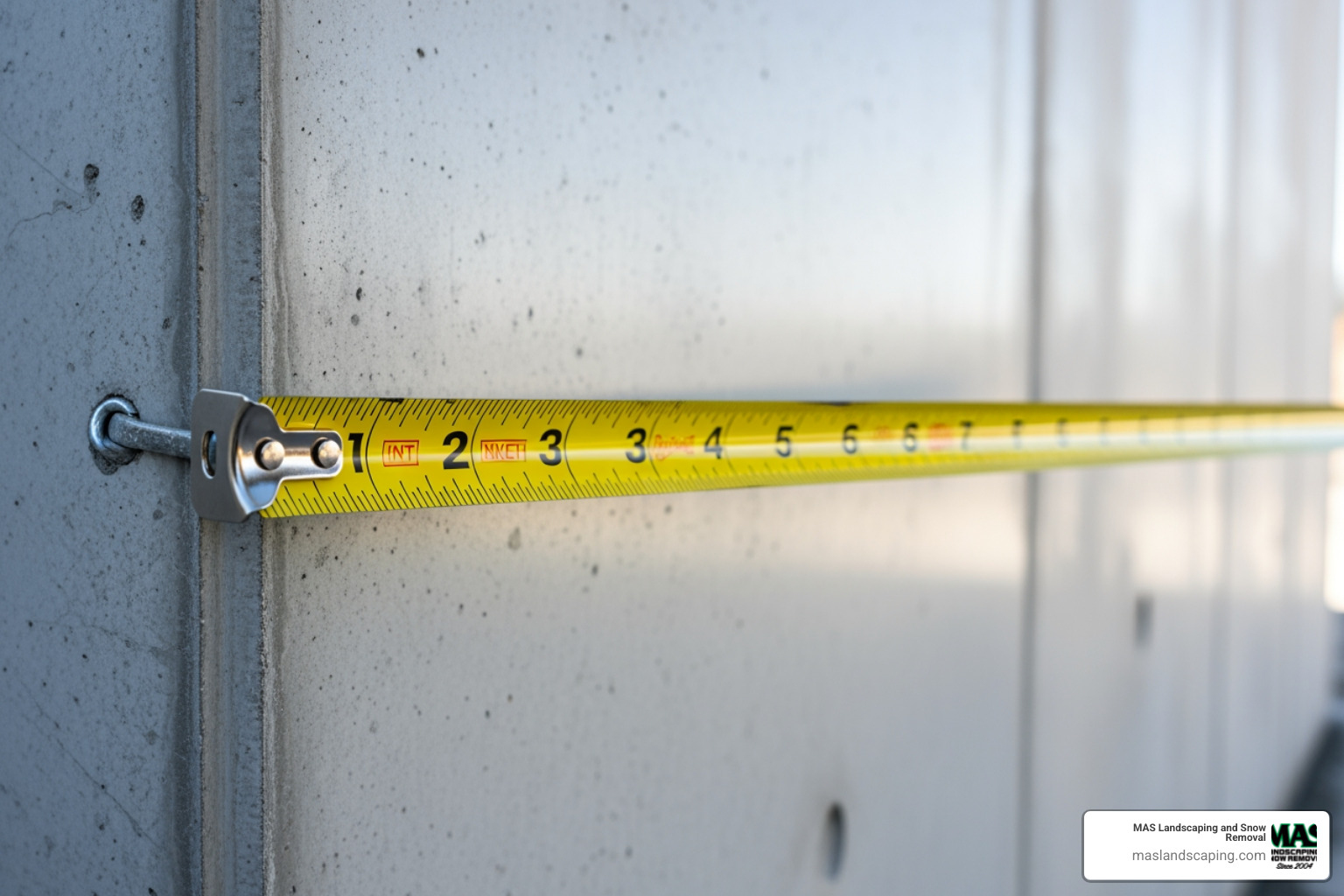
How Height and Length Affect Your Concrete Wall Fence Cost
While it seems straightforward, the relationship between wall dimensions and cost has some nuances.
Taller walls cost more because they require more concrete, rebar, and labor. Based on internet averages (and not MAS Landscaping quotes), materials for a 6-foot fence might run $60-$600 per linear foot, while an 8-foot wall could be $100-$800+ per linear foot. Taller walls also demand a more substantial foundation and reinforcement for stability.
However, longer fences often cost less per foot due to “economies of scale.” Fixed costs for equipment mobilization, site setup, and permitting are spread across more linear feet on a larger project. A short 30-foot project might cost $180 per linear foot, whereas a 150-foot project of the same design could drop to $130 per linear foot. Additionally, ordering materials in bulk for larger jobs often results in better pricing from suppliers.
Understanding Labor Costs
Labor is a significant portion of your concrete wall fence cost, typically accounting for 40-50% of the total project budget. This is because building a concrete wall requires specialized masonry skills, precision, and experience.
Based on internet averages (not MAS Landscaping quotes), professional masonry contractors may charge between $35-$200 per hour, or $8-$120 per square foot, depending on the region and expertise. Several factors can increase labor costs:
- Project Complexity: Curves, decorative elements, or integrated features require more time and skill than a simple, straight wall.
- Site Accessibility: Difficult access for equipment and materials increases manpower and time.
- Foundation Work: Sites requiring extensive excavation, rock removal, or soil remediation will have higher labor costs.
When you hire a professional team like MAS Landscaping, you are paying for expertise that ensures your wall is built correctly and will stand for decades, preventing costly mistakes associated with improper installation. To learn what to look for in a professional, visit our page on retaining wall builders near me.
Concrete Wall Types and Their Price Points
Choosing the right type of concrete wall is a critical decision that will significantly influence your project’s final concrete wall fence cost, timeline, and appearance. Let’s review the main options to help you make an informed choice.
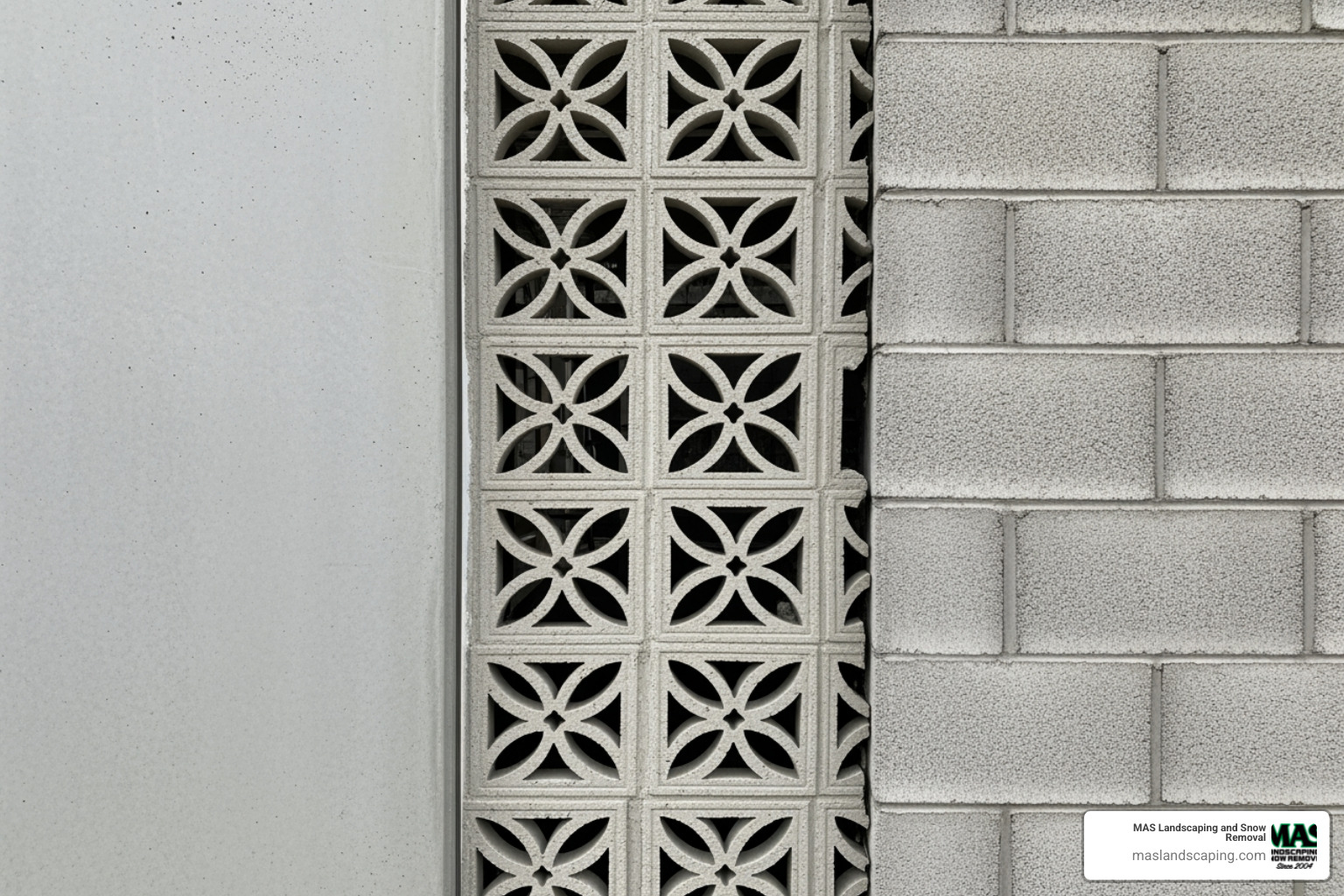
Poured Concrete vs. Precast Concrete Walls
Poured concrete walls are built on-site by constructing forms, placing steel reinforcement (rebar), and pouring wet concrete. This method creates a seamless, monolithic structure that is fully customizable to any shape or size. The main drawback is the time required for the concrete to cure (up to 28 days) and its dependence on weather conditions. Based on internet data (not MAS Landscaping quotes), poured concrete walls typically range from $80 to $650 per linear foot.
Precast concrete panels are manufactured in a controlled factory setting and delivered to your property ready for installation. This process is much faster—what takes weeks for poured concrete can often be done in days. The factory environment ensures consistent quality unaffected by weather. Precast walls generally cost between $120 and $700 per linear foot based on internet averages. For more details, see our precast-concrete-retaining-wall-guide.
Note: All pricing mentioned is a wide range based on internet data, not MAS Landscaping quotes. Your specific project cost will depend on numerous factors unique to your property.
Concrete Block Wall Cost vs. Other Types
A concrete block wall, built from individual Concrete Masonry Units (CMUs), offers excellent versatility. Masons lay the blocks one by one with mortar, often reinforcing the wall by running rebar through the hollow cores and filling them with concrete.
From a cost perspective, block walls can be a budget-friendly option. Internet data suggests a wide range of $10 to $90+ per square foot for materials and labor (not MAS Landscaping quotes). The modular nature of blocks makes them ideal for sites with limited access or irregular layouts. However, the process is labor-intensive, as every block must be individually placed and leveled. We offer various block wall options, which you can explore at block-walls.
Note: These are average costs based on internet data, not MAS Landscaping quotes.
The Difference Between a Fence Wall and a Retaining Wall
It is crucial to understand whether you need a fence wall or a retaining wall, as the structural requirements and costs differ significantly.
A fence wall is a vertical barrier built on relatively flat ground primarily for privacy, security, and aesthetics. It does not hold back soil and has simpler structural needs.
A retaining wall is an engineered structure designed to hold back soil on a slope. It must withstand immense lateral pressure from earth and water. This requires much more robust engineering, including deeper footings, extensive drainage systems, and sometimes geogrid reinforcement. Consequently, the cost for a retaining wall is substantially higher than for a simple fence wall of the same dimensions. If you are unsure which you need, we can help. Learn more at our cost-for-concrete-retaining-wall page.
The Complete Concrete Wall Fence Cost Breakdown
Beyond the basic price of materials and labor, several other factors contribute to the complete concrete wall fence cost. Understanding these additional expenses is key to creating an accurate budget and avoiding surprises.
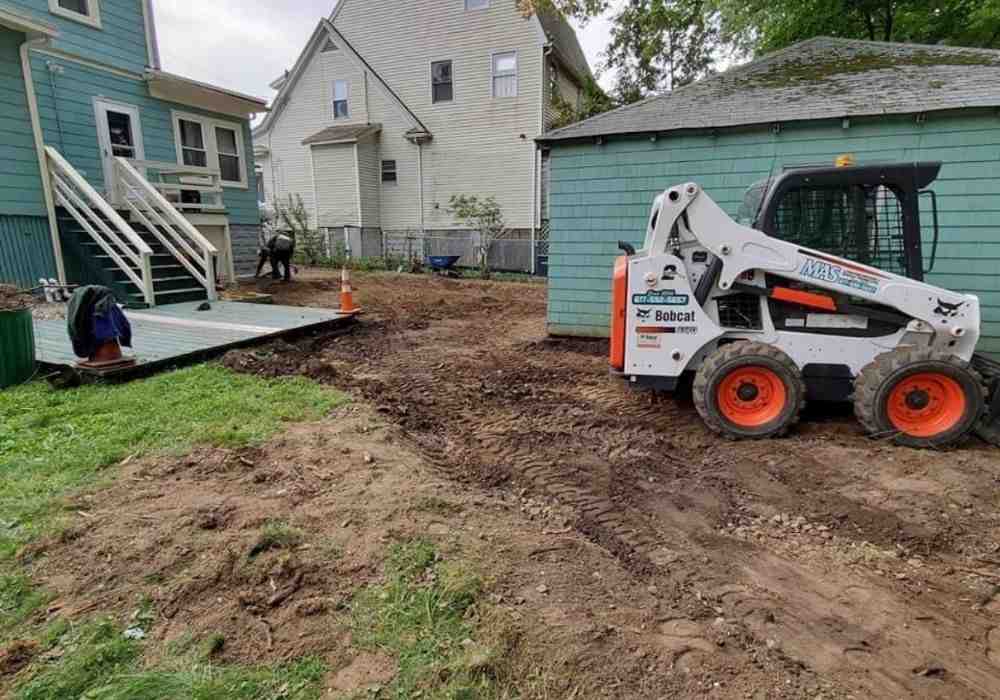
Site Conditions That Increase Installation Costs
Your property’s unique landscape has a major impact on the final cost. Factors that increase expenses include:
- Sloped Terrain: Requires extensive excavation and often necessitates a more expensive retaining wall structure. Learn more at our guide on building-a-retaining-wall-on-a-slope-cost.
- Poor Soil Quality: Rocky, clay, or unstable soil may require extra excavation, compaction, or specialized footings to ensure a stable foundation.
- Trees and Roots: Clearing vegetation and removing large root systems is labor-intensive and adds to the project timeline.
- Underground Utilities: The presence of water lines, gas pipes, or electrical conduits requires careful hand-digging to avoid costly and dangerous accidents.
- Limited Site Access: If equipment cannot get close to the work area, materials must be moved by hand, increasing labor hours and costs.
Permits, Engineering, and Other Professional Fees
Building a safe, legal wall involves necessary professional services and paperwork, which we can help manage.
- Building Permits: Most concrete walls in Massachusetts require a permit, with rules varying by town. Fees typically range from $150 to $2,000 based on internet data.
- Structural Engineering: Taller walls and all retaining walls require a structural engineer’s approval to ensure they are designed to withstand environmental forces. Engineering fees can range from $350 to $720 for a typical residential project, according to industry data.
- Land Survey: A survey may be needed to clearly define property lines and prevent disputes. This is a worthwhile investment for peace of mind.
We adhere to industry best practices, such as those from the National Concrete Masonry Association (NCMA), to ensure your wall is built to the highest standards.
Additional Costs for Footings, Drainage, and Finishes
These essential components ensure your wall’s longevity and aesthetic appeal.
- Concrete Footings: The foundation of your wall must be dug below the frost line to prevent shifting and cracking. Based on internet data (not MAS Landscaping quotes), footings typically add $15 to $180+ per linear foot.
- Drainage Systems: Essential for retaining walls, drainage systems like French drains ($10-$150+ per linear foot) or trench drains ($10-$300+ per linear foot) prevent water pressure buildup that can destroy a wall.
- Finishing Touches: Transform your wall’s appearance with finishes like stamped patterns ($5-$25+ per sq. ft.), stucco, or paint ($1-$6 per sq. ft.). Integrated lighting ($100-$1,200+ per fixture) and custom caps also add to the final cost. Find inspiration on our decorative-retaining-wall page.
All pricing mentioned represents wide ranges based on internet data and industry averages, not actual quotes from MAS Landscaping. Your specific project cost depends on your unique property conditions, design choices, and local requirements.
Long-Term Value: Is a Concrete Fence a Good Investment?
When considering the concrete wall fence cost, it’s important to look beyond the initial price and consider the long-term value. A concrete fence is an investment in your property’s security, privacy, and curb appeal that pays dividends for decades.
While the upfront cost is often higher than for other materials, a well-built concrete wall delivers lasting value with minimal maintenance. You are buying a permanent solution that withstands New England weather year after year.
Maintenance, Repairs, and Lifespan
This is where concrete’s value becomes undeniable. A properly installed concrete wall can last 30 to 100 years, far surpassing other common fencing materials. Maintenance is refreshingly simple: concrete doesn’t rot, warp, or attract pests, and routine cleaning is often all that’s needed.
While not entirely maintenance-free, any issues are typically minor. Small hairline cracks can be repaired inexpensively if addressed early (often $150 to $600+ based on internet data and not MAS Landscaping quotes). To protect against moisture and freeze-thaw cycles, applying a breathable sealant every 10 years is recommended (roughly $1 to $12+ per square foot based on internet data and not MAS Landscaping quotes). For any significant issues, our team offers expert concrete repair services.
How Concrete Fences Compare to Other Materials
To understand the value of concrete, it’s useful to compare it to less durable alternatives. While materials like wood may have a lower initial cost, they require frequent maintenance (staining, repairs for rot) and have a much shorter lifespan of 10-20 years. A concrete fence, lasting 30-100+ years with minimal upkeep, often proves to be the more cost-effective investment over the long term due to its superior durability against weather, pests, and rot.
| Feature | Concrete Fence | Wood Fence |
|---|---|---|
| Initial Cost | Higher (typically ranges widely based on type and finish) | Lower (varies by wood type, often less expensive upfront) |
| Lifespan | Excellent (30-100+ years with proper installation) | Moderate (10-20 years, depending on wood type and maintenance) |
| Maintenance | Very Low (occasional cleaning, sealing every 10 years) | High (painting or staining every 2-5 years, frequent repairs for rot and pests) |
| Durability | Excellent (resists weather, pests, rot, and fire) | Moderate (vulnerable to rot, pests, warping, and weather damage) |
| Security/Privacy | Excellent (solid, robust barrier that’s difficult to breach) | Good (can provide privacy, but less secure than concrete) |
DIY vs. Hiring a Professional: A Cost Analysis
While the DIY route may seem tempting to save on the concrete wall fence cost, it carries significant risks. Building a concrete wall involves heavy materials, structural calculations, and specialized equipment. Mistakes like an improper foundation, poor drainage, or incorrect reinforcement can lead to structural failure, costing far more to fix than hiring a professional from the start.
Hiring a professional is essential for any wall that is structural (like a retaining wall), requires a permit, or is of significant size. A professional team like MAS Landscaping brings the experience, equipment, and knowledge of local building codes to ensure the job is done right. We handle site prep, foundations, reinforcement, and finishing, guaranteeing a safe and durable wall. Learn more about why professionals are the right choice on our do-landscapers-build-retaining-walls page.
How to Reduce Your Concrete Wall Fence Cost
Even as a long-term investment, there are ways to manage your budget without sacrificing quality:
- Get multiple quotes to understand fair market pricing, but prioritize experience over the lowest bid.
- Choose simpler designs, as straight walls with standard finishes are more affordable than custom curves or patterns.
- Consider off-season installation (late fall or early winter) when demand may be lower, potentially leading to better rates.
- Handle your own site prep, such as clearing brush and debris, to reduce labor costs. Check with your contractor first to ensure it meets project requirements.
- Build only what you need by keeping the wall to the minimum necessary height and length.
For more ideas on cost-effective solutions, check out our page on cheap-retaining-wall-ideas.
Frequently Asked Questions about Concrete Walls
Here are answers to some common technical questions homeowners have when planning a concrete fence project.
How thick should a concrete fence wall be?
The required thickness depends on the wall’s height, its purpose, and local building codes.
- Poured concrete walls are typically 8 to 12 inches thick. A simple 4-foot privacy fence might be 8 inches, while a taller 6-foot wall or a retaining wall may need to be 12 inches or more for structural integrity.
- Concrete block walls use standard 6 or 8-inch wide blocks. The wall’s strength comes from steel rebar placed in the hollow cores, which are then filled with concrete.
Any wall serving a structural function must be properly engineered to ensure it is safe and durable. The concrete wall fence cost will reflect these necessary structural requirements.
Do concrete fences require waterproofing?
Yes. Concrete is porous, and moisture penetration can cause damage over time. Waterproofing is critical for a wall’s longevity.
- Below-grade portions of a wall (like foundations or retaining walls) require a specialized waterproof membrane or coating applied before backfilling. This prevents water pressure buildup and seepage.
- Above-grade surfaces should be treated with a breathable sealant every 5 to 10 years. This repels water from rain and snow while allowing the concrete to release internal moisture vapor, protecting it from staining and freeze-thaw damage.
Proper waterproofing and drainage are essential investments that will protect your wall for decades.
How does the cost of a concrete block wall compare to a poured concrete wall?
The cost difference comes down to materials and labor.
- Materials: Concrete blocks (CMUs) are generally cheaper per unit than ready-mix concrete, but the total material cost must also include mortar, rebar, and concrete fill for the cores.
- Labor: Block walls are labor-intensive, requiring skilled masons to lay each block individually. Poured concrete walls require significant upfront labor to build forms, but the pour itself is relatively fast.
Based on internet averages (not MAS Landscaping quotes), both methods often fall within a wide range of $10 to $90+ per square foot installed. For simple fence applications, block walls can sometimes be more budget-friendly. For taller or structural walls, poured concrete may offer superior strength and be more cost-effective in the long run. We can help you determine the best method for your project. Learn more about our options on our block-walls-for-landscaping page.
Conclusion: Finalizing Your Concrete Fence Budget
Now that you understand the factors influencing concrete wall fence cost, you can move forward with turning your vision into a reality. A concrete fence is a significant long-term investment in your home’s security, aesthetic, and value. While the upfront cost may be higher than for a wood fence, the decades of durability and minimal maintenance provide clear long-term value.
Every property is unique, and online estimates can only provide a general idea. Your specific soil conditions, property slope, and design choices will determine the final cost. The best way to budget accurately is with a transparent, professional quote based on your actual site.
At MAS Landscaping, we have years of experience building beautiful, lasting concrete walls in Everett, Lynnfield, Malden, Melrose, Medford, Revere, Saugus, and Chelsea. We understand the local building codes and property challenges in Massachusetts. Our team will walk your property, listen to your goals, and provide a detailed estimate for the complete project, from permits to final finishing.
Ready to get a precise cost for your concrete wall? Let’s discuss your project and budget.
Get a professional estimate for your retaining wall installation