

Why Boulder Retaining Wall Price Varies More Than You’d Expect
Boulder retaining wall price is one of the most common questions homeowners ask before starting a landscaping project — and for good reason. Costs can swing dramatically depending on your site, your materials, and who you hire.
Here’s a quick snapshot of what to expect (based on average internet data, not MAS Landscaping pricing):
| Cost Type | Typical Range |
|---|---|
| Per square foot (installed) | $25 – $150+ |
| Per linear foot | $50 – $600+ |
| Small project (50 ft, 2-4 ft tall) | $2,000 – $10,000 |
| Large or engineered wall | $10,000 – $40,000+ |
These are rough averages. Your actual cost depends on wall size, boulder type, site access, drainage needs, and more.
Boulder retaining walls do more than hold back soil. They control erosion, create usable outdoor space on sloped land, and add a natural, timeless look to your property. Built right, they can last 50 to 200 years with almost no maintenance.
But “built right” is the key phrase. As one landscaping professional put it in a community forum: “$30k for two 100-foot by 4-foot boulder walls is average to a bargain.” That surprises most homeowners — until they understand what goes into the work.
This guide breaks down every cost factor so you can plan your project with confidence.
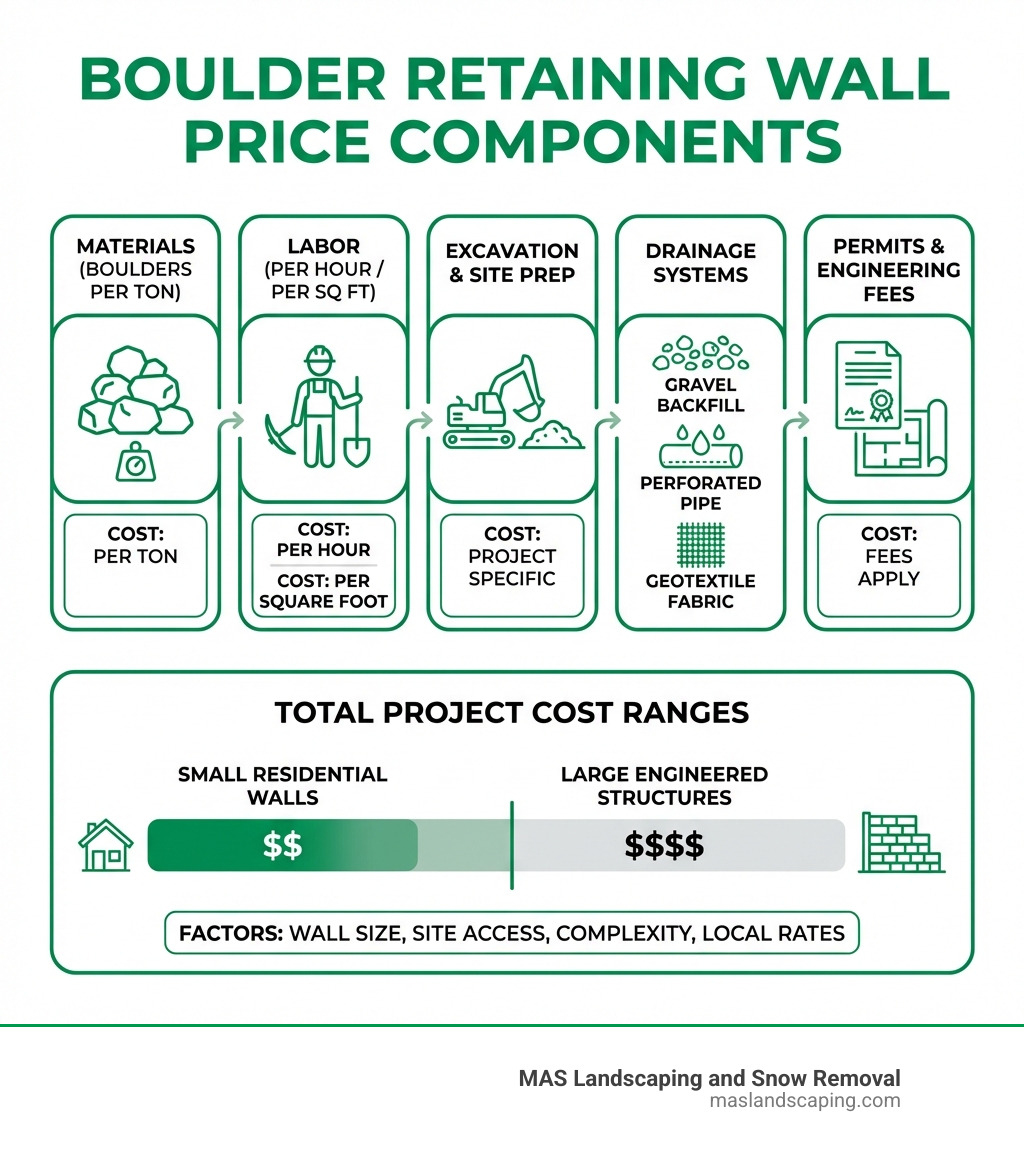
Boulder retaining wall price terms to know:
Average Boulder Retaining Wall Price Breakdown
When we talk about the boulder retaining wall price, we have to look at how the industry measures these massive structures. Unlike a simple fence, a boulder wall is a “gravity structure.” It relies on its sheer weight and the friction between stones to hold back tons of earth. Because boulders come in irregular shapes and sizes, contractors usually estimate based on the “face foot” or “square foot” of the visible wall surface.
Based on general internet data, a typical residential boulder wall project might range from $2,000 to $10,000 for a standard 50-foot wall that stands between two and four feet high. However, for larger estates or complex engineered projects in areas like Lynnfield or North Andover, those costs can easily scale from $10,000 to over $40,000. It is important to remember that these figures are averages found across the web and do not represent a formal quote from us.

For a deeper dive into how these numbers are crunched, check out this more info about boulder wall costs.
Understanding Boulder Retaining Wall Price per Square Foot
The boulder retaining wall price per square foot (often called “face foot”) typically falls between $25 and $150. This wide range exists because of material quality and the skill required for installation.
- The Low End ($25 – $45): Usually involves locally sourced fieldstone or smaller boulders that are easier to move.
- The High End ($75 – $150+): This often involves premium stones like moss rock or large granite boulders that require heavy machinery to place. If the wall requires a specific “batter” (a backward lean for stability) or intricate interlocking, the price per square foot climbs.
Estimating Boulder Retaining Wall Price per Linear Foot
If you prefer to think in terms of length, the boulder retaining wall price per linear foot generally ranges from $50 to $600. The height of the wall is the biggest “multiplier” here. A wall that is 2 feet tall requires significantly less stone and excavation than a wall that is 4 feet tall.
For walls between 2 and 4 feet, you might see national averages of $50 to $200 per linear foot. However, once you exceed that 4-foot mark, the engineering requirements change, often requiring deeper footings and more robust drainage, which can push the price toward the $600 mark or higher. For more details on these variations, see our detailed rock retaining wall cost guide.
Key Factors That Drive Project Costs
Why does one neighbor pay $5,000 while another pays $25,000 for what looks like the same wall? It usually comes down to what’s happening behind the stones and under the dirt.
- Wall Height: This is the most critical factor. The higher the wall, the more soil pressure it must withstand.
- Site Accessibility: Can we get a large excavator into your backyard in Saugus, or do we have to use smaller, more time-consuming “mini” equipment to navigate a tight side yard in Melrose?
- Soil Conditions: Sandy soil behaves differently than heavy clay. If your soil is prone to shifting, we have to account for increased hydrostatic pressure (water weight) behind the wall.
Organizations like the National Concrete Masonry Association (NCMA) provide guidelines on how these structures should be engineered to handle these pressures safely.
Drainage and Foundation Requirements
A boulder wall’s worst enemy isn’t time; it’s water. Without proper drainage, water builds up behind the boulders, creating massive pressure that can eventually push the wall over.
- Gravel Backfill: We typically use clean gravel behind the wall to allow water to flow down to the base.
- Perforated Pipe: A 4-inch “French drain” pipe at the base carries that water away from the structure.
- Geotextile Fabric: This prevents soil from clogging the gravel and drainage pipes.
- Frost Line: In Massachusetts, we have to ensure the foundation is deep enough to handle our “freeze-thaw” cycles, which can heave stones out of place if the base isn’t solid.
Properly managing these elements is a core part of our professional retaining wall installation services.
Permits and Engineering Plans
In many of our service areas, such as Peabody or Reading, local building codes often require a permit for any wall over 3 or 4 feet tall.
- Structural Engineer: If your wall is tall or supporting a heavy load (like a driveway), you may need an engineer to sign off on the plans. These professionals often charge between $100 and $600 per hour.
- Permit Fees: Depending on your town, permit fees can range from $50 to $750. While it might seem like a hassle, these steps ensure your wall won’t collapse and become a liability.
Material and Labor Costs for Natural Stone
The boulders themselves are a significant chunk of the boulder retaining wall price. Boulders are usually sold by weight, with prices ranging from $100 to $1,000 per ton depending on the stone type and where it’s coming from.
- Granite: Often more affordable in the Northeast because it is locally available. It’s incredibly durable and has that classic New England look.
- Moss Rock: A premium option with a weathered, “aged” look that can cost significantly more.
- Delivery: Don’t forget the shipping! Bringing 20 tons of rock to a site in Boxford or Georgetown involves heavy-duty trucking fees.
The Mason Contractors Association of America (MCAA) is a great resource for understanding the standards expected when working with these natural materials.
Labor and Machinery Expenses
You aren’t just paying for the rocks; you’re paying for the expertise to move them. Placing a 500-pound boulder is like playing a high-stakes game of Tetris with a 10-ton machine.
Operator rates for heavy equipment can range from $40 to $250 per hour. A skilled operator can place boulders so they interlock naturally, creating a “gravity wall” that doesn’t need mortar or cement. This process is much faster than hand-stacking small stones, but it requires specialized machinery. You can learn more about retaining wall builders and how they manage these complex logistics.
Comparing Boulder Walls to Other Retaining Structures
How does a boulder wall stack up against other options? Here is a quick comparison:
| Wall Type | Aesthetic | Durability | Installation Speed |
|---|---|---|---|
| Boulder | Natural / Rustic | High (50-200 yrs) | Fast (with machinery) |
| Segmental Block | Modern / Uniform | Moderate (30-70 yrs) | Moderate |
| Gabion | Industrial / Unique | High (50-100 yrs) | Fast |
| Timber | Warm / Natural | Low (10-20 yrs) | Very Fast |
Boulder vs. Segmental Block Walls
Segmental blocks (like those from Belgard or Keystone) offer a very uniform, clean look. They are engineered to interlock perfectly. However, many homeowners in areas like Middleton or Topsfield prefer boulders because they blend into the natural landscape. While block walls are often cheaper upfront, they don’t always match the 100-year-plus lifespan of a well-built boulder wall. For more on the manufactured side, see our guide to precast concrete walls.
Boulder vs. Gabion and Dry-Stack Stone
Gabion walls use wire mesh cages filled with smaller rocks. They are excellent for drainage but have a very industrial look. Dry-stack stone walls use smaller, flatter stones (like fieldstone) and are built by hand. These are beautiful but incredibly labor-intensive, often taking four to five times longer to build than a boulder wall. If you love the look of stone but want to see all your natural stone wall options, there are plenty of varieties to choose from.
Long-Term Benefits and Maintenance
The beauty of a boulder wall is that it actually gets better with age. As the stones settle and perhaps a bit of moss grows in the crevices, the wall becomes a permanent part of the earth.
- Lifespan: You can expect a lifespan of 50 to 200 years.
- Minimal Maintenance: Unlike wood that rots or concrete that can crack and peel, boulders just sit there. You might occasionally need to clear weeds from the gaps, but that’s about it.
- Property Value: A professionally installed stone wall is a “permanent” improvement that adds significant curb appeal and ambiance to your home.
Explore our hardscape retaining wall solutions to see how these benefits can work for your specific property.
Frequently Asked Questions about Boulder Walls
Do boulder retaining walls require a foundation?
Yes! You can’t just plop a boulder on top of grass. We start by excavating a trench and filling it with a compacted gravel subgrade or road-base rock. This provides a level, stable surface that won’t sink when the ground gets wet. For very tall walls, a concrete footer might be necessary, but for most residential walls, a thick, compacted gravel base is the gold standard.
When is it necessary to hire a professional?
If the wall is over 3 feet tall, or if you don’t happen to have a mini-excavator and a decade of experience operating one in your garage, you should hire a pro. Moving boulders is dangerous work—one slip can lead to serious injury or property damage. Professionals also understand the “batter” (the angle) and drainage requirements that keep the wall from failing in five years.
How long do boulder retaining walls last?
With proper drainage and a solid foundation, these walls are essentially “forever” structures. Most industry experts estimate a lifespan of 50 to 200 years. Their durability against New England’s harsh winters and heavy rains makes them one of the most resilient hardscaping choices available.
Conclusion
At MAS Landscaping and Snow Removal, we’ve spent years helping homeowners in Saugus, Lynnfield, Everett, and across Essex and Middlesex counties transform their yards. We know that the boulder retaining wall price is a significant investment, but it’s one that pays off in safety, beauty, and longevity.
Our commitment to professionalism and local expertise means we don’t just stack rocks; we build engineered structures designed to last for generations. Whether you’re looking to stop erosion on a steep slope in Medford or add a decorative touch to your Melrose garden, we’re here to provide personalized service every step of the way.
Ready to see what’s possible for your property? Start your project with our rock retaining wall cost guide and let’s build something beautiful together.