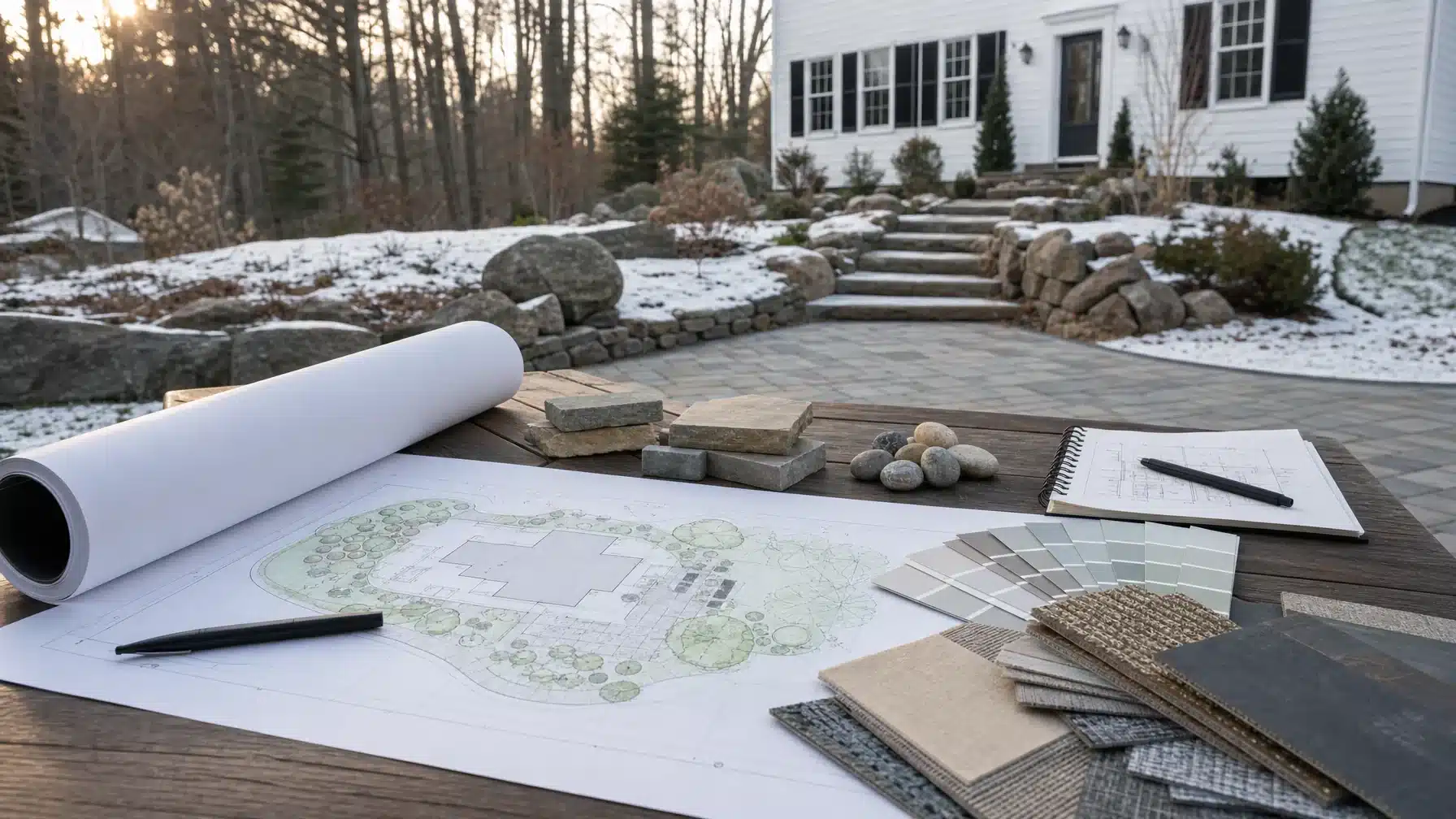



What Do Landscape Designers Charge? Understanding the Scope Behind a Quote
What landscape designers charge needs to be read alongside what they agree to provide. A quote for discussing ideas is not directly comparable to a quote for a documented design, and neither should be confused with the cost of installing the landscape.
This guide does not provide a verified MAS Landscaping design fee schedule or a defensible Saugus-area price range. For a usable answer about your property, request a written, project-specific quote that identifies the work, deliverables, exclusions and terms. The goal is to understand what you are buying before comparing totals.
Separate design fees from installation costs
Design work concerns the planning and decisions behind a proposed landscape. Installation is the physical work of creating it. A proposal may address both, but the written scope should make their relationship clear.
- For design: Ask which site visits, discussions, drawings, selections and revisions are included.
- For installation: Ask whether materials, labor, site preparation, removal and cleanup are covered by a separate proposal.
- For work connecting the two: Ask whether construction questions, substitutions or design changes during installation are included or require separate authorization.
Also distinguish an installation estimate from an agreed installation scope. If plants, materials or dimensions remain undecided, ask which assumptions support the estimate and what must be resolved before the installation proposal can be finalized.
Find out exactly what the design deliverable is
The word “plan” does not tell you enough on its own. Ask what you will receive, how detailed it will be and what you can use it for. The following are questions to clarify a proposal, not a list of deliverables MAS has confirmed for every project.
- Property coverage: Which areas are included, and where does the design scope stop?
- Format: Will you receive written recommendations, a concept sketch, a scaled drawing, a planting plan or another defined document?
- Detail: Will locations, dimensions, plant selections, quantities and material specifications be identified, or will some remain open?
- Purpose: Is the document intended for discussion, installation pricing or use during construction?
- Handoff and use: What files or copies will you receive, and may you share the design with another installer?
Match the deliverable to the decision you need to make. If you are still exploring a layout, ask whether the proposed concept work supports that goal. If you want comparable installation proposals, ask whether the design will specify enough detail for contractors to price the same work.
Clarify revisions, exclusions and billing terms
“Revisions included” leaves important questions unanswered. Ask what counts as a revision, what feedback is covered and when a change becomes additional work. Changing a plant selection and adding a previously excluded part of the property should not be assumed to fall under the same agreement.
- How is the design charge calculated, what work does it cover, and what requires approval for an additional charge?
- Which review meetings and revision rounds are included, and how should feedback be submitted?
- Are surveys, technical assessments, engineering or permit-related work included, excluded or subject to a separate agreement?
- What happens if a site condition or a change in your goals requires the agreed scope to change?
- When are payments due, and what happens if you pause the project or decide not to proceed with installation?
Ask explicitly whether the design agreement is independent of installation or tied to a later installation contract. If a proposal mentions an adjustment to design charges when installation proceeds, request the conditions in writing. Do not assume such an arrangement exists.
A reusable landscape design quote worksheet
Copy this worksheet for each proposal. Fill the blanks with the provider’s written answers, and mark anything not addressed as “not stated.” An empty answer is a reason to ask, not evidence that the item is included.
| Scope item | Proposal A | Proposal B |
|---|---|---|
| Project areas covered | ________ | ________ |
| Deliverables, detail and intended use | ________ | ________ |
| Included visits, meetings and research | ________ | ________ |
| Revision allowance and scope-change terms | ________ | ________ |
| Exclusions and owner responsibilities | ________ | ________ |
| Unresolved selections and assumptions | ________ | ________ |
| Design charge, calculation and payment terms | ________ | ________ |
| Relationship to installation and construction support | ________ | ________ |
| Files supplied and permission to share or use | ________ | ________ |
Compare the scope before the total. Where the proposals differ, ask whether they can be revised to cover the same requested work. If a difference is intentional, decide whether that added detail or support serves your needs rather than treating the lower total as an equivalent offer.
Prepare for a project-specific discussion
Give each provider the same description of the areas and outcomes you want addressed. Use the landscape design brief guide to organize that information without trying to create the design yourself. Then use the worksheet to clarify what each proposal promises.
MAS Landscaping and Snow Removal is based in Saugus, MA, and offers landscape design and installation services. For a service inquiry, visit the landscape design and installation page and ask for a written scope specific to your property.