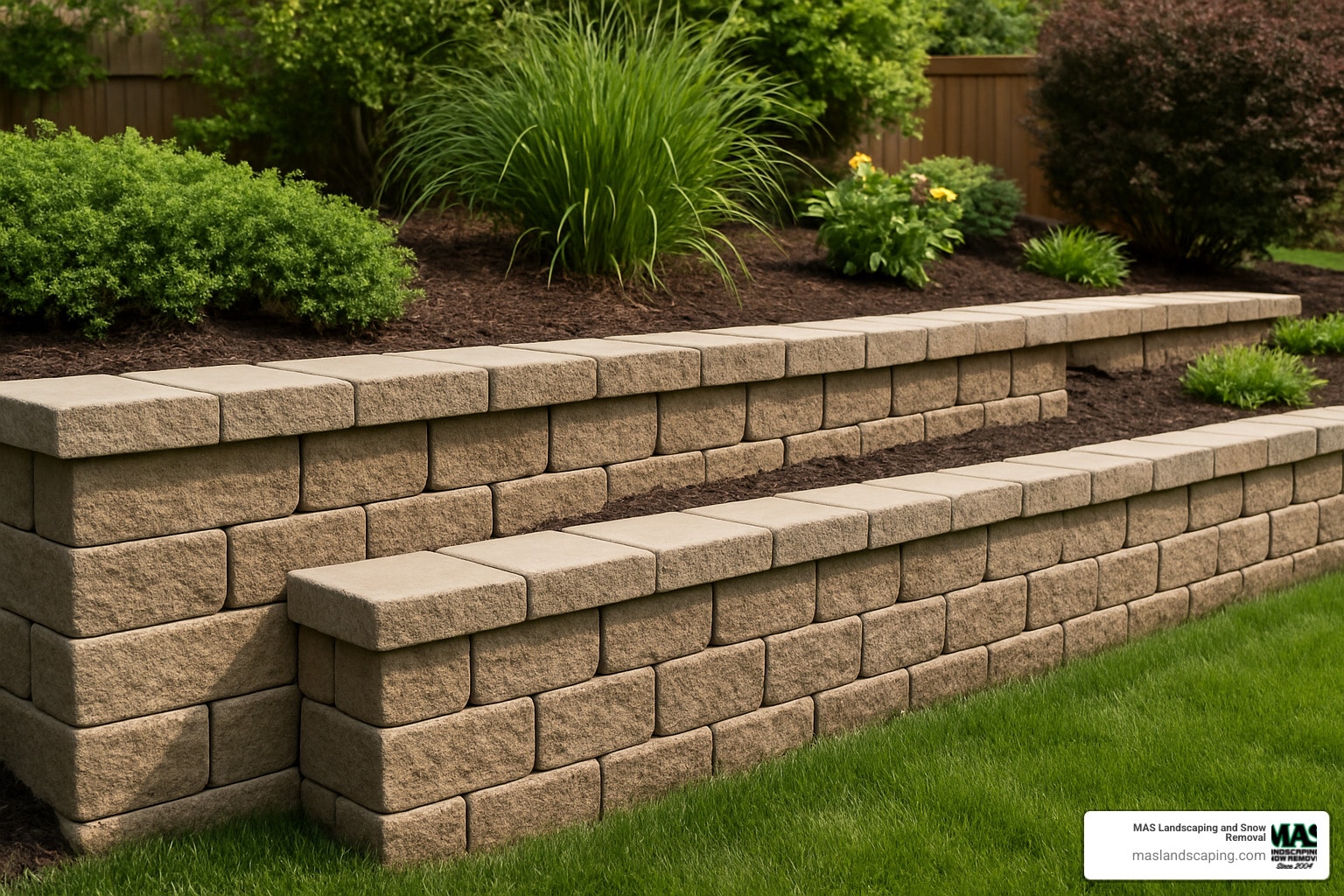


paver retaining wall cost: 2025 Guide to Smart Savings
The Real Cost of Strength: Paver Retaining Wall Pricing
Paver retaining wall cost typically ranges from $20 to $53 per square foot installed, with most homeowners paying between $3,500 and $9,400 for a complete project. The national average falls around $6,075 for a standard installation.
- Material type: $15-$35 per square foot for interlocking blocks
- Wall height: 2-foot walls cost $40-$200 per linear foot; 6-foot walls run up to $360 per linear foot
- Labor vs. materials: Professional installation accounts for 50-60% of total project cost
- Regional variations: Costs can vary by 15-30% depending on your location
When you’re looking to add stability and visual appeal to your landscape, a paver retaining wall represents both a practical solution and a significant investment. These structured walls don’t just prevent soil erosion—they transform sloped properties into usable space while adding architectural character to your outdoor environment.
Retaining walls play a crucial role in landscape management, especially in regions with varied terrain like Greater Boston. As Marco Romani, an experienced stone installer, notes: “Many walls fail early because contractors skimp on drainage. A generous gravel layer behind the wall is more important for longevity than the face material.”
This practical insight gets to the heart of what makes retaining walls both necessary and valuable—they’re engineered structures designed to hold back soil, control water flow, and create level areas in otherwise challenging landscapes.
Whether you’re looking to terrace a sloping backyard, create planting beds, or protect your foundation from erosion, understanding the full spectrum of costs involved will help you plan and budget effectively for your retaining wall project.
Simple paver retaining wall cost glossary:
– brick paver wall
– bulk retaining wall blocks
– hardscape retaining walls
Why Retaining Walls Matter
Retaining walls are much more than decorative landscape features. In the Saugus and greater Boston area, where terrain can vary significantly even within a single property, these structures serve crucial functions:
- Soil Stability: They prevent erosion on sloped properties, particularly important during New England’s heavy spring rains and winter thaws.
- Curb Appeal: A well-designed retaining wall can dramatically improve your property’s appearance, creating clean lines and visual interest.
- Flood Prevention: By controlling water runoff and directing it away from structures, retaining walls are an essential part of property drainage systems.
As one Malden homeowner told us, “After years of dealing with soil washing onto our driveway during rainstorms, our new retaining wall has completely solved the problem while giving us a beautiful new garden area.”
What Is a Paver Retaining Wall?
Imagine stacking blocks as a child, but with a sophisticated twist that can transform your landscape. That’s essentially what a paver retaining wall is – a system of manufactured concrete blocks designed to fit together like puzzle pieces, creating structures that are both sturdy and visually appealing.
Unlike their poured concrete cousins, paver retaining walls (sometimes called segmental retaining walls) use individual blocks that can move slightly with the earth’s natural shifting without cracking. This flexibility is especially valuable in New England, where the ground regularly expands and contracts through our seasonal freeze-thaw cycles.

The heart of any good paver wall system lies in its components. Segmental blocks form the backbone, manufactured in consistent sizes and shapes for predictable installation. These blocks feature interlocking systems – lips, pins, or clips that connect each piece to create a unified structure rather than just a stack of blocks.
Most walls under 4 feet tall are built as gravity walls, which rely on their own weight and a slight backward lean (setback) to hold back soil. For taller projects, reinforced walls incorporate layers of geogrid mesh that extend into the soil behind the wall, creating a composite structure with impressive strength.
“The secret to a long-lasting wall isn’t what you see from the front,” explains Marco, our lead hardscape installer at MAS Landscaping. “It’s the drainage core – that column of gravel behind the blocks that lets water flow down instead of pushing against your wall. Skip that, and even the prettiest wall will fail in a few seasons.”
Key Differences From Other Wall Types
When comparing paver retaining wall costs with alternatives, understanding their fundamental differences helps explain their value:
Wood Timbers might seem budget-friendly initially, but their 10-20 year lifespan means you’ll replace them 2-3 times during the life of a single paver wall. While they’re easier for DIY beginners, wood’s vulnerability to moisture, insects, and warping makes them less ideal for our Massachusetts climate.
Poured Concrete walls require forms, reinforcement, and often specialized equipment. Though solid, they’re notorious for developing cracks during freeze-thaw cycles – something we know all too well in Saugus and surrounding areas. Their limited aesthetic options often mean additional costs for veneers to improve appearance.
Natural Stone Veneer offers best beauty but comes with premium pricing and labor-intensive installation. While beautiful, these walls require significant skill to construct properly.
“Paver walls hit the sweet spot for many homeowners in our region,” notes Jim Connolly, a Saugus-based landscape designer. “They offer concrete’s durability with more design flexibility, and they handle our harsh winters better than wood or poured walls.”
Pros and Cons of Paver Systems
Before investing in your retaining wall project, consider these practical advantages and limitations:
On the plus side, paver walls offer remarkable modular flexibility – they can follow curves, wrap around corners, or create multiple terraces on steep slopes. They’re reasonably DIY-friendly for shorter walls, though we always recommend professional installation for walls over 3 feet tall for safety and longevity.
Their repair options provide peace of mind too – if a section gets damaged (perhaps from a wayward snowplow during one of our Massachusetts winters), individual blocks can be replaced without dismantling the entire structure. With countless design varieties available, you can match your home’s architecture or create striking contrast.
The downsides? While the upfront material price exceeds wood options, their longevity makes them more economical long-term. They do require some maintenance demands – occasional checking of joints and ensuring proper drainage. The installation precision needed for a stable, long-lasting wall shouldn’t be underestimated – a perfectly level base and careful compaction are essential for preventing future problems.
And don’t forget the weight considerations – these aren’t lightweight materials. A pallet of retaining wall blocks can weigh over a ton, requiring thoughtful delivery planning and often specialized equipment for larger projects.
2025 Paver Retaining Wall Cost Overview
The paver retaining wall cost landscape in 2025 continues to evolve, reflecting both material price fluctuations and shifts in the labor market. For homeowners in Massachusetts considering this valuable addition to their property, understanding current pricing trends is essential for proper budgeting.
Based on our research and industry insights, most homeowners across the country are investing between $3,500 and $9,400 for complete retaining wall projects, with the national average hovering around $6,300. Here in the Northeast, particularly in the Everett, Malden, and Saugus areas, we typically see prices trending 10-15% above these national figures due to our higher labor costs and material transportation expenses.
When breaking down the numbers, you’ll generally find paver retaining wall costs falling between $20-$60 per square foot for a professionally installed wall. Thinking in terms of linear feet? Expect to invest anywhere from $40-$360 per linear foot, with the wide range reflecting how dramatically wall height affects your bottom line.
Don’t forget to factor in permit fees if your wall exceeds 4 feet in height – these typically range from $50 up to $450 depending on your municipality and project specifics.
Average Cost Per Square Foot & Linear Foot
Understanding how paver retaining wall costs are calculated helps you better prepare for your investment. The square footage approach (measuring the vertical face area of your wall) gives you the most accurate picture of total project costs.
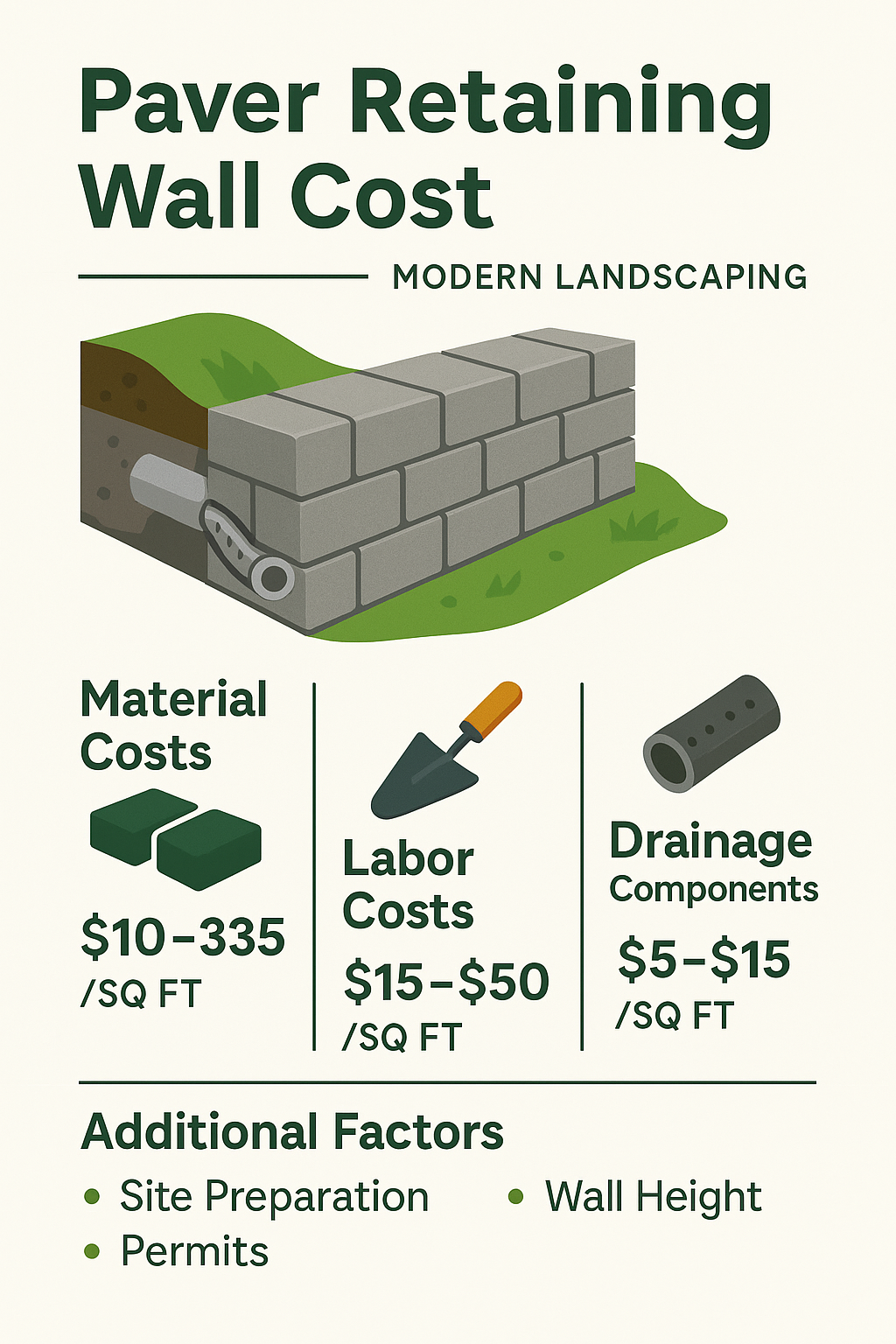
For a typical installation, materials will account for roughly $10-$35 per square foot, while professional labor adds another $15-$50 per square foot. Combined, your total installed cost generally falls between $20-$60+ per square foot.
However, many contractors quote by linear foot, which accounts for the length of your wall. This is where height becomes a crucial factor:
| Wall Height | Cost per Linear Foot | 25-foot Wall Total |
|---|---|---|
| 2 feet | $40-$200 | $1,000-$5,000 |
| 4 feet | $80-$300 | $2,000-$7,500 |
| 6 feet | $150-$360 | $3,750-$9,000 |
Notice how dramatically the price jumps as walls get taller? That’s because taller walls require deeper foundations, more materials, potentially geogrid reinforcement, and often more complex engineering – all factors that increase both material and labor costs.
Cost of Individual Paver Blocks
When examining the building blocks themselves, you’ll find they represent a significant portion of your material budget. Standard retaining wall blocks typically cost between $3-$8 each, while specialty pieces command premium prices: cap stones run $5-$15 per piece, and corner units range from $6-$12 each.
If you’re drawn to designer colors or specialty finishes, prepare for a 10-25% premium over standard options. However, there’s good news for larger projects – buying in bulk often yields 10-15% savings when purchasing by the pallet.
For planning purposes, most retaining walls require approximately 1.25 blocks per square foot of wall face. So for a typical 30-foot long, 3-foot high wall (90 square feet), you’d need roughly 113 standard blocks plus the appropriate cap stones to finish the top edge beautifully.
Here in the Saugus area, we’ve noticed that even DIY enthusiasts often benefit from purchasing through professional channels rather than retail home improvement stores. The quality is typically higher, and the bulk pricing can offset the slightly higher individual block costs you might find at the big box stores.
Major Factors That Influence Paver Retaining Wall Cost
When planning your retaining wall project, understanding what drives the final paver retaining wall cost can help you budget more effectively and avoid surprises. Every wall is unique, and several key factors determine why two seemingly similar projects might have very different price tags.
Wall Dimensions and Site Conditions
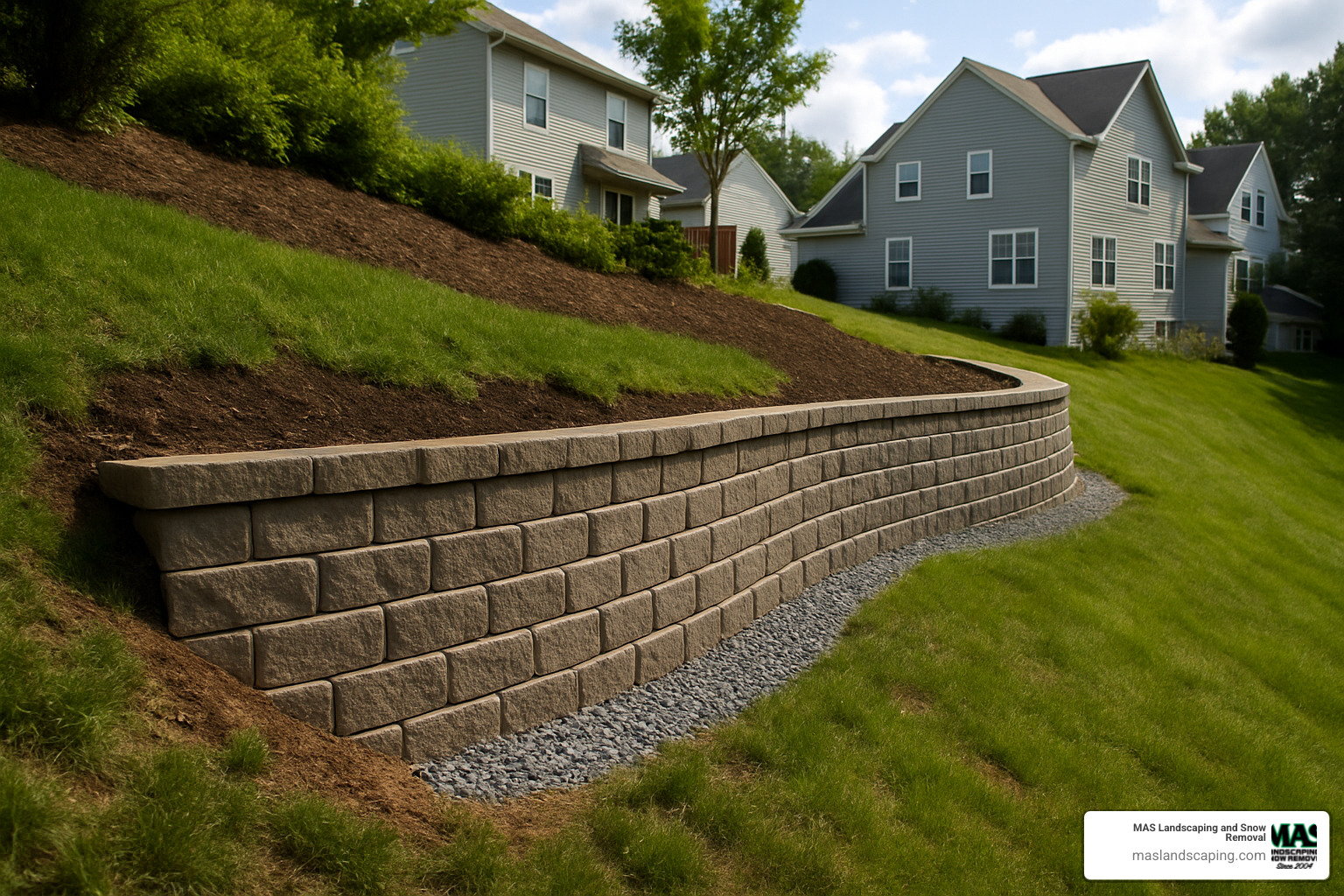
The physical characteristics of your property significantly impact your project cost. Wall height is perhaps the most influential factor—each additional foot doesn’t just add material; it exponentially increases engineering requirements and labor complexity. Similarly, while longer walls require more materials, they often benefit from economies of scale since setup costs are spread across more square footage.
Your property’s site slope can dramatically affect labor costs—walls built on steep inclines might cost up to 50% more than those on gentle slopes due to the additional excavation and safety measures required. The type of soil on your property matters too; sandy soil typically requires less extensive foundations than clay soil, which can expand and contract significantly with moisture changes.
Many Saugus homeowners are surprised to learn that access challenges can substantially impact their bottom line. If heavy equipment can’t reach your installation site, the crew may need to resort to hand excavation, significantly increasing labor hours and costs.
In Massachusetts, your wall’s foundation depth must extend below the frost line—typically about 4 feet in our region—to prevent frost heave from damaging your investment during our harsh winters.
Recent advances in segmental retaining wall design have also improved performance in seismic zones. According to the latest research on seismic walls, properly engineered paver walls can now withstand significant ground movement in earthquake-prone areas.
Material & Style Upgrades
The aesthetic choices you make can substantially influence your paver retaining wall cost. Walls with textured face blocks typically command a 15-30% premium over standard blocks, but they add significant visual appeal. Similarly, blended colors might increase costs by 10-25%, but they create a more natural, less uniform appearance that many homeowners prefer.
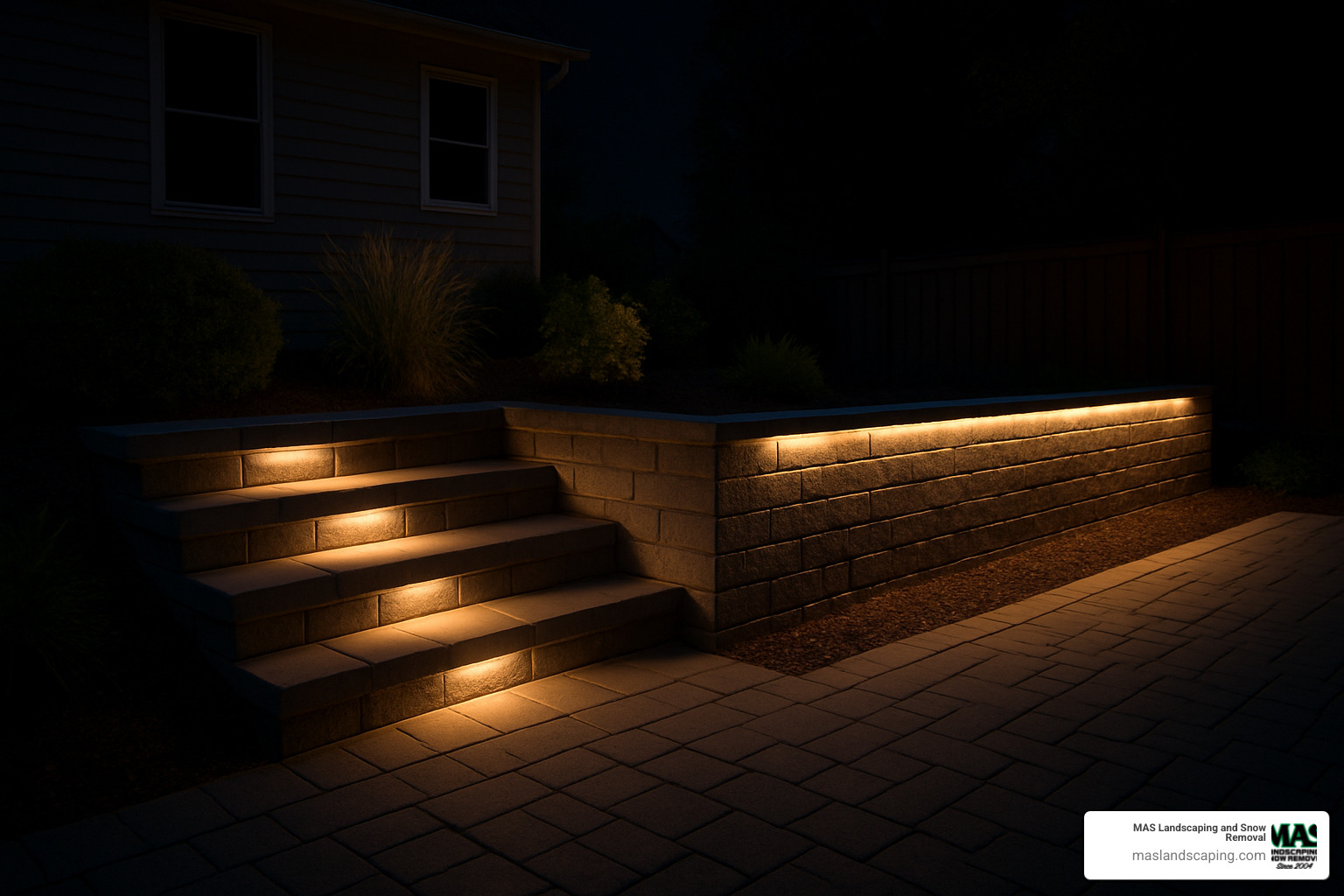
“One upgrade that delivers both beauty and function is integrated lighting,” explains our hardscape specialist. “While each fixture might add $30-$100 plus wiring costs, the dramatic nighttime effect and added safety around steps make it worth considering.” Similarly, integrated steps add both functionality and visual interest, though each step section can add $300-$500 to your project.
Don’t forget that curved designs, while visually stunning, typically cost 20-30% more than straight walls due to the additional cutting, fitting, and skill required. For many Malden and Everett homeowners, however, these curves better complement natural landscape features and are worth the investment.
Site Preparation, Permits & Drainage
Before the first block is placed, substantial preparation work lays the foundation for a long-lasting wall. Excavation costs typically range from $50-$200 per cubic yard depending on soil conditions, while a proper gravel base (6-12 inches of compacted material) adds $45-$75 per ton installed.
“The biggest mistake we see in failed walls is inadequate drainage,” notes our lead hardscape installer. “Investing in proper drainage behind the wall might add 15% to your project cost, but it can double or triple the wall’s lifespan.” This includes filter fabric at $0.50-$1.50 per square foot that prevents soil migration while allowing water to pass through.
For walls over 4 feet tall, you’ll likely need permits costing $50-$450, varying by municipality. These taller structures may also require engineering plans ($500-$2,000) to ensure structural integrity. In our Massachusetts climate, where freeze-thaw cycles are common, proper planning for frost line considerations is non-negotiable—footings must extend below the frost line (typically 48 inches) to prevent seasonal movement.
Building on challenging terrain? You might find helpful information in our detailed guide on Building a Retaining Wall on a Slope Cost, which covers the specific challenges and solutions for sloped properties.
While proper drainage and site preparation might seem like places to cut corners, they’re actually the foundation of your wall’s longevity. As one Lynnfield customer told us after a heavy rainstorm: “I watched the water flow through my wall’s drainage system exactly as designed—worth every penny knowing my wall isn’t fighting against that water pressure.”
DIY vs. Professional Installation Costs
Thinking about tackling that paver retaining wall cost by grabbing a shovel and doing it yourself? You’re not alone! Many homeowners in the Saugus area consider the DIY route to save some cash, and for some projects, it makes perfect sense.
DIY paver retaining wall cost breakdown
When you go the DIY route, you’re looking at roughly $4-$20 per square foot versus the $20-$53 you’d pay for professional installation. That’s a significant difference that could save you thousands on larger projects. However, before you start loading blocks into your trunk, consider what this approach really involves.
“I thought building my own retaining wall would be a weekend project,” laughs Mark from Malden. “Three weekends later, I was still at it—but I did save about $2,000, so I’d call it a win.”
For DIY success, you’ll need:
– Basic construction knowledge and the patience to learn
– A wall design under 4 feet tall (anything taller requires engineering expertise)
– Access to proper equipment (and the knowledge to use it safely)
– Understanding of drainage principles (the silent killer of amateur walls)
Don’t forget to factor in equipment rental costs: a plate compactor ($80-$120/day), circular saw with masonry blade ($50-$100), levels, string lines, wheelbarrows, and various hand tools. Material delivery will add another $100-$300 depending on your property’s accessibility.
Hiring a Pro: What You’re Paying For
When you hire professionals from MAS Landscaping, your investment covers far more than just labor. You’re paying for peace of mind and expertise that comes from years of building retaining walls throughout Everett, Lynnfield, and surrounding areas.
Professional installation includes engineering expertise custom to your specific soil conditions. Our team brings specialized equipment that ensures proper compaction—a critical factor that determines whether your wall lasts 5 years or 25 years. We handle all permits and inspections, a process that can be surprisingly complicated for walls over certain heights.
“After watching professionals install my neighbor’s wall, I realized the expertise involved was worth every penny,” shared a client from Revere. “They finished in three days what would have taken me weeks, and their warranty gives me confidence it’s built right.”
For complex projects or walls over 3 feet tall, professional installation isn’t just a luxury—it’s practically a necessity. Our team’s experience means we’ve seen (and solved) virtually every challenge that Greater Boston’s unique soil and climate conditions can throw at a retaining wall. Learn more about our professional approach as a Retaining Wall Company.
Return on Investment & Added Home Value
Here’s where the math gets interesting. A professionally installed retaining wall often pays for itself when you consider:
- Quality retaining walls can boost your home’s value by up to 15%
- The average ROI ranges from 100-200% (meaning you could get double your investment back at sale time)
- Homes with attractive hardscaping typically sell faster in the competitive Boston-area market
Real estate agents throughout Melrose and Medford consistently tell us that well-designed retaining walls rank among the top exterior improvements for increasing property values. They transform unusable slopes into functional space while simultaneously solving drainage issues—a double win for property value.
Whether you choose DIY or professional installation, paver retaining wall cost should be viewed as an investment in your property’s long-term value and functionality, not just an expense.
Lifespan, Maintenance & Long-Term Costs
When you’re calculating the true paver retaining wall cost, it’s smart to think beyond just the initial price tag. These sturdy structures typically last between 50-100 years when properly installed and maintained—significantly outlasting wood walls (10-20 years) or even poured concrete (30-50 years).
This impressive longevity makes paver walls surprisingly economical over time. Think about it: a $7,000 paver wall lasting 70 years breaks down to just $100 per year of service. Compare that to a $4,000 wooden wall needing replacement after 15 years (costing you $267 annually), and the value becomes clear.
“Most homeowners focus entirely on installation costs, but I always encourage them to consider the decades of service they’ll get from a quality paver wall,” shares our senior hardscape designer. “When you spread that initial investment across 50+ years, it’s actually one of the most cost-effective landscape improvements you can make.”
Signs Your Wall Needs Repair or Replacement
Even the sturdiest walls will eventually show signs of aging. Being alert to these warning signals can save you thousands in preventable damage:
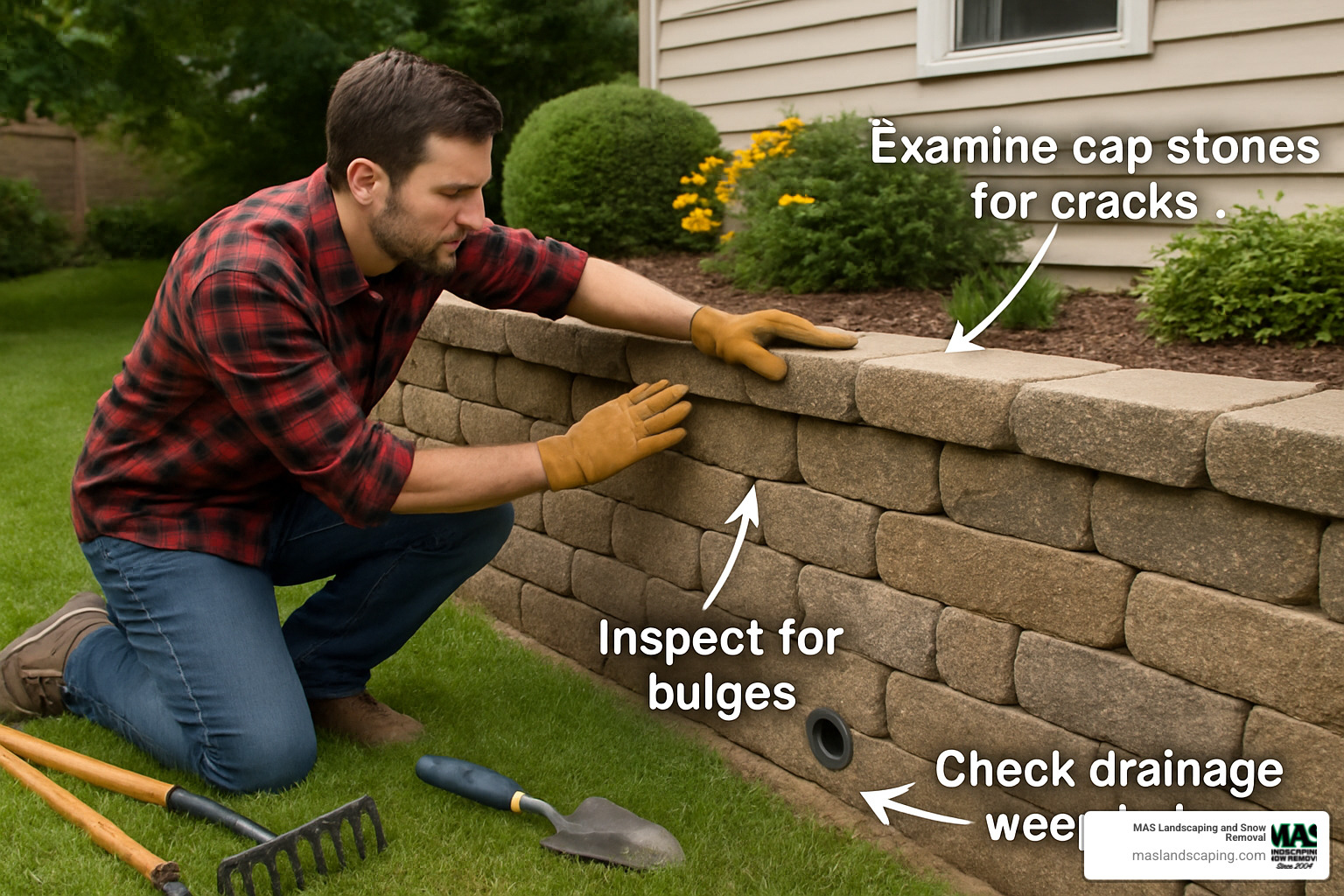
Bulging sections often indicate soil pressure problems or compromised drainage behind the wall. This shouldn’t be ignored as it suggests the structural integrity might be compromised.
Cracked cap stones typically result from seasonal freeze-thaw cycles or ground settlement. While sometimes just an aesthetic issue, they can allow water to penetrate and cause bigger problems.
Clogged weep holes prevent proper drainage, leading to dangerous pressure buildup behind the wall. A simple cleaning can often resolve this before it causes structural damage.
Leaning more than 10 degrees from vertical suggests foundation issues that likely require professional attention. This is especially concerning for taller walls.
Repair costs typically run $30-$80 per square foot, varying widely based on the extent of damage. Minor fixes like replacing a few blocks might cost just a few hundred dollars, while serious structural problems could require partial or complete rebuilding.
Typical Annual Maintenance Budget
The good news? Paver retaining walls require minimal ongoing maintenance—typically just $0.50-$1 per square foot annually. To maximize your wall’s lifespan, budget time (and a little money) for these simple routine tasks:
An annual inspection costs nothing but time and can catch small issues before they become expensive problems. Walk the length of your wall each spring, looking for any changes or concerning signs.
Power washing every 2-3 years removes stains and prevents algae growth that can make your wall look prematurely aged. This simple refresh can make a decade-old wall look almost new again.
Joint sand refill helps maintain block stability, especially after heavy rains or seasonal ground movement. This is particularly important for walls in areas with significant freeze-thaw cycles like we experience in Massachusetts.
Drainage cleaning ensures water continues to flow properly through and away from your wall. Clear weep holes of debris and check that water isn’t pooling near the base of the wall.
Vegetation control prevents plant roots from compromising your wall’s structure. While some climbing plants look attractive, their root systems can cause significant damage over time.
“Maintenance is where many homeowners fall short,” explains our maintenance supervisor at MAS Landscaping. “A simple annual inspection that costs nothing can identify small issues before they become $5,000 problems. It’s the easiest money you’ll ever save.”
Smart Ways to Save on Your Paver Retaining Wall
While quality shouldn’t be compromised, there are legitimate ways to reduce your paver retaining wall cost:
Strategic Planning
- Keep height under 4 feet: Avoids engineering requirements and permits in most municipalities
- Terraced design: Multiple lower walls often cost less than one tall wall
- Off-season scheduling: Winter planning for spring installation can secure better pricing
- Phased approach: Build the most critical sections first, adding additional walls over time
- Bundle projects: Combine with other hardscaping for efficiency in equipment and labor
Affordable vs. Premium Paver Options
The block selection significantly impacts your bottom line:
- Basic concrete blocks: $3-$5 per block, functional but limited aesthetic appeal
- Mid-range options: $5-$8 per block, better color and texture variety
- Premium blocks: $8-$15+ per block, improved appearance and features
- Tumbled finish: Adds a weathered, natural look for 15-20% more
- Faux-stone veneer: Achieves natural stone appearance at 30-40% less cost
For many Saugus and Everett homeowners, choosing mid-range blocks for the main wall and premium cap stones creates an attractive compromise between cost and appearance.
Cost-Effective Add-Ons & Improvements
Some upgrades offer excellent value relative to their cost:
- LED wall lights: $30-$60 per fixture, dramatically improves nighttime appearance
- Planter pockets: Built-in areas for flowers add visual interest for minimal additional cost
- Seating caps: Wider cap stones create informal seating for $10-$20 more per linear foot
- Drainage fabric upgrades: Premium fabrics add minimal cost but significantly extend wall life
Frequently Asked Questions about Paver Retaining Wall Cost
How long does it take to build a paver retaining wall?
Building a retaining wall isn’t an overnight project, but the timeline is reasonable for the value it adds to your property. For a typical residential wall around 30 feet long and 3 feet high, here’s what you can realistically expect:
If you’re taking the DIY route, plan for about 2-4 weekends of work, depending on your experience level and how many helping hands you have. Many of our Saugus customers who tackle this themselves find the first few feet go slowly as they learn the process, then pick up speed as they develop a rhythm.
Professional installation moves considerably faster—our teams typically complete the actual construction in just 3-7 days. However, the total project timeline generally spans 2-3 weeks when you factor in permits, material ordering, and proper site preparation.
New England weather can be unpredictable! We always build some flexibility into our schedules, especially during spring when unexpected rain showers can delay work. That’s why we typically recommend planning your retaining wall projects between late spring and early fall when conditions in the Saugus area are most favorable.
Do paver retaining walls add value to a home?
Absolutely! Quality retaining walls consistently rank among the smartest outdoor investments homeowners can make. The numbers tell the story:
Most well-constructed retaining walls deliver a 100-200% return on investment—meaning you’ll likely recoup your entire investment and potentially double it when selling your home. Property values typically increase up to 15% with professional hardscaping that includes features like retaining walls.
Beyond the raw numbers, homes with attractive, functional outdoor spaces simply sell faster. Real estate agents throughout Melrose, Malden, and Medford report that properties with professional landscaping and hardscaping typically sell 5-12% faster than comparable homes without these features.
As one local realtor told us, “When I show a home with a beautifully terraced yard and professional retaining walls, buyers immediately see the usable space rather than a challenging slope. That perceived value translates directly into stronger offers.”
Are permits always required for paver retaining walls?
The permit question is one that confuses many homeowners, and it’s no wonder—requirements vary significantly depending on where you live. Here’s a general framework to help you understand what to expect:
Walls under 3 feet tall typically don’t require permits in most municipalities around Saugus and Everett. These lower walls are considered minimal risk structures.
Walls between 3-4 feet fall into a gray area where some towns require permits while others don’t. Factors like proximity to property lines or structures often determine whether you’ll need official approval.
Walls over 4 feet almost universally require permits, and in most cases, you’ll also need professional engineering plans that verify the wall’s structural integrity.
Special situations like walls near utilities, public rights-of-way, or in conservation areas typically require additional permits regardless of height.
The good news? When you work with us at MAS Landscaping and Snow Removal, we handle all the permitting headaches for you. Our team manages the entire process, from initial applications to communicating with local building departments and coordinating any required inspections in Saugus, Everett, Malden, and all surrounding communities we serve.
Conclusion
When all is said and done, the paver retaining wall cost represents more than just a line item in your landscaping budget—it’s a long-term investment in your property’s health and beauty. While most homeowners in our area spend between $3,500 and $9,400 for their retaining walls, what they’re really buying is decades of soil stability, flood protection, and improved outdoor living space.
Think of it this way: spread across the 50-100 year lifespan of a properly built wall, even a seemingly substantial upfront investment becomes quite reasonable on a yearly basis. As one of our Malden clients recently put it, “It felt like a big check to write at first, but three years later, I can’t imagine our backyard without the terraced walls—they’ve completely transformed how we use our property.”
The real value of a quality retaining wall reveals itself over time through:
- Minimal yearly maintenance requirements (usually just periodic inspection and cleaning)
- Protection of your property from costly erosion and water damage
- Creation of level, usable outdoor space where there was once unusable slope
- Improved curb appeal and landscaping possibilities
- Significant boost to your home’s market value when it’s time to sell
We’ve seen too many homeowners try to save money by cutting corners on drainage systems or base preparation, only to face the much higher cost of rebuilding a failed wall just a few years later. As the old saying goes, “The bitterness of poor quality remains long after the sweetness of low price is forgotten.”
Here at MAS Landscaping and Snow Removal, we’ve been building retaining walls throughout Saugus, Everett, Malden, Melrose, Medford, Revere, Chelsea and surrounding communities for years. We understand the unique challenges of New England soils, weather patterns, and municipal requirements. Our team takes pride in creating structures that not only look beautiful on day one but continue to perform flawlessly through decades of freeze-thaw cycles and Nor’easters.
Your retaining wall isn’t just holding back soil—it’s creating new opportunities for your outdoor space while protecting your most valuable asset: your home. When you’re ready to explore how a paver retaining wall could improve your property, we’d love to share our local expertise and help you make the most of your investment.
For more detailed information about our professional installation process and approach, please visit our resource page on retaining wall installation.