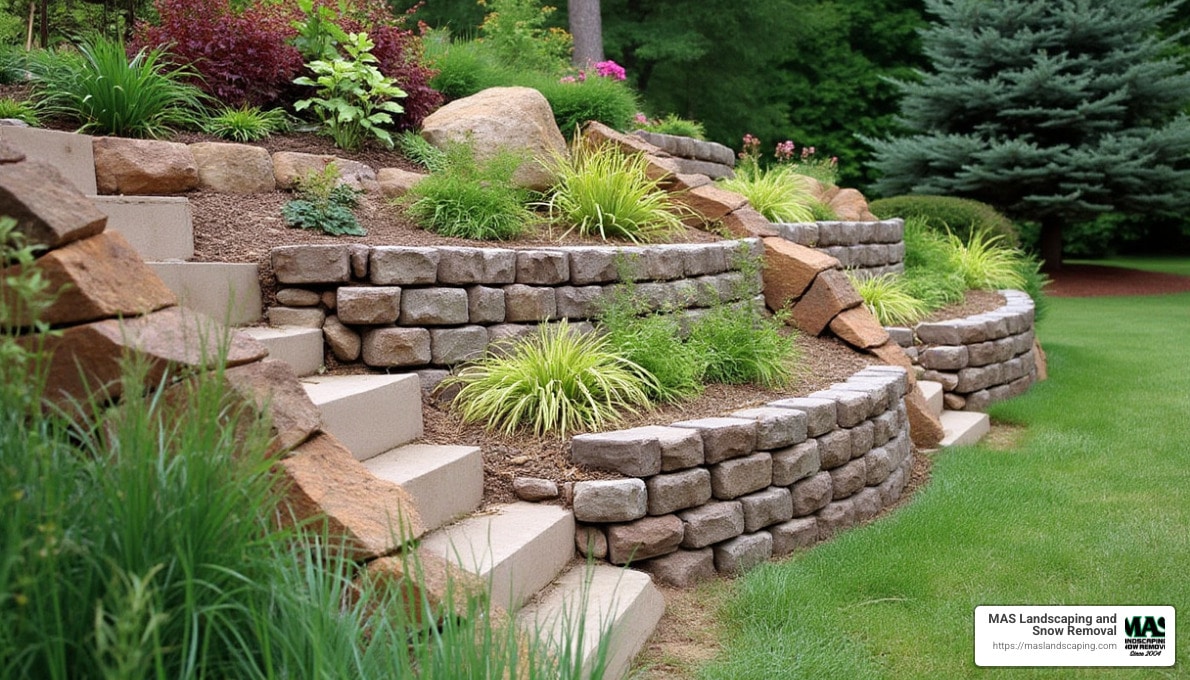



Why Retaining Wall Installations Are Essential for Your Property
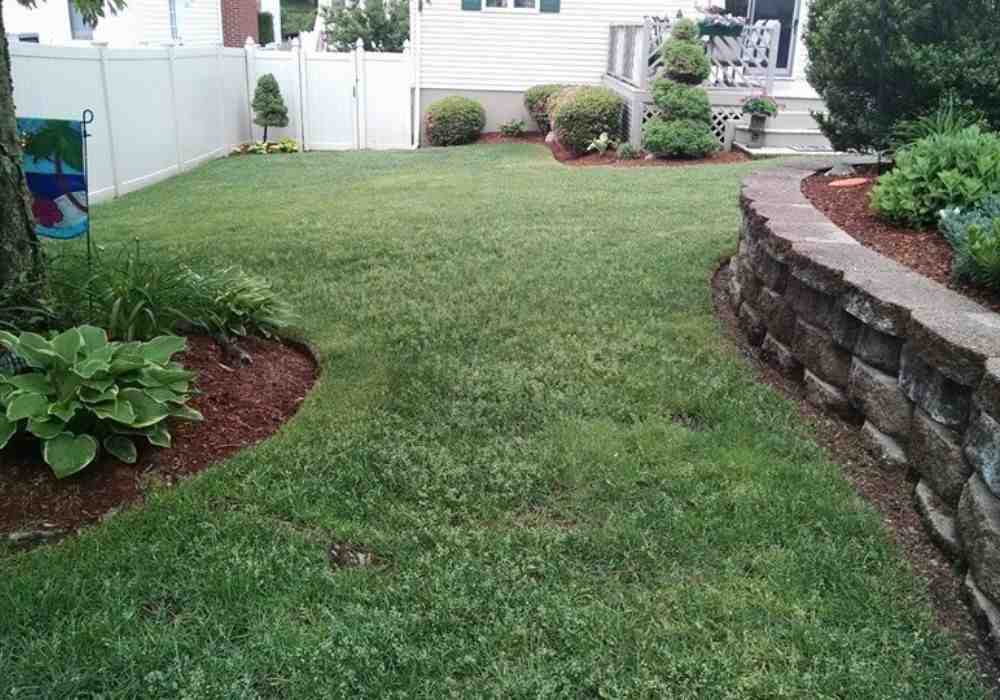
Retaining wall installations transform sloped, unusable yards into functional outdoor spaces while preventing costly erosion damage. Whether you’re creating a level patio area, building raised garden beds, or protecting your property from washouts during storms, a properly installed retaining wall is both a practical necessity and an investment in your home’s value.
Key Steps for Retaining Wall Installation:
- Plan and prepare – Mark layout, call 811, check permits
- Excavate trench – Dig 8+ inches deep, twice the block width
- Build level base – Add 6 inches of compacted gravel
- Install first course – Bury at least half the block height
- Add drainage – Place perforated pipe behind blocks
- Stack courses – Stagger joints, backfill and compact in 8-inch lifts
- Finish top – Secure capstones with adhesive
A retaining wall isn’t just decorative—it must withstand enormous forces. As one industry expert notes, retaining walls face lateral earth pressure from the soil they hold back, and this pressure increases dramatically when that soil becomes saturated with water. This increase in hydrostatic pressure is a basic principle of soil mechanics and is well explained in resources like retaining wall engineering. That’s why proper drainage is the single most important factor in preventing wall failure.
The rewards of a well-built retaining wall are significant. According to the National Association of Realtors, landscape redesign projects that include retaining walls saw an average 105% value recovery, with 75% of homeowners saying the project increased their desire to be home.
But here’s the reality: water is the number one cause of retaining wall failure. Without proper drainage, even the most beautiful wall can lean, crack, or collapse within a few years. That’s why this guide emphasizes the critical steps of base preparation, drainage installation, and proper backfilling techniques.
Whether you’re tackling a small garden wall under 3 feet or planning a larger project that requires professional engineering, understanding these fundamentals will help you make informed decisions about your property.
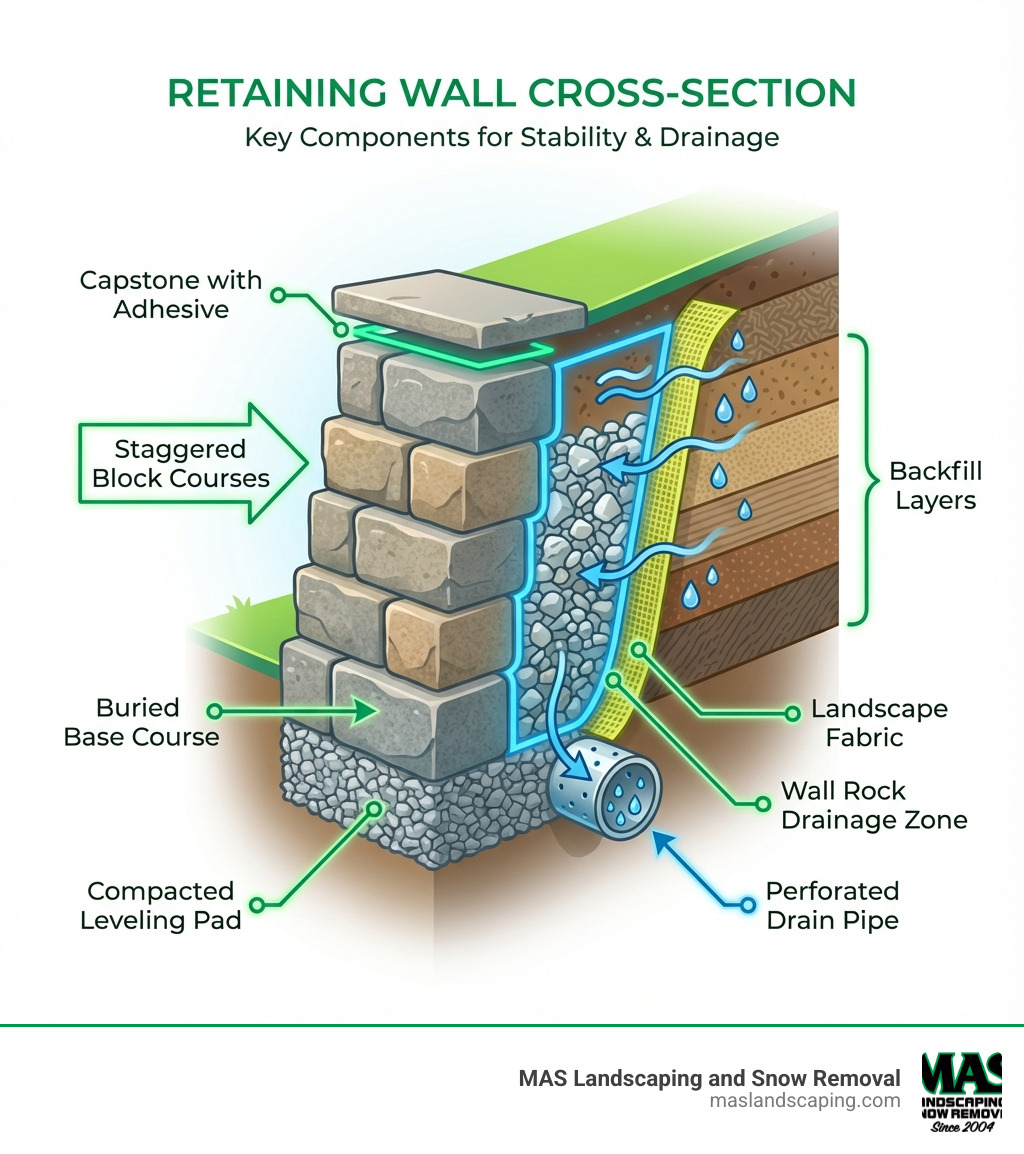
Retaining wall installation vocab to learn:
Planning Your Project: Before You Dig
Before we even think about digging, a successful retaining wall installation starts with meticulous planning. This crucial first phase ensures we understand the scope, potential challenges, and necessary resources for our project. We’ll assess the site, consider our budget, decide between a DIY approach or professional help, and map out a realistic timeline. Building a retaining wall is a significant undertaking, but with proper planning, it can be a rewarding one.
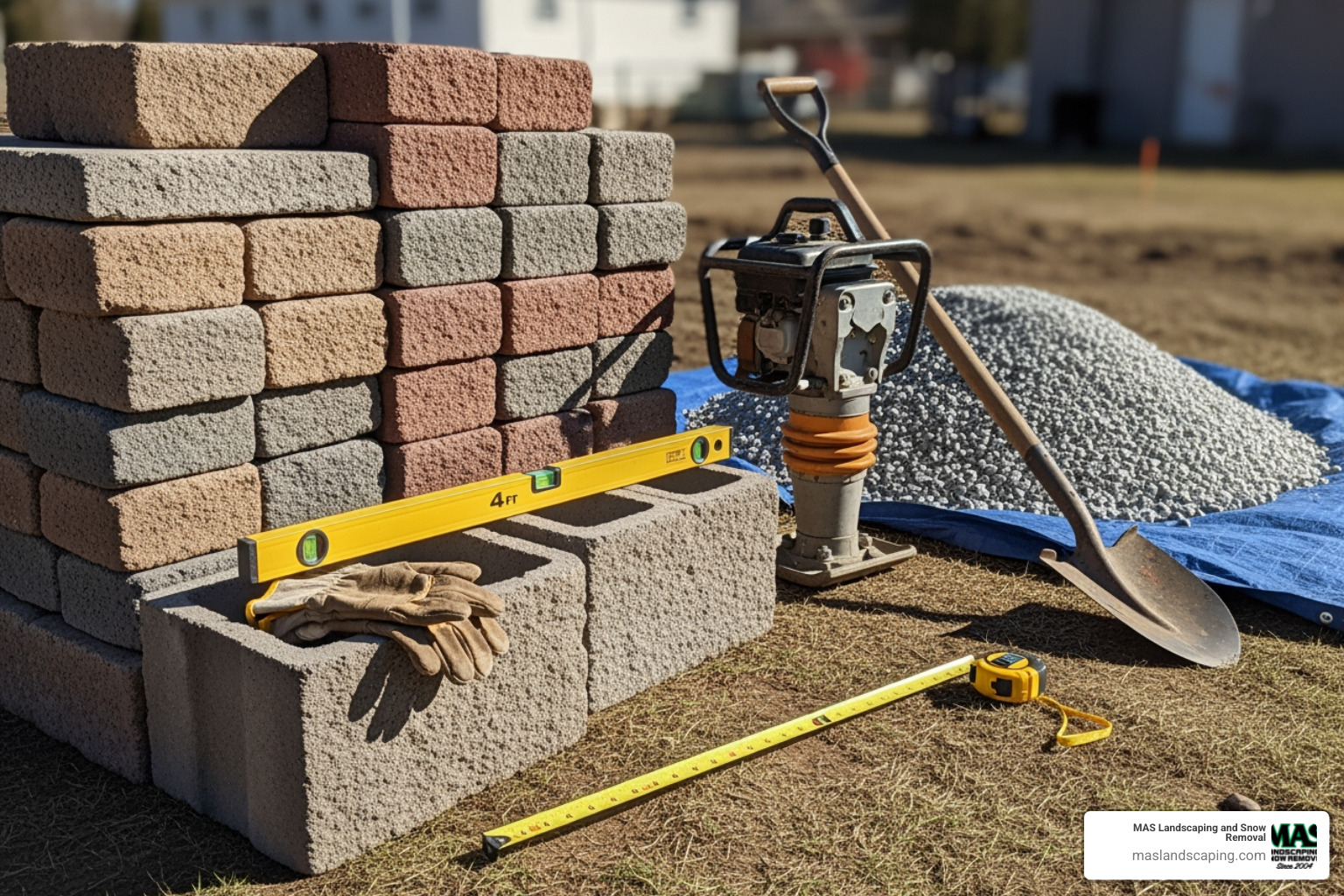
Choosing Your Materials and Tools
The right materials and tools are key to a lasting retaining wall. For most homeowners, interlocking concrete blocks offer the easiest and most secure option for DIY retaining wall installation. These come in various styles and colors, like Nicolock or Allan Block units, and are designed to fit together, adding extra security.
Other popular materials include:
- Natural stone: Offers a classic, rustic look, but often requires more skill to install.
- Wood timbers: A more economical choice, but timber walls may need replacement within 5 to 10 years due to deterioration.
Regardless of the material chosen, we’ll need specific aggregates:
- Gravel (wall rock): Essential for the leveling pad and for backfilling behind the wall to ensure proper drainage. We look for clean, graded aggregate, ideally 0.25 to 1.5 inches, free of silts or clay.
- Paver base/Coarse sand: Used for the leveling pad to create a uniform, compactable surface.
- Perforated drainage pipe: Critical for channeling water away from the wall.
- Landscape fabric: Prevents soil from migrating into the drainage gravel.
Here’s a list of essential tools we’ll need for most retaining wall installation projects:
- Shovel and spade
- Tape measure
- Level (long carpentry level, line level, and torpedo level)
- Hand tamper or walk-behind plate compactor (a must for proper compaction!)
- Rubber mallet or dead blow hammer
- Masonry saw or chisel (for cutting blocks)
- Wheelbarrow
- String line and stakes
- Broom (to keep block surfaces clean)
- Safety glasses, gloves, and sturdy work boots (PPE is non-negotiable!)
Understanding Codes, Permits, and Safety
Before any dirt is moved, we must address local regulations and safety. This is particularly important in our service areas of Everett, Lynnfield, Malden, Melrose, Medford, Revere, Saugus, and Chelsea, MA, where local building codes can vary.
- Call 811 Before You Dig: This is paramount. Even shallow excavations can damage underground utility lines. Calling 811 ensures these lines are marked, preventing costly accidents and potential injury.
- Local Building Codes and Permits: Many municipalities require permits for retaining walls above a certain height. For example, walls above 3 to 4 feet in height often trigger a permitting process and may require an engineer’s sign-off. We always recommend checking with your local building department in Massachusetts to understand specific requirements.
- Walls Over 4 Feet: Walls that support heavy loads or exceed four feet in height almost always require special soil reinforcement (like geogrid) and often professionally designed plans. Ignoring this can lead to wall failure, which can be a serious safety hazard.
- Property Lines: Be mindful of property lines. A retaining wall should be entirely on your property unless you have a written agreement with your neighbor.
- Safety Precautions: Always wear appropriate Personal Protective Equipment (PPE) such as safety glasses, gloves, and sturdy boots. When cutting blocks, a respirator mask is essential as masonry dust can be dangerous to inhale. Building when the soil is dry also makes the job easier and safer.
The Step-by-Step Retaining Wall Installation Process
A successful retaining wall installation is built on precision, patience, and proper technique. Each step builds upon the last, and shortcuts can compromise the entire structure’s integrity. We’re laying the foundation for a wall that will stand strong against the forces of nature and time.
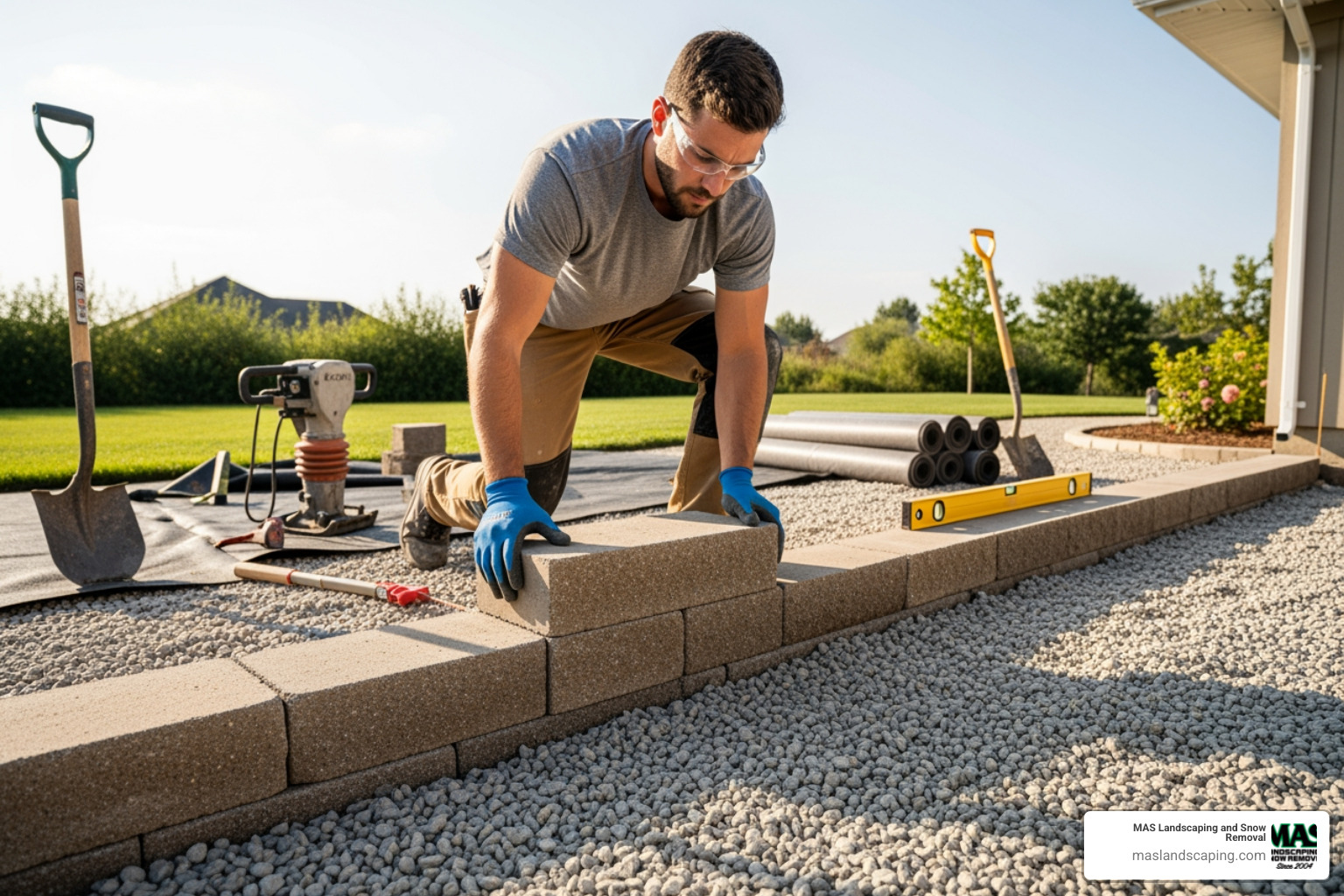
Step 1: Site Preparation and Excavation
This is where the rubber meets the road—or rather, where the shovel meets the earth. Our goal here is to create a perfectly prepared bed for our wall.
- Marking the Layout: We’ll start by marking the wall’s path. Use stakes and a string line for straight sections, ensuring the line is level. For curved walls, a garden hose is an excellent tool to visualize and mark the desired shape.
- Excavating the Trench: This is more than just digging a ditch. We need to create a stable, level trench for the wall’s base.
- Trench Depth: The first course of blocks needs to be partially buried for stability. For low walls, at least half the height of the first course should be below ground level. For walls higher than 3 feet, a full block will need to be underground. A good rule of thumb is to create a trench around eight inches deep, ensuring the first course is buried to a depth equal to 10% of the wall’s exposed height or a minimum of 6 inches, whichever is greater.
- Trench Width: The trench should be wide enough to accommodate the block and drainage material. For walls under 4 feet, an 18-inch wide trench is often sufficient. For walls over 4 feet, we’ll need a minimum of 24 inches wide to account for geogrid reinforcement if required.
- Compacting the Trench Bottom: Once the trench is excavated and all surface vegetation and organic materials are removed (they cannot be used as backfill!), we’ll compact the soil at the bottom. A hand tamper works for small projects, but for larger walls, a walk-behind plate compactor is essential to achieve a firm, solid foundation. We aim for a minimum of two passes with the compactor.
Step 2: Preparing the Leveling Pad for a DIY Retaining Wall Installation
The leveling pad is the unsung hero of a retaining wall. It’s the stable, perfectly level surface that the first course of blocks rests on, and its precision dictates the success of the entire project.
- Leveling Pad Purpose: Think of it as the foundation of your foundation. A well-compacted and level pad prevents settling, shifting, and unevenness in the finished wall. The first row of blocks is critically important; if it’s not perfect, every subsequent course will be off.
- Spreading Gravel Base: We’ll spread a layer of clean, graded aggregate (often called wall rock or paver base) into the trench. This layer should be approximately 6 inches thick. For walls under 4 feet, a 4-inch deep gravel base might suffice, but 6 inches provides greater stability.
- Compacting the Base Material: Just like the trench bottom, this gravel layer needs thorough compaction. We’ll use our hand tamper or plate compactor to ensure it’s dense and stable.
- Using a Screed Board: To create a perfectly level surface, we’ll use a screed board and two 1-inch diameter screed pipes (or similar guides). This allows us to strike off the gravel, ensuring a uniform and flat plane.
- Laying the Base Course: Now, we carefully place the first course of retaining wall blocks onto the prepared leveling pad. We’ll start at the lowest elevation of the wall. Each block should be placed with its raised front lip (if applicable) facing up and forward, centered on the base material.
- Checking Level Front-to-Back and Side-to-Side: This step cannot be rushed. We carefully check each block for level from side-to-side, front-to-back, and with adjacent units. Minor adjustments can be made by tapping the block with a rubber mallet or by adding a small amount of coarse sand underneath. A string line can help maintain alignment for straight sections. By having this first row partially underground and perfectly level, we ensure the wall is anchored and much stronger.
Step 3: Managing Drainage and Backfilling
Water is the number one enemy of a retaining wall. It’s not an exaggeration to say that proper drainage is the single most important factor in preventing wall failure. Hydrostatic pressure, the force exerted by water behind the wall, can cause even the most robust structures to lean, crack, or collapse.
- Importance of Drainage: Our goal is to keep water out of the back of the wall and ensure it flows away. This prevents the soil behind the wall from becoming saturated, which significantly increases lateral earth pressure.
- Installing a Perforated Drain Pipe: For any reinforced wall, gravity walls over 4 feet tall, or sites with poor drainage (common in our Everett, Lynnfield, Malden, Melrose, Medford, Revere, Saugus, and Chelsea, MA areas with their varied soil conditions), a perforated drain pipe is essential.
- We’ll place this pipe at the lowest point, towards the back of the trench, directly behind the first course of blocks.
- The pipe should be covered with a drain sleeve or filter fabric to prevent clogging with soil fines.
- Crucially, the drain pipe must be vented to daylight or a storm sewer system, ideally every 50 feet, to allow water to escape.
- Adding Drainage Aggregate (Clean Gravel): Once the drain pipe is in place, we’ll fill the hollow cores of the blocks and the area immediately behind the wall (at least 12 inches deep) with clean, graded drainage aggregate (wall rock). This free-draining gravel allows water to quickly move down to the perforated pipe.
- Backfilling in Lifts: Behind the wall rock, we’ll backfill with approved infill or on-site soils. This isn’t a one-and-done job; we apply the backfill in “lifts”—layers no more than 8 inches deep.
- Compacting Each Lift: After each 8-inch lift of backfill, we thoroughly compact the material using a plate compactor. This prevents future settling and ensures the soil mass behind the wall is stable. Proper compaction to a minimum of 95% of Standard Proctor is vital for structural integrity.
This meticulous approach to drainage and backfilling is what separates a lasting retaining wall from one destined for an early failure. For more insights into how proper hardscaping can transform your outdoor space, explore our hardscaping projects.
Step 4: Stacking Courses and Finishing with Capstones
With the base course firmly in place and drainage addressed, we can now build upwards, course by course, until our wall reaches its desired height.
- Staggering Joints (Running Bond Pattern): For structural integrity and aesthetic appeal, we’ll always stack blocks in a running bond pattern, meaning the vertical seams of each course are offset from the course below. A common practice is to offset by at least 1/4 the length of the block, or by half a block. This distributes the load evenly across the wall.
- Sweeping Blocks Clean: Before placing a new course, we always sweep any debris, dirt, or small stones off the top of the blocks below. This ensures a clean, level surface for the next course to sit on and maintains proper interlock.
- Checking for Level on Each Course: Just like the base course, each subsequent course needs to be checked for level, both side-to-side and front-to-back. Slight adjustments can be made with a rubber mallet.
- Cutting Blocks for Ends or Curves: When we reach the end of a course or need to form a curve, we’ll cut blocks to fit. A masonry saw with a diamond blade is ideal for precise cuts, but a mason’s chisel can also be used. For curves, some block systems allow for removing “wings” to achieve tighter radii for outside curves.
- Applying Construction Adhesive: Once the wall reaches its full height, it’s time for the capstones. These decorative and functional tops are secured using a suitable masonry adhesive. We ensure both the top course of blocks and the capstones are dry and dust-free for a strong bond.
- Installing Capstones: We carefully place the capstones on the final course, securing them with adhesive. Capstones typically overhang the retaining blocks by 1 to 1 1/2 inches, providing a finished look and helping to shed water.
Advanced Techniques and When to Call a Pro
While the step-by-step guide covers the basics for many DIY-friendly retaining wall installation projects, some situations demand more advanced techniques or the expertise of a professional. Complex site conditions, the need for increased structural integrity, or specific engineering principles often necessitate a different approach. When in doubt, it’s always best to consult with experienced landscapers or engineers. For comprehensive solutions that blend functionality with aesthetic appeal, we offer specialized landscape design services custom to your unique property needs. See our landscape design services.
Building on Slopes and Creating Terraced Walls
Dealing with sloped terrain is often why a retaining wall is needed in the first place. Building on a slope requires careful planning to ensure stability.
- Stepping the Base Up a Slope: Instead of digging one long, level trench, we’ll excavate and install the base course in steps, following the natural grade. Each “step” in the base must be perfectly level, and it’s critical to ensure proper burial depth for each block across the entire length of the wall. This ensures the wall remains stable as it ascends the slope.
- Designing Terraced Walls: For significant slopes or to create multiple usable levels, terraced walls are an excellent solution. This involves building a series of shorter walls rather than one tall, imposing structure.
- Spacing Between Walls: A key rule for terraced walls is that the horizontal distance between the face of the lower wall and the base of the upper wall should be at least twice the height of the lower wall (D > 2H1). This ensures adequate support for the upper wall and prevents excessive pressure on the lower one.
- Compaction for Upper Walls: When building terraced walls, soil compaction is paramount, especially for the areas supporting the upper walls. We might use shorter compaction lifts (as little as 4 inches) to ensure maximum density and stability.
Incorporating Geogrid for Taller Walls
Geogrid is a vital reinforcement material that transforms a simple block wall into a robust, engineered structure capable of handling greater heights and loads.
- What is Geogrid: Geogrid is a flexible, synthetic mesh made of polymer materials. It comes in rolls and is laid horizontally within the wall structure.
- When Geogrid is Required: While walls up to 3 feet in height are often attainable without geogrid, reinforcement becomes necessary for taller walls. Generally, walls over 3 to 4 feet in height, or those supporting heavy loads like driveways or patios, will require geogrid. For instance, many guidelines suggest that walls exceeding 4 feet require geogrid reinforcement.
- How Geogrid Works: Geogrid works by interlocking with the backfill soil, creating a reinforced soil mass. This cohesive soil mass acts as a single, stronger unit, resisting the immense lateral earth pressure and preventing the wall from sliding or overturning. It essentially extends the wall’s “footprint” into the stable soil behind it.
- Laying Geogrid Between Courses: Geogrid is typically installed on specific courses of the wall, often every other course, as specified by an engineer’s design. We roll it out along the back of the wall, directly on top of a block course.
- Extending Geogrid into the Backfill: The geogrid must extend a specified length back into the compacted backfill material. This length depends on the wall height and soil conditions.
- Proper Tensioning: Once laid, the geogrid needs to be pulled taut and staked in place before backfilling and compaction to ensure it engages properly with the soil.
Why You Might Need an Engineer
While many low-level retaining walls can be a successful DIY project, there are clear instances where professional engineering expertise is not just recommended, but essential for safety and longevity.
- Walls Over 4 Feet: This is the most common trigger. Walls exceeding four feet in height are subject to significant forces and often require complex design calculations to ensure stability.
- Supporting Heavy Loads (Surcharges): If your retaining wall will support structures like a driveway, a patio, a swimming pool, or even a steep slope above it (known as a “surcharge”), an engineer’s design is critical. These added loads dramatically increase the pressure on the wall.
- Poor Soil Conditions: If your property has weak, unstable, or highly expansive soils (like certain clays), a standard gravity wall might not suffice. An engineer can assess the soil and design a wall system, potentially with specialized footings or reinforcement, to suit the conditions.
- Complex Tiered Designs: While we discussed basic terracing, highly complex or multi-tiered wall systems, especially those on steep slopes, benefit greatly from an engineer’s oversight to ensure overall slope stability.
- Ensuring Safety and Longevity: An engineer’s design provides peace of mind. It ensures the wall is structurally sound, compliant with local codes, and built to last, protecting your property and preventing potential liabilities from a failing structure.
Frequently Asked Questions about Retaining Wall Installation
How high can I build a retaining wall by myself?
Most local codes and best practices suggest that DIY retaining walls should not exceed 3 to 4 feet in height. Taller walls, or those supporting critical loads like a driveway, require a professional design from a qualified engineer to ensure they can safely handle the immense lateral earth pressure. Walls up to 3 feet can typically be built without soil reinforcement (geogrid). However, if a wall is above 3 feet, or if it’s considered a “structural wall” (generally over 2 feet high), it’s wise to check local building codes in places like Saugus, MA, and consider professional consultation. For anything above 4 feet, an engineer is strongly recommended.
What is the most critical step in building a retaining wall?
The most critical step is creating a solid, level base. The first course of blocks (the base course) dictates the success of the entire wall. If the base is not perfectly level and well-compacted, the wall will be unstable, uneven, and prone to failure over time. Industry experts consistently emphasize that the first row is incredibly important, as having it properly buried and level anchors the entire structure, making it much stronger.
How much value does a retaining wall add to a home?
A well-designed retaining wall is part of a larger landscape redesign, which can provide a significant return on investment. According to a recent study by the National Association of Realtors, landscape redesign projects saw an average of 105% value recovery, making them one of the top outdoor projects for boosting a home’s resale value. Beyond financial returns, 75% of surveyed homeowners reported an increased desire to be home, and 65% found greater enjoyment in their home after such projects, highlighting the lifestyle benefits.
Conclusion
A successful retaining wall installation is a blend of careful planning, diligent execution, and an understanding of the forces at play. We’ve seen that a solid base, proper drainage, and careful compaction are the pillars of a lasting structure. While many smaller projects can be tackled by a determined DIYer, recognizing when to call in the professionals for taller walls, complex designs, or challenging site conditions is key to ensuring safety and longevity.
The reward for a job well done is not just a beautiful, functional landscape, but also the satisfaction of a significant home improvement that adds value and enjoyment. For those in Everett, Lynnfield, Malden, Melrose, Medford, Revere, Saugus, or Chelsea, MA, looking to transform their outdoor spaces with a retaining wall, we at MAS Landscaping and Snow Removal are here to help. Our commitment to professionalism, personalized service, and local expertise ensures your project is in capable hands.
Whether you’re envisioning a simple garden wall or a complex terraced landscape, a well-built retaining wall can be a game-changer for your property. Don’t let slopes dictate your yard’s potential.
Contact us for your professional retaining wall installation