


Stone Delivery: #1 Reliable Guide 2025
Why Stone Delivery Makes Your Landscaping Projects Easier
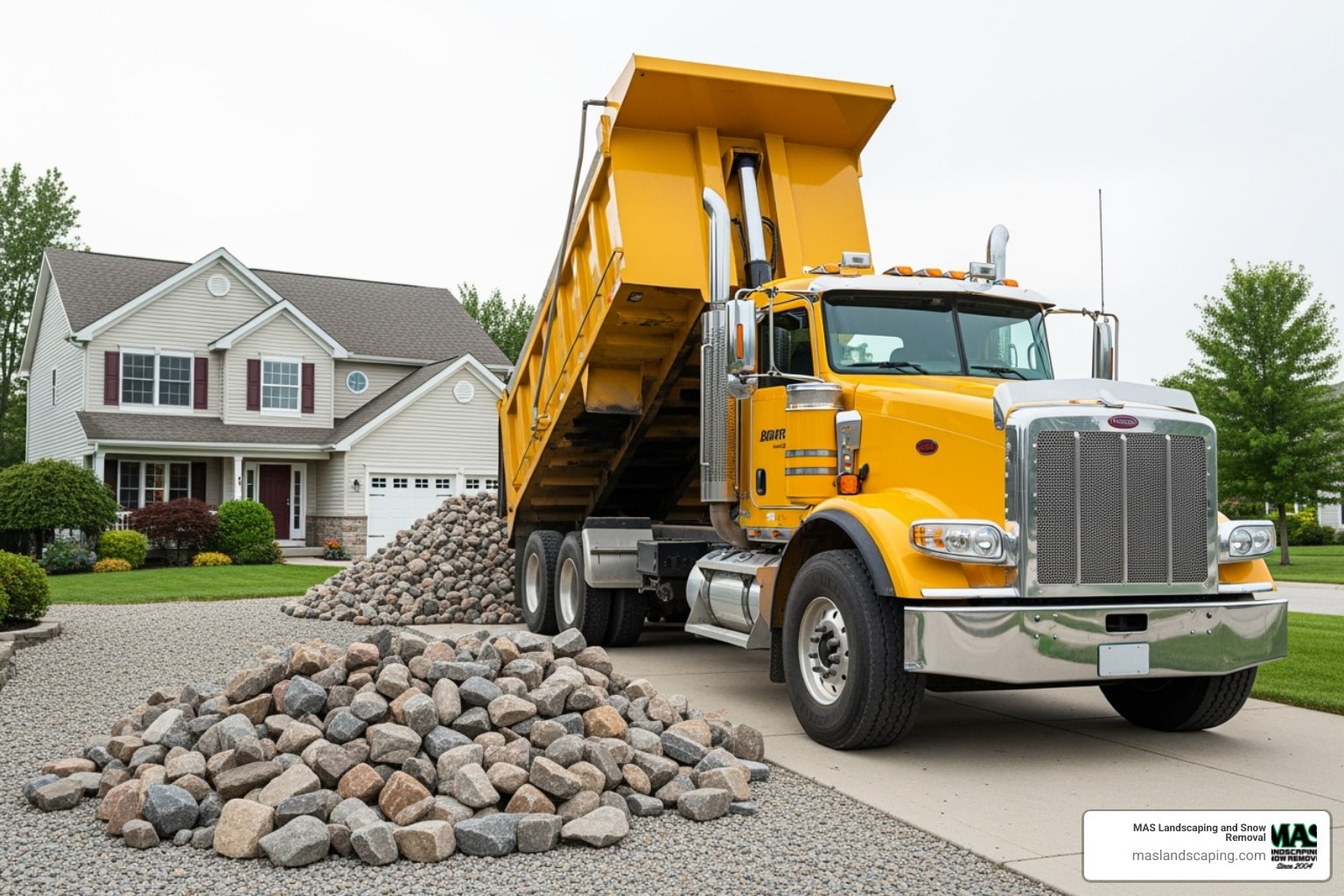
Starting on a landscaping project is exciting, but the logistics of sourcing and transporting heavy materials can quickly become a major headache. Arranging for professional stone delivery is one of the smartest moves you can make, changing a potentially back-breaking task into a simple, streamlined process. Instead of spending your weekend making multiple trips to a supply yard, waiting in line, and manually loading and unloading tons of rock, you can have the exact amount you need deposited right where you need it.
Here are the key benefits that make stone delivery an essential service for any serious DIY or professional landscaping project:
- Time Efficiency: Your time is valuable. Stone delivery eliminates the hours spent driving, waiting, and hauling. A single delivery can accomplish in minutes what might take you an entire day of hard labor.
- Physical Safety: Landscaping stone is incredibly heavy. A single cubic yard can weigh over a ton. Lifting bags or shoveling loose stone repeatedly puts you at high risk for back, shoulder, and knee injuries. Letting a dump truck do the heavy lifting is the safest option.
- Cost-Effectiveness: For any project larger than a small garden patch, buying stone in bulk is significantly cheaper per yard than purchasing it in bags from a big-box store. The delivery fee is often a small price to pay for the savings on the material itself and the value of your time and physical well-being.
Of course, a successful delivery requires a bit of planning. The primary challenge is site access. A fully loaded dump truck can weigh over 18 tons and requires ample clearance—horizontally and vertically. Narrow driveways, soft ground that can’t support the weight, low-hanging tree branches, or overhead utility lines can all prevent a truck from reaching your desired drop spot.
To ensure a smooth process, focus on three key steps: accurately calculate your material needs, prepare a clear and firm drop spot, and communicate openly with your supplier about any potential access issues. By mastering these basics, you make the delivery the easiest part of your project.
Key vocab:
Choosing the Right Stone for Your Project
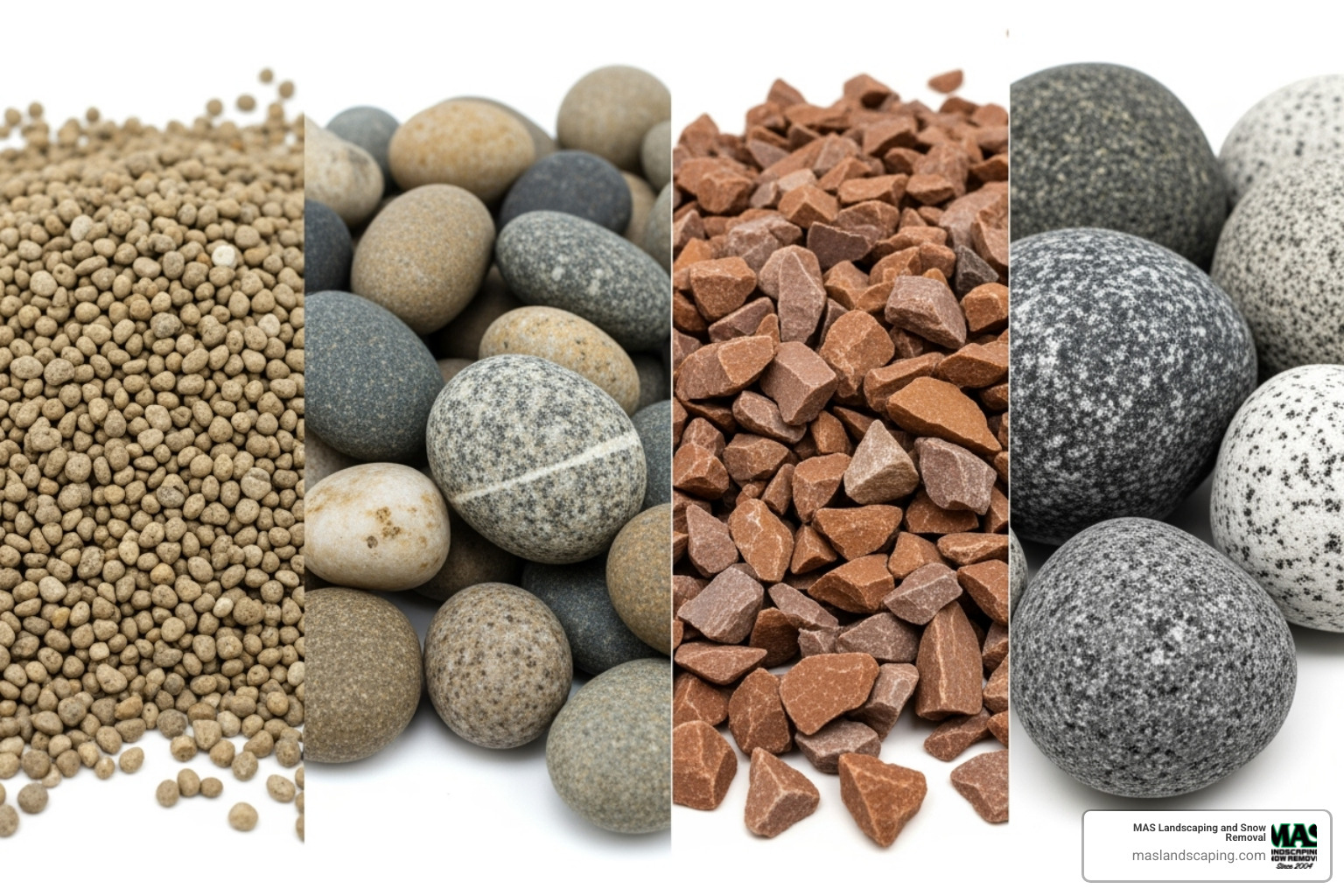
The sheer variety of landscaping stone can feel overwhelming, but the selection process becomes much simpler when you follow a golden rule: function first, looks second. Identify the practical need your project addresses—be it drainage, a stable base, or weed suppression—and select the type of stone engineered for that job. Once the functional choice is made, you can then select a color, size, and texture that complements your home and landscape design.
Common Types of Stone for Delivery
- Crushed stone & gravel: This is the workhorse of landscaping materials. It comes in various sizes, from fine stone dust to large, chunky pieces. Angular crushed stone (like 3/4″ crush) is ideal for driveway surfaces and paver bases because the sharp edges interlock to create a stable, compacted surface. A “modified” blend (e.g., 2A Modified) includes stone dust and smaller aggregates that bind together tightly when compacted, making it perfect for sub-bases.
- Decorative rock: This category includes aesthetically pleasing stones like smooth, rounded river rock, porous and lightweight lava rock, and bright marble or granite chips. Their primary purpose is visual appeal. They are perfect for top-dressing garden beds, creating dry creek beds, or accenting water features. Their color and texture can be used to create contrast and highlight plantings.
- Sand & screenings: These are fine-particled materials with specific uses. Coarse, washed concrete sand is the industry standard for the bedding layer directly beneath pavers, as it provides a stable yet flexible setting bed. Screenings, also known as stone dust, are the fine particles left over from the stone crushing process. They are excellent for filling the joints between pavers or as a compactable base for flagstone walkways.
- Boulders & wall stones: For making a statement, nothing beats boulders. They can serve as dramatic focal points, natural seating, or anchors for a garden bed. Wall stones are flatter, more stackable stones used to build structural retaining walls or decorative garden borders. The choice between rugged fieldstone and more uniform cut stone will define the wall’s style.
- Pavers & flagstone: These materials are delivered on pallets due to their uniform shape and weight. Concrete pavers offer a wide range of colors and styles for creating durable, interlocking patios and walkways. Flagstone provides a more natural, irregular look with its flat, quarried slabs, perfect for rustic paths and patios.
Need ideas? Browse our Backyard Stone Work gallery.
Matching Stone to Your Landscaping Needs
- Drainage: Use “clean” 3/4″ stone or larger river rock for applications like French drains or backfilling behind retaining walls. “Clean” means it has been washed to remove fine particles (dust and dirt), ensuring water can percolate through freely without clogging.
- Walkways/Driveways: Angular crushed stone is non-negotiable for these high-traffic areas. The interlocking pieces create a stable surface that resists shifting and rutting under weight. Rounded pea gravel, while attractive, will constantly shift underfoot and is not suitable for driveways.
- Garden Beds: A 2- to 3-inch layer of 3/8″–2″ decorative rock over landscape fabric is highly effective at suppressing weeds, retaining soil moisture, and creating a clean, polished look that lasts for years without needing replacement like mulch.
- Patios: A successful patio is built in layers. Start with a 4- to 6-inch compacted base of modified crushed stone, add a 1-inch bedding layer of coarse sand, and then lay your Pavers for Patios or flagstone on top.
- Retaining Walls: Use dense, flat wall stone for stacking. For taller walls, it’s often a veneer over a concrete block structure. Crucially, backfill behind the wall with clean drainage stone to relieve hydrostatic pressure and prevent bowing. See examples at Hardscape Retaining Walls.
For detailed river-rock ideas, visit Hardscaping with River Rock.
How Much Stone Do You Need? Calculating Your Order

One of the most common project pitfalls is miscalculating material quantities. Order too much, and you’re left with a permanent rock pile in your yard; order too little, and your project grinds to a halt while you wait for a second delivery. Most bulk landscaping stone is sold by the cubic yard (yd³), which is a volume measurement equivalent to a cube that is 3 feet long, 3 feet wide, and 3 feet tall (27 cubic feet).
A good rule of thumb for quick estimates is: 1 cubic yard of stone will cover approximately 100 square feet at a depth of 3 inches.
Quick Formula for Calculation
For a more precise calculation, use this simple three-step formula:
- Calculate the Area: Multiply the Length of your project area (in feet) by the Width (in feet) to get the total area in square feet (sq ft).
- Determine the Volume: Multiply the Area (sq ft) by your desired Depth (in inches).
- Convert to Cubic Yards: Divide the total from step 2 by 324. The result is the number of cubic yards you need.
Example: You’re installing a new gravel driveway that is 50 ft long and 10 ft wide, and you need a 4-inch layer of stone.
- Area: 50 ft × 10 ft = 500 sq ft
- Volume: 500 sq ft × 4 in = 2000
- Cubic Yards: 2000 ÷ 324 = 6.17 yd³
In this case, you would round up and order 6.5 or even 7 cubic yards. It’s always wise to order about 10% extra to account for compaction, slight variations in grade, and any minor spills or miscalculations. Having a little extra on hand is far better than running short.
Prefer a tool? This Landscape Calculator can help with various shapes and materials.
Tons vs. Cubic Yards
To make things more confusing, some suppliers quote prices by the ton (weight) instead of the cubic yard (volume). This is a critical distinction, as the weight of a cubic yard of stone varies dramatically by material.
- Cubic yard = A measure of volume (27 cubic feet).
- Ton = A measure of weight (2,000 pounds).
Dense, crushed granite might weigh 1.4 tons (2,800 lbs) per cubic yard, while porous lava rock could weigh as little as 0.7 tons (1,400 lbs). Always confirm whether a price is per yard or per ton to compare offers accurately. A professional supplier, like those discussed in A Shipper’s Guide to Stone Transport, will be clear about their units of sale.
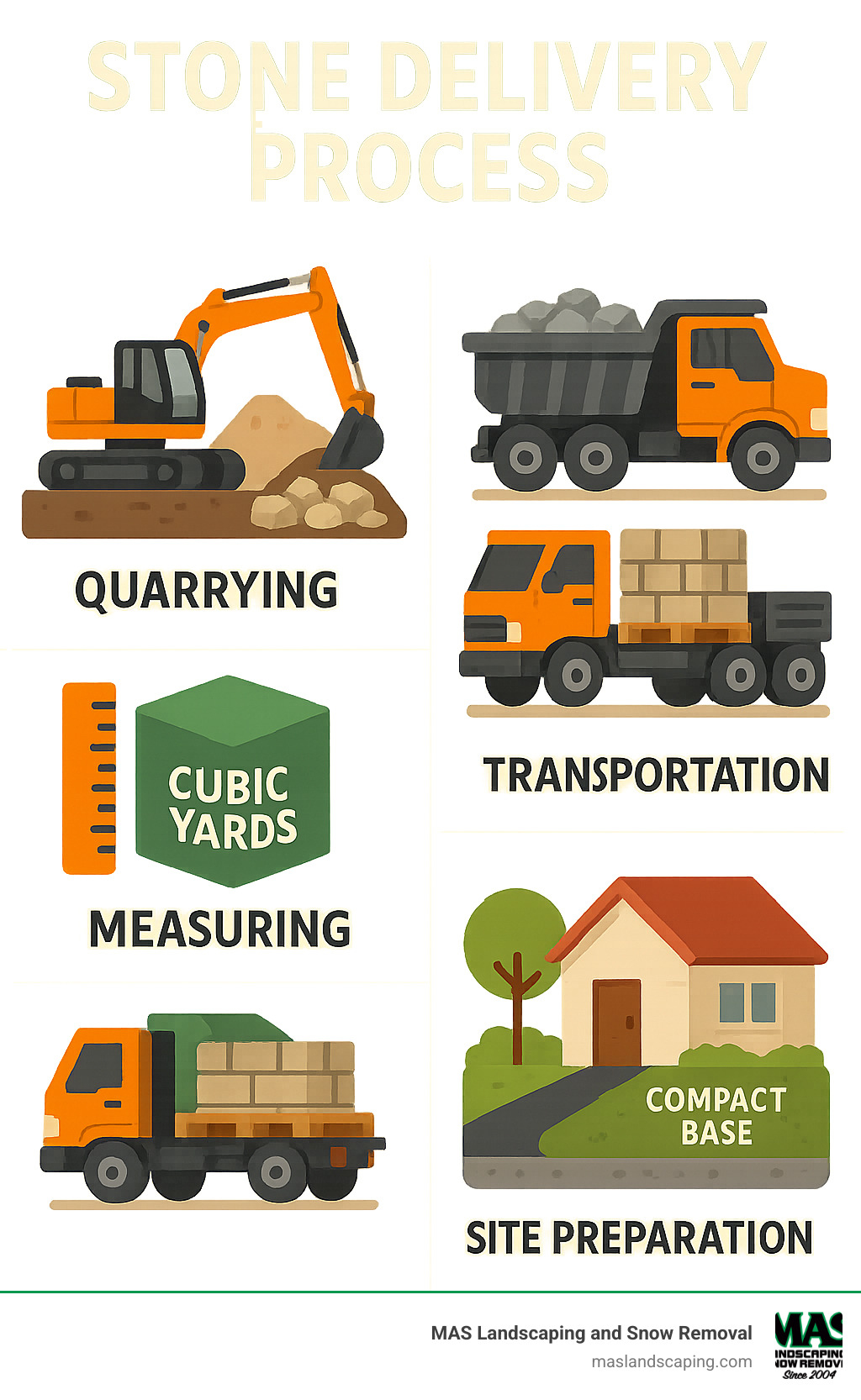
The Complete Guide to the Stone Delivery Process
Once you’ve chosen your stone and calculated the quantity, the delivery itself is the final step. The process is generally quick and efficient, but proper preparation is key to avoiding any hiccups. Most suppliers can offer delivery within a few days, with many providing same or next-day service for orders placed early. However, during the peak landscaping seasons of spring and summer, it’s wise to book your delivery several days in advance as schedules fill up quickly.
Preparing Your Property for Delivery
A few simple steps will ensure the delivery is safe and efficient for both you and the driver.
- Designate and Prepare the Drop Spot: Your driveway is almost always the best location. It’s a hard, stable surface designed to handle weight. If you must use a lawn area, be aware that a heavy truck will likely leave ruts. Never ask a driver to dump over a septic system, leach field, or known underground utilities.
- Clear the Area Completely: Move all vehicles, basketball hoops, garbage cans, and children’s toys from the driveway and the path leading to it. Look up! Check for low-hanging tree limbs or utility wires that could obstruct the raised bed of the dump truck. A typical dump truck needs at least 15-20 feet of vertical clearance.
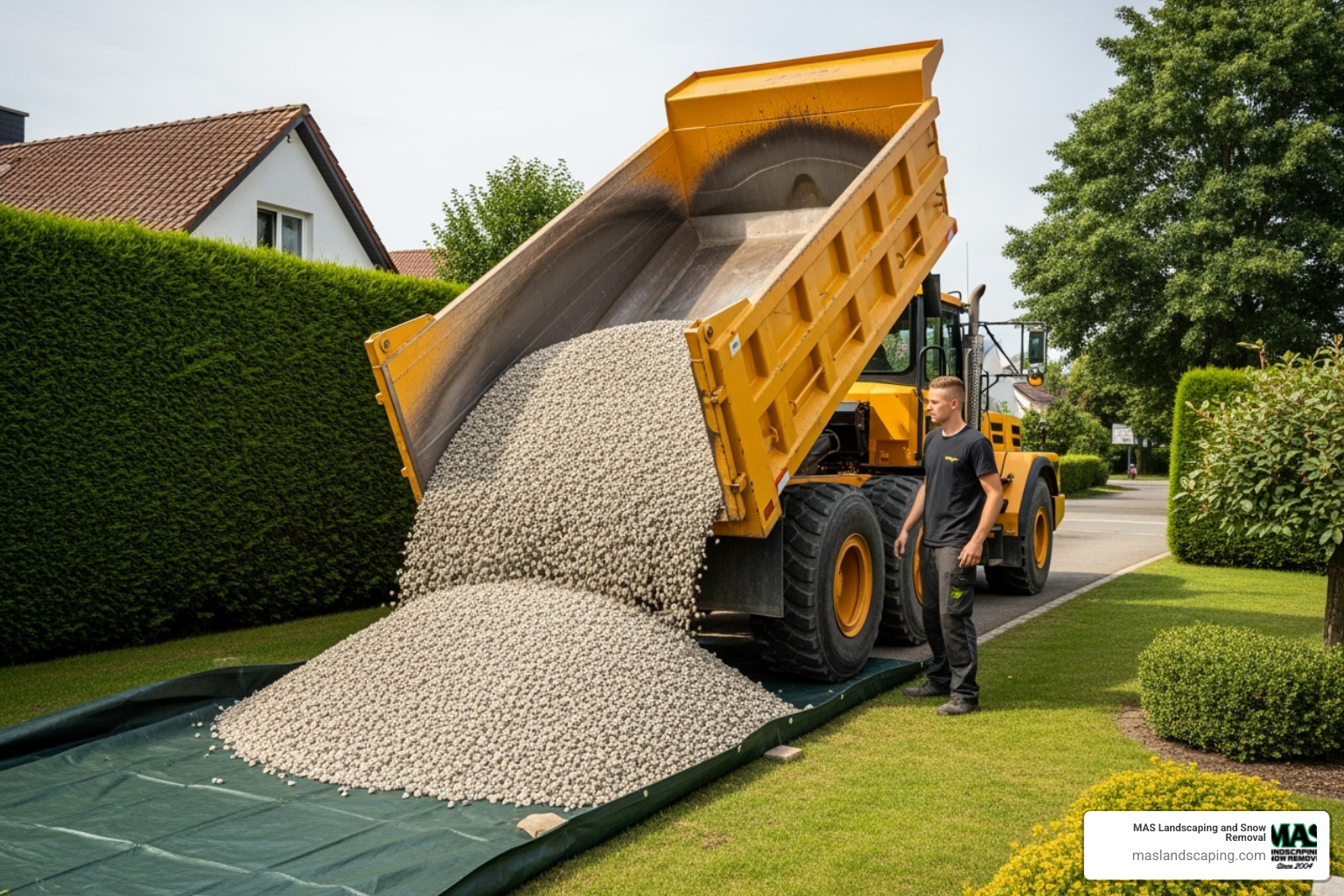
- Lay Down a Tarp: Placing a large, heavy-duty tarp on the drop spot is a pro tip. It makes cleanup significantly easier, prevents the bottom layer of your stone from mixing with dirt and grass, and protects your driveway surface from potential scratches.
- Communicate with the Supplier: When you place your order, inform the dispatcher of any potential challenges: a narrow street, a tight turn into the driveway, a steep slope, or a low-hanging wire. The more information they have, the better they can plan the delivery.
Delivery Vehicles & Methods
- Standard Dump Trucks: These are the most common vehicles, delivering 1–15 cubic yards of loose stone.
- Tri-Axle Dump Trucks: For large-scale projects, these trucks can haul up to 22 tons (approximately 15–18 cubic yards of dense stone), offering a lower cost-per-yard for big orders.
- Flatbeds with Forklifts: Palletized materials like pavers, wall stone, and flagstone are delivered on a flatbed truck, often equipped with a portable forklift (like a Moffett) that can drive the pallets to a convenient spot on your property. These forklifts still require a solid, relatively flat surface to operate.
- Hiab Crane Trucks: For precise placement of large boulders or super sacks of material, some suppliers offer trucks with a knuckle boom crane, though this service comes at a premium.
Typical Residential Challenges
Even with perfect planning, some properties present unavoidable challenges. Narrow driveways, cul-de-sacs, sharp turns, very steep grades, or local roads with weight restrictions may make it impossible for a large truck to access your property. In these cases, the driver will be forced to make a curbside delivery, leaving the material on the street at the edge of your property. The driver always makes the final call based on safety. It’s far better to have to wheelbarrow the stone a little farther than to have an 18-ton truck stuck in your lawn or damaging your property.
Need pro coordination? Our Hardscape Contractors can manage the entire process, from ordering to placement, ensuring everything goes off without a hitch.
Understanding Stone Delivery Costs and Policies
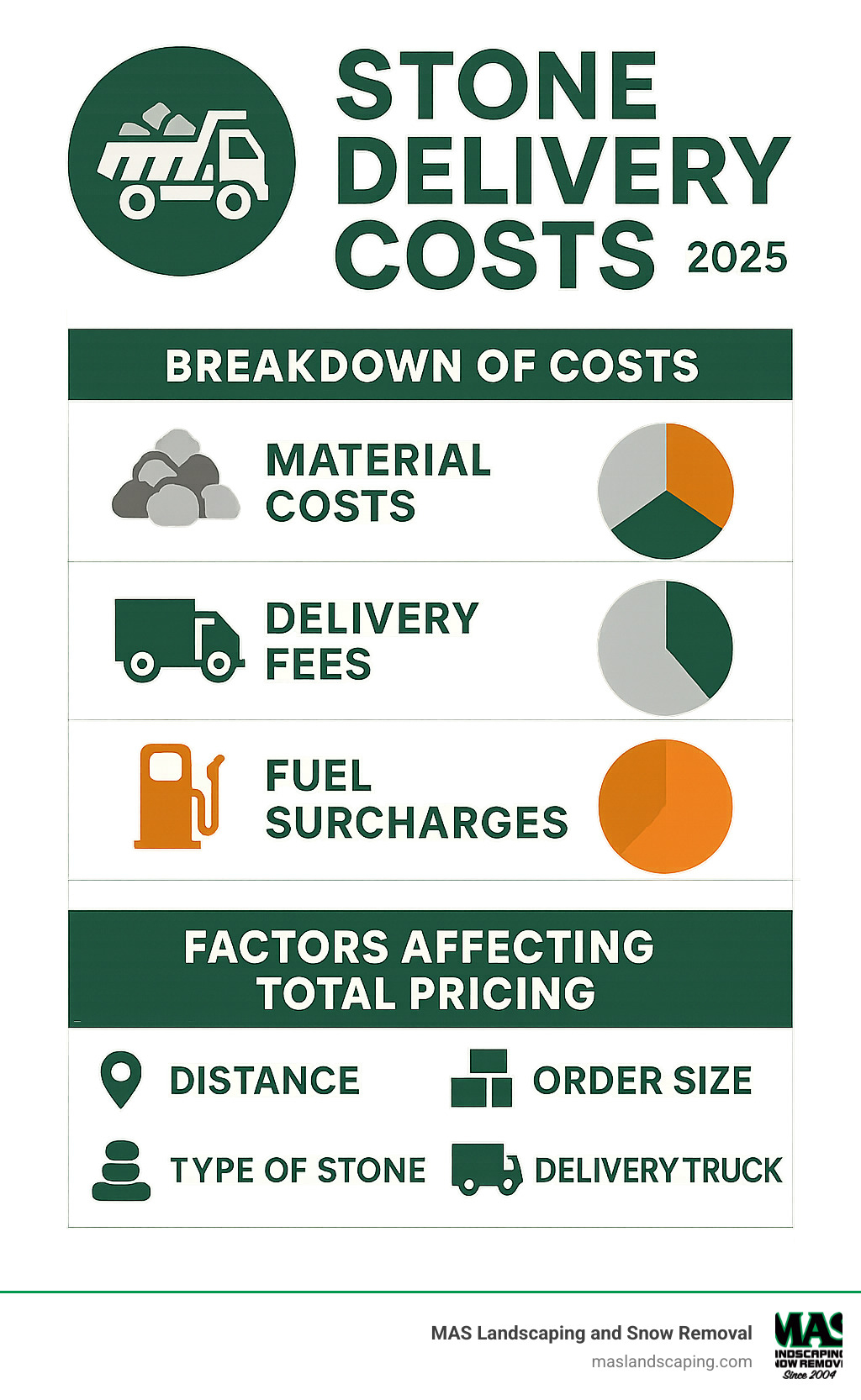
Budgeting for your project requires understanding the full cost of getting stone to your site. The price tag on the material itself is only one part of the equation. Delivery fees, fuel surcharges, and other potential charges can significantly impact the final bill, especially for smaller orders or locations far from the supply yard.
Breakdown of Costs
- Material Price: This is the cost per cubic yard or per ton of the stone itself. Prices vary widely based on the type of stone (common gravel vs. rare decorative rock), the amount of processing required, and its origin. Local stone is generally less expensive than stone that has to be transported from distant quarries.
- Delivery Fee: This fee covers the transportation of the material to your property. It’s often calculated based on zones or mileage from the supplier. Many companies offer free or discounted delivery for large orders (e.g., a full tri-axle load) within a certain radius.
- Fuel Surcharge: Due to fluctuating fuel prices, many suppliers add a separate fuel surcharge to each delivery. This is a variable cost that you should ask about when ordering.
Average Price Ranges (internet data, not MAS Landscaping rates)
- Crushed gravel: $45 – $150 per yd³
- Decorative river rock: $90 – $450 per yd³
- Boulders: $100 – $1,500 each (depending on size, type, and rarity)
- Tri-axle load (22 tons): $400 – $2,500+
Generally, placing a single large order is more economical than multiple small orders. The cost-per-yard for small quantities (under 3-5 yd³) is often higher, and a standard delivery fee will apply, making it less efficient.
Returns & Failed Deliveries: Costly Mistakes
It’s crucial to get your order and delivery plan right the first time, as mistakes are costly.
- Returns: Once bulk stone like gravel or sand is dumped on your property, it is considered non-returnable. It cannot be reloaded without contamination. Palletized stone (like pavers) can sometimes be returned if it’s unopened and in perfect condition, but you will almost certainly face a significant restocking fee (typically 15–25%) plus the cost of return freight.
- Failed Deliveries: If a truck arrives at your property and cannot safely deliver the material because the drop site is blocked, inaccessible, or unsafe, you will be charged a failed delivery fee. This fee, often ranging from $75 to $200, covers the driver’s time and fuel for the wasted trip. This is why clear communication and property preparation are so important. Double-check every detail before confirming your order.
Frequently Asked Questions about Stone Delivery
Can the delivery truck dump stone in my backyard?
In most cases, the answer is no. Residential lawns, especially when wet, are too soft to support the weight of a multi-ton loaded truck. Attempting to drive on the lawn risks creating deep ruts, damaging irrigation systems, and potentially cracking underground septic tanks or utility lines. Drivers will always prioritize safety and property preservation, which usually means sticking to the driveway. Plan on driveway delivery and be prepared to move the material to the backyard using a wheelbarrow or small power equipment.
How much stone can be delivered at once?
This depends on the supplier’s fleet. Small, single-axle dump trucks can typically handle 1 to 5 cubic yards, making them suitable for smaller projects. For large projects like driveways or foundations, suppliers use large tri-axle dump trucks that can carry up to 22 tons, which translates to roughly 15-18 cubic yards of a dense material like crushed stone. Ordering a full truckload is often the most cost-effective way to purchase materials.
Do I need to be home for the delivery?
It is strongly recommended that you or another responsible adult be present for the delivery. This allows you to confirm it’s the correct material and quantity, and most importantly, to show the driver the exact drop spot and discuss any potential obstacles. If you absolutely cannot be there, you must mark the drop zone very clearly (e.g., with a tarp, cones, or stakes) and be reachable by phone. If the driver cannot reach you with a question, they may be forced to make a judgment call or cancel the delivery, which could result in extra fees.
Can the driver spread the stone with the truck?
This is a common request, but it’s generally not feasible. A skilled driver might be able to perform a “tailgate spread” by moving the truck forward as the bed is raised, but this is an imprecise method that is not a substitute for proper spreading and grading with landscaping equipment. Delivery service covers dropping the pile in one location; spreading is part of the installation work.
What’s the difference between “clean” and “modified” stone?
“Clean” stone has been screened and/or washed to remove all the fine particles, sand, and dust (known as “fines”). This allows water to flow through it easily, making it essential for drainage applications. “Modified” stone (like 2A Modified) is an unscreened mix of various-sized crushed stone and fines. The fines act as a binder, allowing the material to be tightly compacted into a stable, solid base, which is why it’s used for foundations and sub-bases.
Your Local Partner for Landscaping Success

Every property, from the historic homes in Melrose to the suburban lots in Lynnfield, presents unique access challenges, soil conditions, and design opportunities. True landscaping success comes from partnering with a team that possesses deep local knowledge. At MAS Landscaping, we understand the specific considerations for properties throughout the Saugus, Malden, and Everett areas. We don’t just drop off rocks; we provide a comprehensive service that matches the right stone, the most appropriate delivery method, and a flawless installation plan to your specific project goals.
Changing your outdoor space begins with a solid foundation. We are committed to ensuring that the first step of your project—getting the materials on-site—is as smooth and stress-free as possible.
Ready to bring your vision to life? Browse our Gallery Hardscaping Photos for inspiration, then explore our Bulk Landscaping Materials page to view our selection. When you’re ready to plan your project, reach out to us through our website for a personalized consultation and quote. Let’s build something beautiful together.