




Why a Sloped Yard Doesn’t Have to Mean a Big Bill
If you’re exploring retaining wall ideas on a budget, here are the most affordable options to consider:
- Concrete blocks – stackable, widely available, easy DIY install
- Pressure-treated timber – beginner-friendly, rustic look, low upfront cost
- Gabion baskets – wire cages filled with local rock, great drainage
- Salvaged/reclaimed materials – reclaimed brick, broken concrete, free stone
- Poured concrete – cheapest by material cost, best for simple gravity walls
A sloped yard is both a challenge and an opportunity. Without the right structure, you get erosion, runoff, and an unusable patch of ground. With one, you get defined garden beds, usable outdoor space, and real curb appeal.
The good news? A solid retaining wall doesn’t require a contractor’s budget.
DIY-friendly materials like concrete blocks and landscape timbers put a functional, attractive wall within reach for most homeowners. And with the right planning — especially for drainage and base prep — a budget wall can last decades.
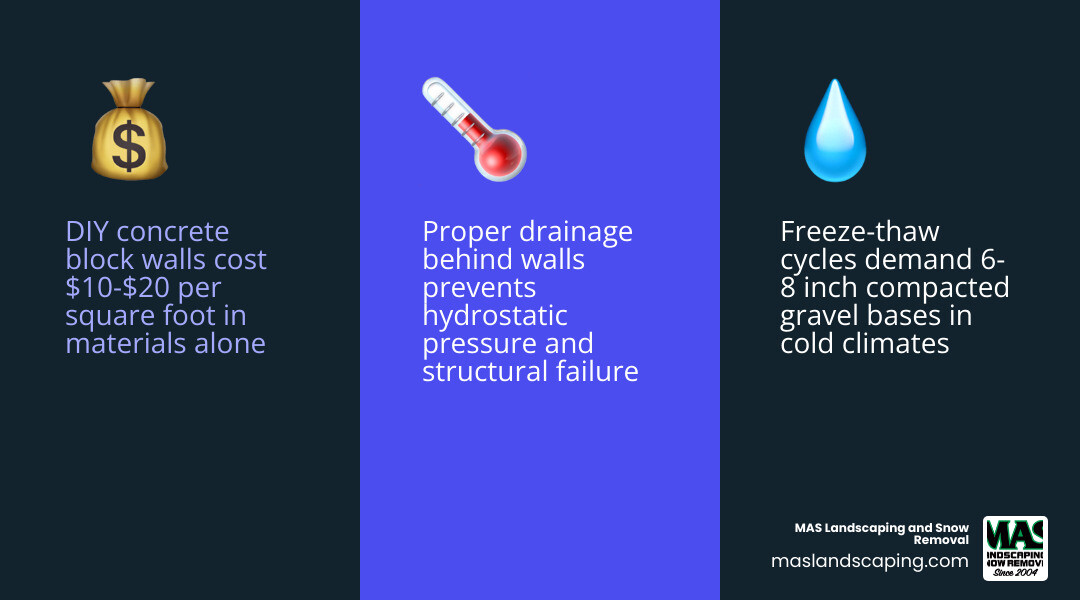
For Greater Boston homeowners, there’s an extra layer to think about. Freeze-thaw cycles are hard on landscape structures. The materials you choose and how you build the base matter more here than almost anywhere else in the country.
This guide covers 15 practical retaining wall ideas across a range of budgets, the best materials for cold climates, step-by-step building basics, and how to find low-cost or even free materials near you.
15 Retaining Wall Ideas on a Budget for Every Yard
Not every yard needs a massive engineered wall. In many Essex County and Middlesex County properties, a series of lower-cost, lower-height walls does the job better and keeps the project manageable.
Here are 15 ideas we recommend most often when homeowners want function first and frills second.
- Basic interlocking concrete block wall
- Plain-faced concrete garden wall with cap
- Pressure-treated timber terrace
- Stepped timber wall for a hillside
- Simple gabion wall with local stone
- Gabion-and-wood bench wall
- Reclaimed brick retaining edge
- Broken concrete “urbanite” wall
- Salvaged block wall from leftover pallets
- Tiered garden retaining wall
- Low wall with built-in planter pockets
- Retaining wall with bench seating
- Wall that frames a fire pit or patio edge
- Wall integrated with steps
- Driveway border retaining wall

Concrete block retaining wall ideas on a budget
Concrete blocks are usually the easiest place to start. They are widely available, simple to lay out, and many are designed to lock together with a built-in setback. That makes them one of the best DIY-friendly choices for homeowners who want a clean look without fancy masonry skills.
Budget-friendly ideas include:
- A straight garden terrace wall
- A curved planting bed border
- A low wall around a patio
- A split-face block wall with simple caps
- A two-tier front yard wall with mulch beds between levels
Concrete block systems are popular because they balance affordability, strength, and appearance. Research shows DIY gravity walls with concrete blocks often fall into a reasonable material-only range per face square foot, while professional installation is much higher. If you want a deeper breakdown, here is More info about Retaining Wall Cost.
Best for:
- Walls under about 3 feet for experienced DIYers
- Front yard terracing
- Straight or gently curved layouts
- Homeowners who want low maintenance
Timber retaining wall ideas on a budget
Pressure-treated timber has a warm, natural look and is often the most beginner-friendly option. It works especially well for garden terraces, backyard slopes, and raised planting beds.
Good budget uses include:
- Short terraced walls on a gentle slope
- Raised bed retaining walls around patios
- Stepped timber walls that follow the yard grade
- Rustic borders around a play area or garden path
For our local climate, the treatment rating matters. In Greater Boston freeze-thaw conditions, wood in ground contact needs to be rated for that use. Better lumber costs more up front, but bargain wood that rots early is not actually a bargain. Funny how the cheapest board in the store can become the most expensive one in your yard.
Pros:
- Lower upfront material cost
- Easy to cut and fasten
- Great for rustic and casual landscapes
Cons:
- Shorter lifespan than block or stone
- Needs more maintenance
- More vulnerable to moisture and rot
Gabion retaining wall ideas on a budget
Gabion walls use wire cages filled with stone or recycled fill. They are one of the smartest choices for wet sites because they naturally let water pass through instead of trapping it behind the wall.
Affordable gabion ideas include:
- A low wall with fieldstone fill
- A modern wall filled with mixed local rock
- A gabion planter border
- A gabion base with a timber seat cap
- A driveway-side erosion control wall
Gabions are especially helpful in yards with poor drainage, washout areas, or a modern design style.

Reclaimed and salvaged material walls
If your goal is lowest possible cost, salvaged materials can be the winner. Reclaimed brick, leftover retaining wall blocks, broken concrete slabs, and free stone from local listings can all cut costs dramatically.
Popular options include:
- Broken concrete stacked as “urbanite”
- Leftover concrete blocks from online marketplace listings
- Reclaimed brick for short decorative retaining edges
- Free fieldstone from excavation leftovers
- Salvaged timbers for rustic garden terraces
This is also one of the best ways to create character on a budget. No two reclaimed walls look exactly alike, which is part of the charm.
For inspiration, see Retaining Wall Too Expensive? 5 Cheap Retaining Wall Ideas , 21 Retaining Wall Ideas Using Affordable Materials , and 24 Inexpensive Retaining Wall Ideas for Budget Yards – Too Much Time .
Tiered retaining walls for steep slopes
For steeper yards, several short walls are often more practical than one tall one. That is because lower walls handle less soil pressure, are easier to build, and usually require less complicated planning.
Tiered wall benefits:
- Better stability
- More planting space
- Easier drainage management
- Safer DIY construction for small projects
- Cleaner look on a steep yard
Research-backed best practice is to leave enough horizontal space between tiers so each one behaves independently. In simple terms: do not stack them too close together and expect them to mind their own business.
Multi-purpose walls that save money
The cheapest wall is often the one doing two jobs.
Ideas we like:
- Retaining wall plus bench seating
- Retaining wall plus raised planter
- Retaining wall plus steps
- Retaining wall plus patio edge
- Retaining wall plus driveway border
These combinations can reduce the need for extra hardscape features elsewhere in the yard. For more visual ideas, check out 5 DIY Retaining Wall Ideas That Are Budget-Friendly , 15 Budget-Friendly Retaining Wall Ideas to Refresh Your Yard , and 11 Beautiful and Affordable Ideas for Retaining Walls – Lowe’s .
Cheapest Materials and How to Choose the Right One
Choosing the right wall material is not just about price. We also need to think about lifespan, drainage, appearance, maintenance, and whether the material fits the slope and soil.
What is the cheapest retaining wall material?
By raw material cost alone, poured concrete is often cited as the cheapest retaining wall type. Pressure-treated pine is usually next among common residential options. But in the real world, the true cheapest wall is usually the one built from salvaged or free materials.
That said, low sticker price does not always mean low total cost. Forming and pouring concrete can be difficult for DIY work. Salvaged materials may be free but require lots of sorting, hauling, and cleaning. Timber may be affordable at the start but usually will not last as long as block.
Average internet data in the research also shows a clear gap between DIY and professional work, with DIY block walls often much cheaper in material cost alone than full installation. If you want more detail, see More info about A Z Guide to Retaining Wall Cost.
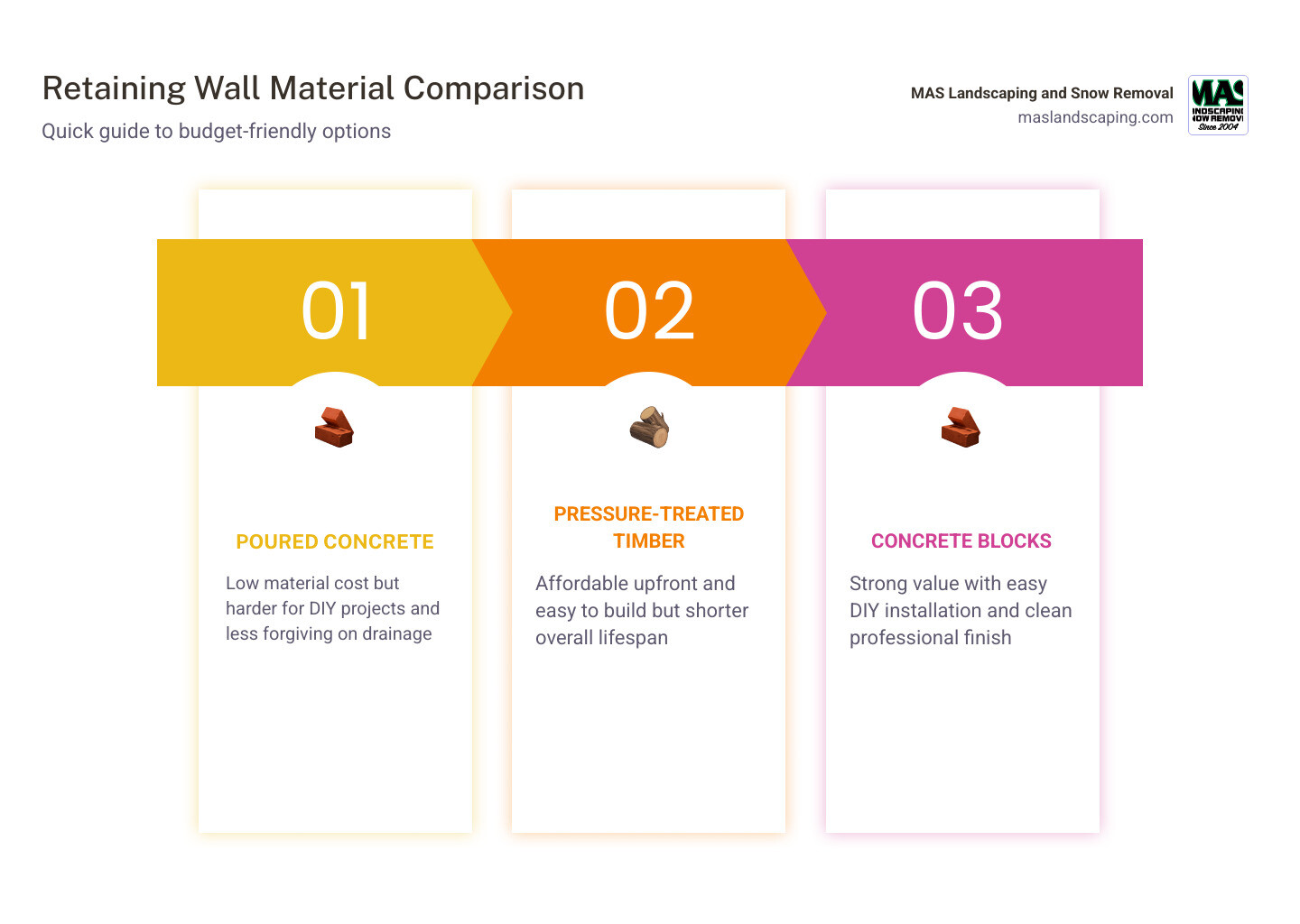
Quick comparison:
- Poured concrete: low material cost, harder DIY, less forgiving
- Pressure-treated timber: affordable, easy to build, shorter lifespan
- Concrete blocks: strong value, easy DIY, clean finish
- Gabions: good for drainage, fill can be cheap, cage cost varies
- Salvaged materials: cheapest when sourced free, more labor-intensive
Pros and cons of timber vs concrete blocks vs gabions
Timber
Pros:
- Usually affordable
- Simple tools and installation
- Natural, softer appearance
Cons:
- Can rot over time
- More maintenance
- Shorter lifespan in wet or freeze-thaw conditions
Concrete blocks
Pros:
- Durable
- Easy to find
- Many systems are designed for DIY
- Individual units are repairable
Cons:
- Can look plain without caps or planting
- Heavy to move
- Still needs proper base and drainage
Gabions
Pros:
- Excellent drainage
- Strong visual texture
- Can use local stone or recycled fill
- Flexible for modern or rustic designs
Cons:
- Wire quality matters
- May not fit every home’s style
- Filling baskets is labor-heavy
For walls that need to survive New England winters with less fuss, concrete blocks and gabions usually beat timber on long-term maintenance.
How to choose for slope, soil, and yard use
Use the site conditions to guide the material.
Choose concrete blocks when:
- The slope is moderate
- You want a tidy look
- You need a dependable DIY system
- The wall borders a patio, walkway, or front yard bed
Choose timber when:
- The wall is short
- The look is rustic or natural
- You want the simplest beginner project
- Drainage is manageable and the area is not constantly wet
Choose gabions when:
- The soil stays wet
- Drainage is poor
- The area gets runoff
- You want a permeable wall
Choose tiered layouts when:
- The slope is steep
- One tall wall would feel bulky
- You want planting pockets between levels
Be more cautious with any DIY wall if:
- The wall is near a driveway with vehicle loads
- The wall height increases beyond typical DIY-friendly limits
- The site has active erosion, poor base soils, or heavy runoff
How to Build a Budget-Friendly DIY Retaining Wall That Lasts
A cheap wall that fails in two winters is not a deal. The basics matter more than the material.
Step-by-step retaining wall ideas on a budget for DIYers
For a small gravity wall, the process usually looks like this:
- Plan the layout
- Mark the wall with paint, stakes, or a garden hose for curves.
- Measure height and length carefully.
- Keep most DIY projects under about 3 feet unless you have advanced experience and local rules allow it.
- Dig the trench
- Excavate for the buried first course and base.
- In many small walls, a compacted base of about 6 to 8 inches is common.
- Add base stone
- Use clean, angular gravel or stone.
- Compact it in thin lifts.
- This step is boring, but it is where the wall earns its future.
- Set the first course
- Get the first row perfectly level front-to-back and side-to-side.
- Bury part of the first course for stability.
- Stack with staggered joints
- Offset the joints so they do not line up vertically.
- Follow the block or timber system’s recommended setback or batter.
- Backfill as you go
- Add clean drainage stone behind the wall.
- Do not trap wet soil right against the back of the wall.
- Add caps or finish boards
- Glue caps where appropriate, especially in freeze-thaw areas.
- Finish the top cleanly so water sheds away from the wall.
For related reading, see Cheap Retaining Wall Ideas, Cheap Retaining Wall Tips, and Affordable Garden Walls.
Drainage basics on a budget
Drainage is not optional. Water buildup behind a wall creates hydrostatic pressure, and that pressure is one of the main reasons retaining walls lean, bulge, or fail.
A budget-friendly drainage setup often includes:
- A 4-inch perforated pipe at the base
- Clean stone backfill behind the wall
- Landscape fabric separating soil from stone
- A slight slope on the pipe toward daylight or an outlet
- Weep holes where the wall type needs them
This is one place where trying to save a few dollars can cost a lot more later. Gravel and pipe are cheaper than rebuilding.
Key safety and structural rules before you build
Before you start, remember these basics:
- Check local permit rules before building
- In many municipalities, walls over 4 feet require permits, and some may have stricter thresholds
- Call before digging so utilities can be marked
- Wear gloves, eye protection, and proper boots
- Get help with heavy lifting
- Batter the wall slightly back into the slope when the system requires it
- Be cautious near foundations, driveways, and property lines
For our service area around Saugus, Lynnfield, Everett, Malden, and nearby communities, local code review matters. Rules can vary by municipality, and taller walls may need engineering.
How to Find Free or Low-Cost Materials and Estimate Total Cost
Budget projects are won or lost in the sourcing phase.
Where to source free or discounted wall materials
Good places to look include:
- Online marketplace listings for leftover block pallets
- Local buy nothing groups
- Habitat ReStore locations
- Demolition or renovation leftovers
- Excavation surplus stone
- Curb alerts for brick, stone, or timbers
- Contractor leftovers from overordered jobs
- Local quarries for simpler, lower-cost stone choices
Be selective. Free materials are only free if they are usable, safe, and worth hauling.
Low-cost source checklist:
- Inspect for cracks, rot, or rust
- Confirm dimensions match across batches
- Avoid contaminated or questionable railroad materials
- Estimate transport weight before you volunteer your suspension for sacrifice
How to estimate total project cost without surprises
Start with face square footage:
- Wall length x wall height = face square footage
Then add all supporting materials:
- Base gravel
- Drainage stone
- Drainpipe
- Landscape fabric
- Caps or top finish
- Adhesive if needed
- Fasteners or spikes for timber
- Tool rental
- Delivery or hauling
- Disposal of spoil
- About 10 percent extra material for waste and mistakes
That last item is important. Several sources recommend buying extra to cover cuts, breakage, and future repairs.
For a fuller breakdown, see More info about Building a Small Retaining Wall Without Breaking the Bank What You Need to Know About Costs.
Average retaining wall price ranges in 2026
Based on average internet data in the research, small DIY gravity block walls often fall in a much lower material range than professionally installed walls. Installed retaining walls in Massachusetts can vary widely depending on material, access, drainage needs, and height. Total residential projects can range from modest garden walls to major slope-stabilization work.
Important note: these are general market averages from internet research, not pricing for MAS Landscaping and Snow Removal.
Research also suggests that hardscape improvements such as retaining walls can return up to 80 percent of their cost in resale value, which helps explain why many homeowners see them as both a repair and an upgrade.
For more cost reading, visit Cost for Concrete Retaining Wall, Concrete Retaining Wall Cost Guide, and Cost to Build Block Wall Fence.
Maintenance Tips for Inexpensive Retaining Walls
Even the best low-cost wall needs occasional checkups.
Low-maintenance retaining wall ideas on a budget
If you want less upkeep, focus on:
- Concrete block walls
- Gabion walls
- Dry-stack stone walls
- Walls with clean gravel drainage zones
- Walls with durable caps and minimal exposed wood
These materials generally need less routine treatment than timber and are easier to keep stable if drainage is done correctly.
Material-specific maintenance by wall type
Timber walls
- Inspect yearly for rot, splitting, and fastener movement
- Re-seal or retreat exposed wood as needed
- Keep mulch and soil from staying piled against exposed faces
Concrete block walls
- Check for shifting, bulging, or separated caps
- Reset loose units early before movement spreads
- Keep drainage outlets clear
Gabion walls
- Inspect wire baskets for corrosion or damage
- Check for settlement in the fill
- Remove vines or roots that may distort the cages if needed
All wall types
- Clear leaves and debris from drainage exits
- Watch for new leaning after winter
- Repair small issues early
- Keep aggressive roots from pushing into the wall system
Frequently Asked Questions About Retaining Wall Ideas on a Budget
Do you really need drainage behind a small retaining wall?
Yes. Even a small wall can fail if water builds up behind it. The most budget-friendly protection is simple: clean stone backfill, fabric separation, and a perforated drainpipe when needed. A good wall is a water manager first and a garden feature second.
Is DIY cheaper than hiring a pro for a retaining wall?
Often yes, especially for small walls using concrete blocks or timber. Sweat equity saves money. But DIY is not automatically cheaper if you misjudge drainage, buy the wrong materials, rent too many tools, or have to rebuild a leaning wall. For larger, taller, or more complicated walls, professional installation can save money in the long run.
If you are weighing that option, see Retaining Wall Builders Near Me.
Are tiered walls cheaper than one tall wall?
They often can be, especially on steep yards. Tiered walls reduce the pressure on each wall, simplify construction, create planting space, and often avoid the visual heaviness of one large structure. They can also be phased over time if you want to spread the budget out.
Conclusion
The best retaining wall ideas on a budget are the ones that match your yard, your drainage conditions, and your skill level. For some homeowners, that means a simple concrete block terrace. For others, it means timber beds, gabions with local stone, or a clever reclaimed-material wall that costs more sweat than cash.
Around Saugus and the surrounding Essex County and Middlesex County communities, we always recommend planning with winter in mind. Freeze-thaw cycles, runoff, and drainage details can make or break a budget wall.
If you want help designing a retaining wall that looks good, works hard, and fits your property, explore our retaining wall services. You can also browse more visual inspiration with Retaining wall design inspiration.
For homeowners looking beyond the wall itself, we also offer support with landscaping services, landscape design, patio installation, and retaining wall installation.
If you are ready to turn a difficult slope into usable outdoor space, contact us and we will help you plan the smartest next step.
