

What Is the Average Cost of a Yard Sprinkler System in 2026?
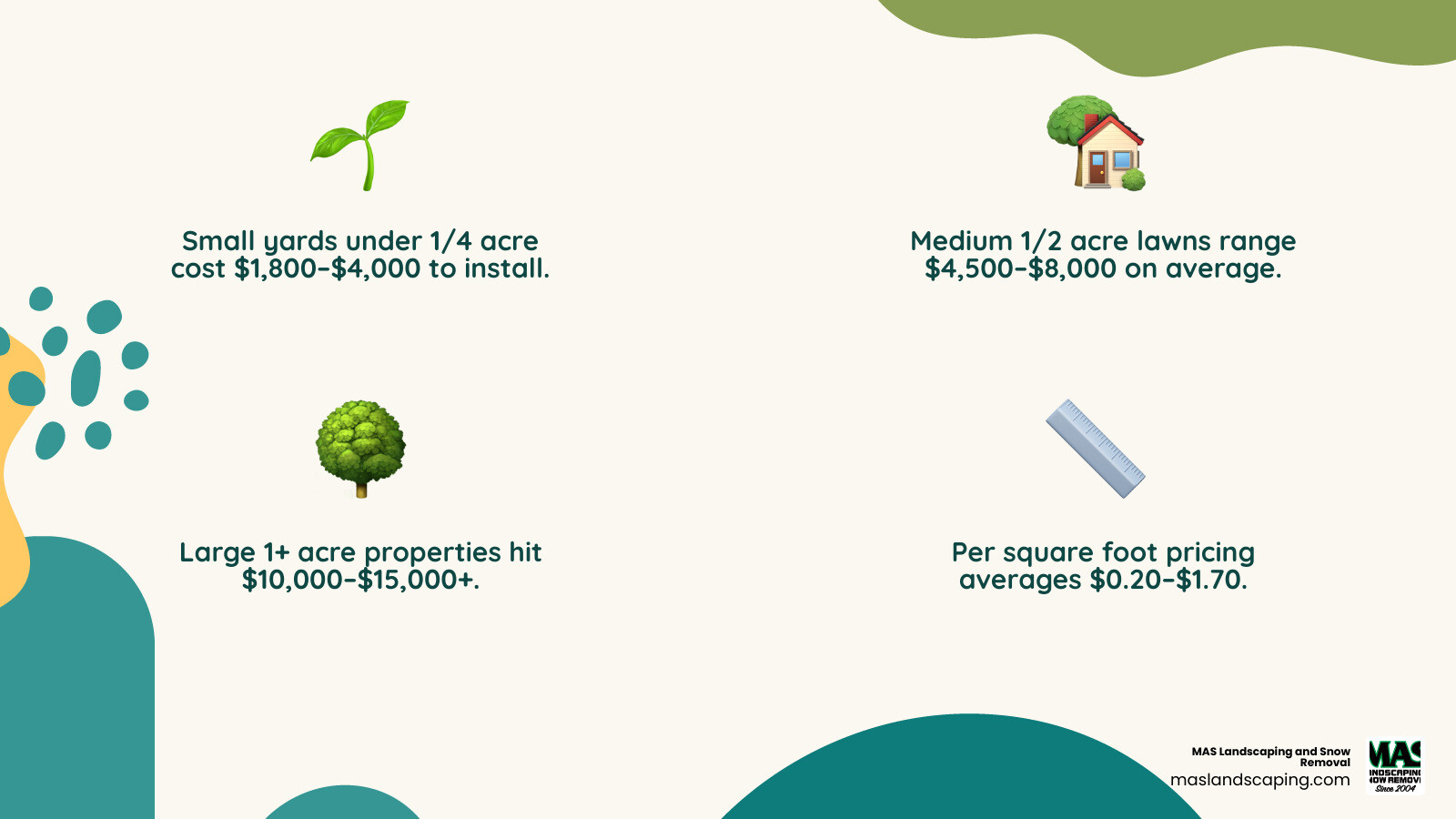
The average cost of a yard sprinkler system can range quite a bit depending on your lawn size, location, and the type of system you choose. Here’s a quick snapshot to answer the most common question right away:
| Yard Size | Typical Cost Range |
|---|---|
| Small (under 1/4 acre) | $1,800 – $4,000 |
| Medium (1/2 acre) | $4,500 – $8,000 |
| Large (1 acre+) | $10,000 – $15,000+ |
| Per square foot | $0.20 – $1.70 |
Note: These are average costs based on national internet data and do not reflect actual pricing from MAS Landscaping and Snow Removal. Your local costs in the Greater Boston area may vary.
Most homeowners spend somewhere around $2,500 to $5,500 for a professionally installed system on a small to medium-sized lawn. But that number can swing dramatically — a basic above-ground setup might cost just a few hundred dollars, while a full in-ground automatic system with smart controls on a larger property can push well past $15,000.
If you’re a homeowner in the Saugus or Greater Boston area, you already know that outdoor conditions here — from clay-heavy soil to freeze-thaw winters — add their own wrinkles to the equation. Getting the right system installed the right way matters a lot in this climate.
This guide walks you through everything: system types, yard size costs, zones, components, labor, and long-term maintenance. Whether you’re budgeting for the first time or comparing quotes, you’ll leave with a clear picture.
Breaking Down the Average Cost of a Yard Sprinkler System
When we look at the How Much Does Sprinkler System Installation Cost? [2026 Data] | Angi , it becomes clear that “average” is a relative term. Nationally, the typical residential sprinkler system installation lands around $2,540, but the broad range spans from $1,638 to $3,581 for basic setups. However, for those of us in the Northeast, particularly in areas like Lynnfield or Reading, MA, labor and material costs often trend higher than the national baseline.
One of the most accurate ways to estimate your budget is by looking at the square footage of your yard. On average, you can expect to pay between $0.20 and $1.00 per square foot for the coverage area, though some premium in-ground installations can reach up to $1.70 per square foot. It is important to remember that these figures are based on broad internet data and not specific MAS Landscaping quotes.
Labor is the “silent partner” in your bill, often accounting for about 60% of the total project cost. This is because installing a system isn’t just about the parts; it’s about the hours spent trenching, mapping out water pressure, and ensuring every corner of your lawn gets the hydration it needs without flooding your neighbor’s driveway.
Factors Affecting the Average Cost of a Yard Sprinkler System by Lawn Size
Yard size is the most significant driver of your total investment. As the acreage increases, so does the amount of piping, the number of sprinkler heads, and the complexity of the zone management.
Based on our research into the Cost Of New Lawn Irrigation System Installation, here is how those costs typically scale:
- 1/4 Acre (approx. 10,890 sq. ft.): $1,800 – $4,000. This is the standard size for many homes in Saugus or Melrose.
- 1/2 Acre (approx. 21,780 sq. ft.): $4,500 – $13,500. As you double the size, the number of zones usually increases significantly to maintain water pressure.
- 1 Acre (approx. 43,560 sq. ft.): $10,000 – $30,000+. For larger properties in areas like Boxford or Middleton, the system becomes a major infrastructure project.
Interestingly, the cost per square foot often decreases slightly as the yard gets larger. For a tiny 5,000-square-foot lawn, you might pay $0.45 per square foot, whereas for a property over 10,000 square feet, that might drop closer to $0.30 because the fixed costs (like the controller and the main water connection) are spread over a larger area.
System Types and the Average Cost of a Yard Sprinkler System
Not all watering systems are created equal. The Sprinkler System Cost Guide: Pricing by Yard Size highlights several different technologies that can impact your final bill:
- In-Ground Systems ($1,740 – $5,500+): These are the gold standard. Pipes are buried 8 to 12 inches underground, and heads pop up only when the water is running. They are durable, add the most value to your home, and are the most common choice for our clients in the North Shore.
- Drip Irrigation ($450 – $1,500+): Instead of spraying water into the air, drip systems deliver it directly to the roots of your plants through a network of low-pressure tubes. This is incredibly efficient for flower beds and vegetable gardens. A quarter-acre drip system typically costs between $450 and $1,350.
- Automatic Systems ($1,800 – $6,000+): Most modern in-ground systems are automatic, meaning they use a programmable controller to water your lawn on a schedule. This eliminates the “I forgot to turn off the hose” water bill spike.
- Above-Ground Kits ($50 – $500): These are essentially fancy hoses and tripod sprinklers. While they are the cheapest option, they aren’t permanent, they can be an eyesore, and they don’t provide the uniform coverage needed for a truly lush lawn.
Key Factors Influencing Your Installation Estimate
If you’ve ever tried to dig a hole in Essex County, you know that our soil isn’t always “user-friendly.” This is one of the biggest reasons why the average cost of a yard sprinkler system fluctuates. According to the Cost to Install a Sprinkler System – 2025 Price Guide , several site-specific factors can drive prices up or down.
- Soil Type: Sand is easy to trench. Clay and rocks? Not so much. In many of our service areas like Danvers and Peabody, rocky soil can increase trenching costs by 10% or more because it requires specialized equipment.
- Terrain and Slope: If your yard looks like a mini-mountain range, your system will need more “muscle.” Sloped yards often require check valves to prevent water from pooling at the bottom of the hill and specialized heads to ensure even coverage.
- Municipal Permits: Most towns in Middlesex and Essex County require a permit for irrigation installation, which can range from $35 to $200.
- Backflow Preventers: This is a non-negotiable safety feature that prevents irrigation water (which might contain fertilizer or lawn chemicals) from flowing back into your home’s drinking water. These units typically cost between $100 and $600.

Irrigation Zones and Coverage Requirements
Think of your yard as a collection of different neighborhoods. Your sun-drenched front lawn has different needs than the shady patch under your oak trees. This is where “hydrozoning” comes in.
As explained in How To Master Your Yard With A 4 Zone Sprinkler System Kit, a zone is a group of sprinkler heads controlled by a single valve. Most average-sized lawns need between 3 and 6 zones.
- One Zone Cost: $500 – $1,500.
- Additional Zones: Usually about $1,000 each.
The number of zones you need is determined by your water pressure. If you try to put too many heads on one zone, the water will just “burp” out of the heads instead of spraying. Professionals calculate your “Gallons Per Minute” (GPM) to ensure each zone has exactly the right amount of pressure to reach every blade of grass.
Sprinkler Head Varieties and Component Costs
The “business end” of your system — the sprinkler head — comes in several varieties, each with a different price point:
- Pop-Up Heads ($6.50 – $20 each): These stay flush with the ground until the water starts flowing. They are great for small lawn areas.
- Rotary Heads ($15 – $45 each): These deliver a slow, steady stream of water that rotates. They are much more efficient for larger areas and help prevent runoff.
- Impact Sprinklers ($20 – $60 each): The classic “chk-chk-chk” sprinklers. These are durable and can cover huge distances, making them ideal for very large lots.
Beyond the heads, you have the “brain” of the system. A basic manual timer might only cost $10 to $50, but a high-end smart Wi-Fi controller can range from $125 to $500+. These smart controllers are worth the investment; they connect to local weather stations and automatically skip a watering cycle if rain is in the forecast, potentially saving you 20% on your water bill.
Professional vs. DIY: Is the Investment Worth It?
We get it — the “Do It Yourself” spirit is strong in New England. You might see a DIY sprinkler kit at a big-box store and think, “How hard can it be?” While a DIY approach can save you roughly 30% to 40% on labor costs, it comes with significant risks.
The Lawn Sprinkler System Cost: What to Expect – Bob Vila notes that professional installation is usually the smarter long-term play for several reasons:
- Utility Safety: Before we dig, we coordinate with “Dig Safe” (811) to ensure we don’t hit gas lines, electric cables, or fiber optic internet. A DIY mistake here can be incredibly dangerous and expensive.
- Design Efficiency: A pro knows how to overlap spray patterns (called “head-to-head coverage”) so you don’t end up with yellow “donuts” of dead grass in your yard.
- Warranty and Longevity: Professional systems often come with warranties on both parts and labor. Plus, a pro-installed system can last 20 years or more, whereas a DIY kit often needs major repairs within 5 years.
One of the best arguments for professional installation is the Return on Investment (ROI). A healthy, green lawn significantly boosts curb appeal. According to the National Association of Realtors, a well-maintained sprinkler system can offer an ROI of up to 86% when it comes time to sell your home.
Ongoing Maintenance and Hidden Expenses
The average cost of a yard sprinkler system doesn’t end on installation day. To keep your lawn looking like a golf course, you need to budget for annual upkeep.
In our neck of the woods — from Saugus to Andover — the most critical maintenance task is winterization. If water stays in your pipes when the ground freezes, those pipes will burst.
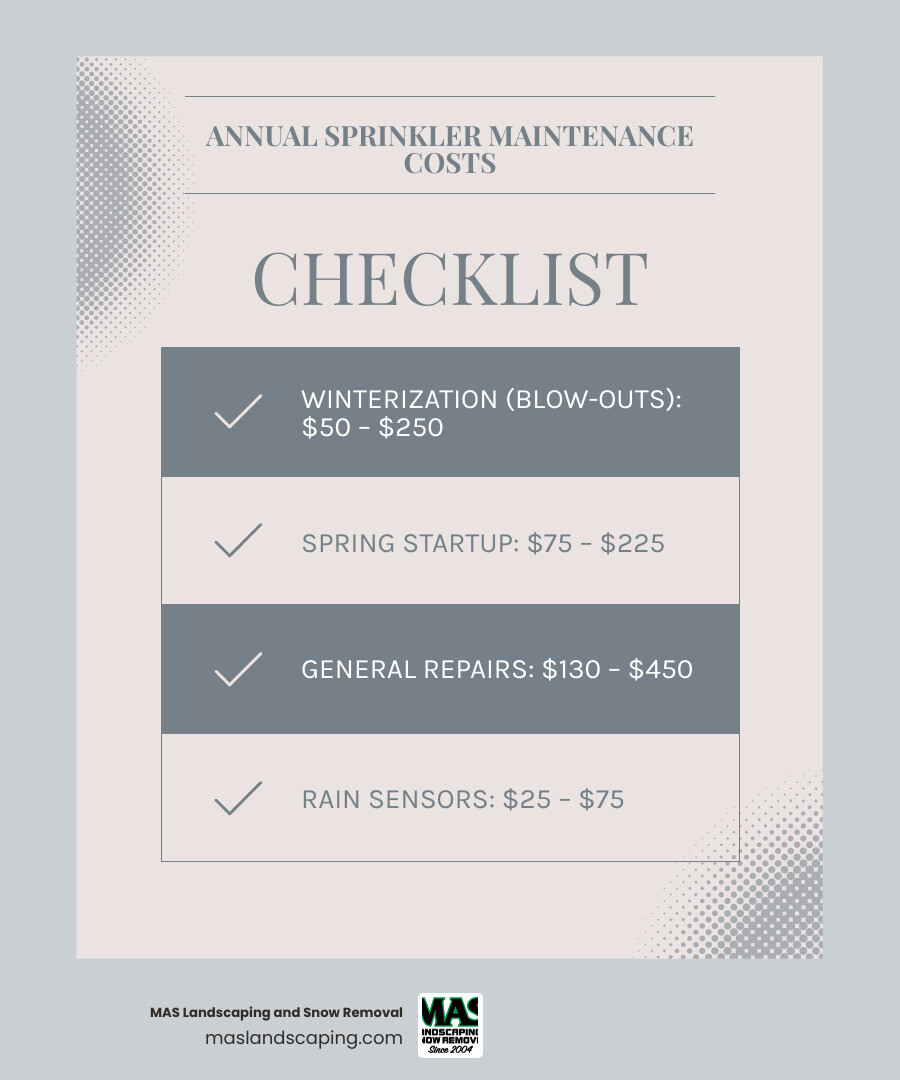
- Winterization (Blow-outs): $50 – $250. A technician uses a high-volume air compressor to clear all water from the lines.
- Spring Startup: $75 – $225. This involves turning the water back on, checking for leaks that may have developed over the winter, and adjusting the heads for the new growing season.
- General Repairs: $130 – $450. Over time, mower blades might nick a head, or a seal might wear out.
Don’t forget the water bill. While a sprinkler system is more efficient than a manual hose, you are likely to use more water simply because your lawn is finally getting the consistent hydration it needs. You can expect your summer water bills to increase, though rain sensors ($25 – $75) can help keep that increase manageable by preventing watering during storms.
Frequently Asked Questions about Sprinkler Costs
Does a sprinkler system increase my home’s resale value?
Absolutely. While it’s not as “flashy” as a new kitchen, a sprinkler system signals to buyers that the home has been meticulously maintained. In the competitive Greater Boston real estate market, a lush, green lawn can be the deciding factor that gets a buyer through the front door. Most experts agree you can recoup a large portion of the cost (around 83% to 86%) in home value.
How much will my monthly water bill increase?
This depends on your town’s water rates and how often you water. However, using a system with a smart controller and rain sensors can actually save you money compared to manual watering, where people often forget to turn the sprinkler off. On average, expect a noticeable but manageable increase during the peak summer months of July and August.
Can I save money by digging my own trenches?
Some homeowners choose to do the “grunt work” themselves to save on labor. Trenching can cost between $4 and $12 per linear foot when done by a pro. If you’re willing to spend a weekend with a rented trencher, you could save between $400 and $1,200. However, be warned: trenching is back-breaking work, and if you hit a hidden utility line, those savings will vanish instantly.
Conclusion
Investing in your landscape is one of the best ways to enjoy your home more today while protecting its value for tomorrow. While the average cost of a yard sprinkler system involves an upfront commitment, the benefits — a beautiful lawn, time saved, and improved water efficiency — are well worth it.
At MAS Landscaping and Snow Removal, we’ve spent years helping our neighbors in Saugus, Lynnfield, and across the North Shore create functional and stunning outdoor spaces. We understand the local soil, the local climate, and exactly what it takes to make an irrigation system last through a Massachusetts winter.
Whether you’re looking for a brand-new installation or need help maintaining your existing setup, our team is here to provide personalized, professional service. Ready to stop dragging the hose around and start enjoying a perfect lawn? More info about our landscaping services is just a click away. Let us help you take the guesswork out of your yard care.