




Understanding the 4 Zone Sprinkler System Kit
A 4 zone sprinkler system kit is an all-in-one irrigation package that divides your yard into four independently controlled watering areas — giving you smarter, more efficient coverage than a single-zone setup.
Here’s what you need to know at a glance:
- What it is: A bundled kit including a 4-zone controller, valves, sprinkler heads, tubing, and fittings
- Who it’s for: Homeowners with small-to-medium yards who want automated, customized watering
- How it works: Each zone runs on its own schedule and covers a specific area (lawn, garden beds, shrubs, etc.)
- Key requirement: Most kits need a faucet supplying at least 50–56 PSI and 4.5–5 GPM of water flow
- Smart options: Many modern kits support Wi-Fi, rain sensors, and app control
If you’ve ever watched sprinklers run at full blast in the middle of a rainstorm, you already understand the problem. The EPA estimates that up to 50% of outdoor water use is wasted through inefficient irrigation. That’s not just bad for the environment — it’s bad for your water bill.
A 4-zone kit solves this by letting you treat different parts of your yard as separate areas with different needs. Your shady flower beds don’t need the same water as your sun-baked front lawn. Your vegetable garden has different needs than your ornamental shrubs.
Four zones hits a sweet spot. It’s enough flexibility for most residential properties without the complexity — or cost — of a 6- or 8-zone professional system.
This guide walks you through everything: how these kits work, what’s included, how to install one, and how to keep it running year after year.
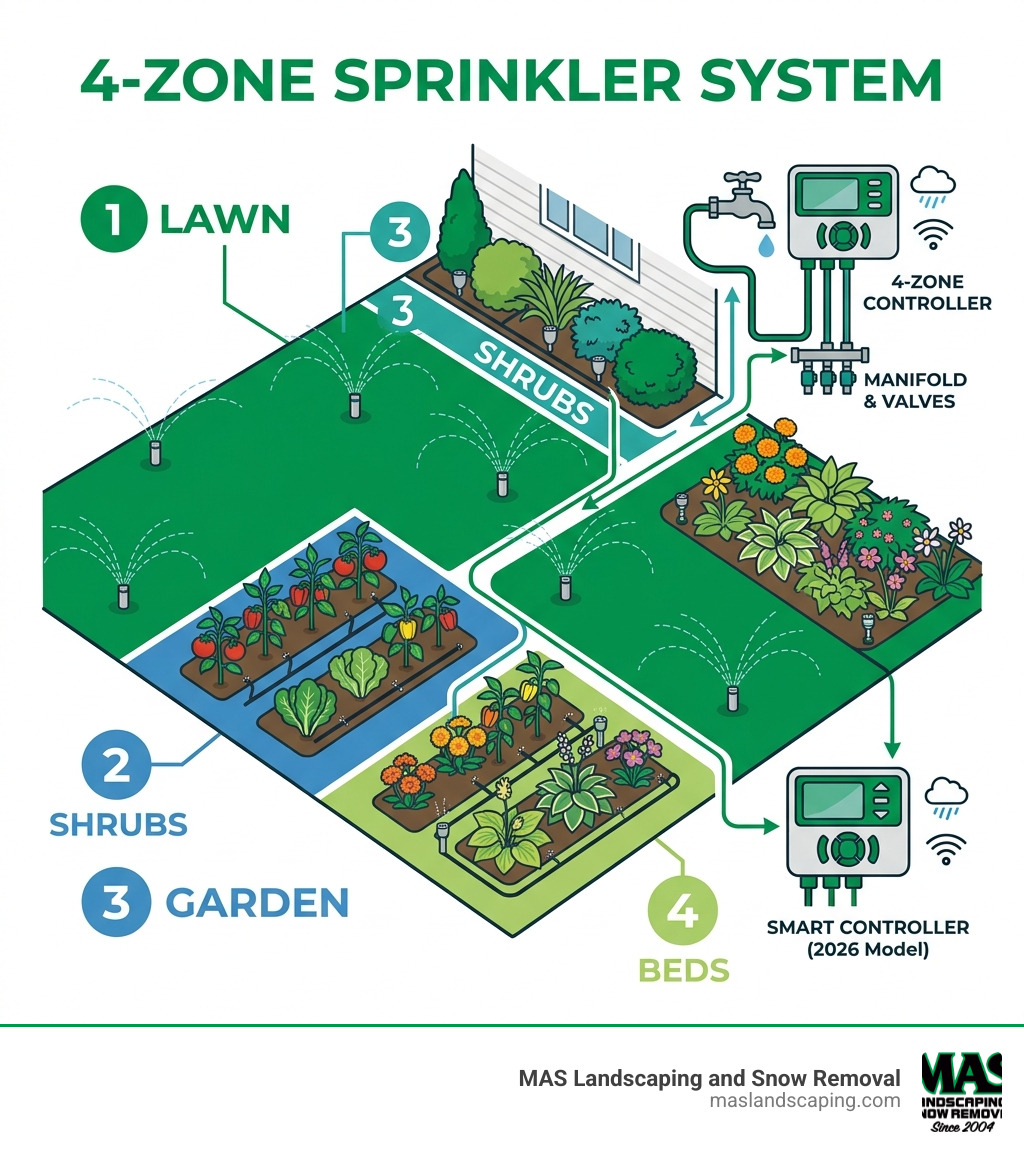
When we talk about a 4 zone sprinkler system kit, we are looking at a comprehensive package designed to take the guesswork out of irrigation. At its heart, the system relies on “hydrozoning.” This is the practice of grouping plants with similar water requirements together. Instead of one giant sprinkler trying to hit everything at once, a 4-zone setup breaks your landscape into four distinct “neighborhoods.”
The physical “brain” of the operation is the manifold. This is a hub where the water from your main source (usually an outdoor faucet or a dedicated line) is split into four directions. Each direction is controlled by an electric valve. When the controller tells Zone 1 to turn on, that specific valve opens, and water flows only to the heads in that area.
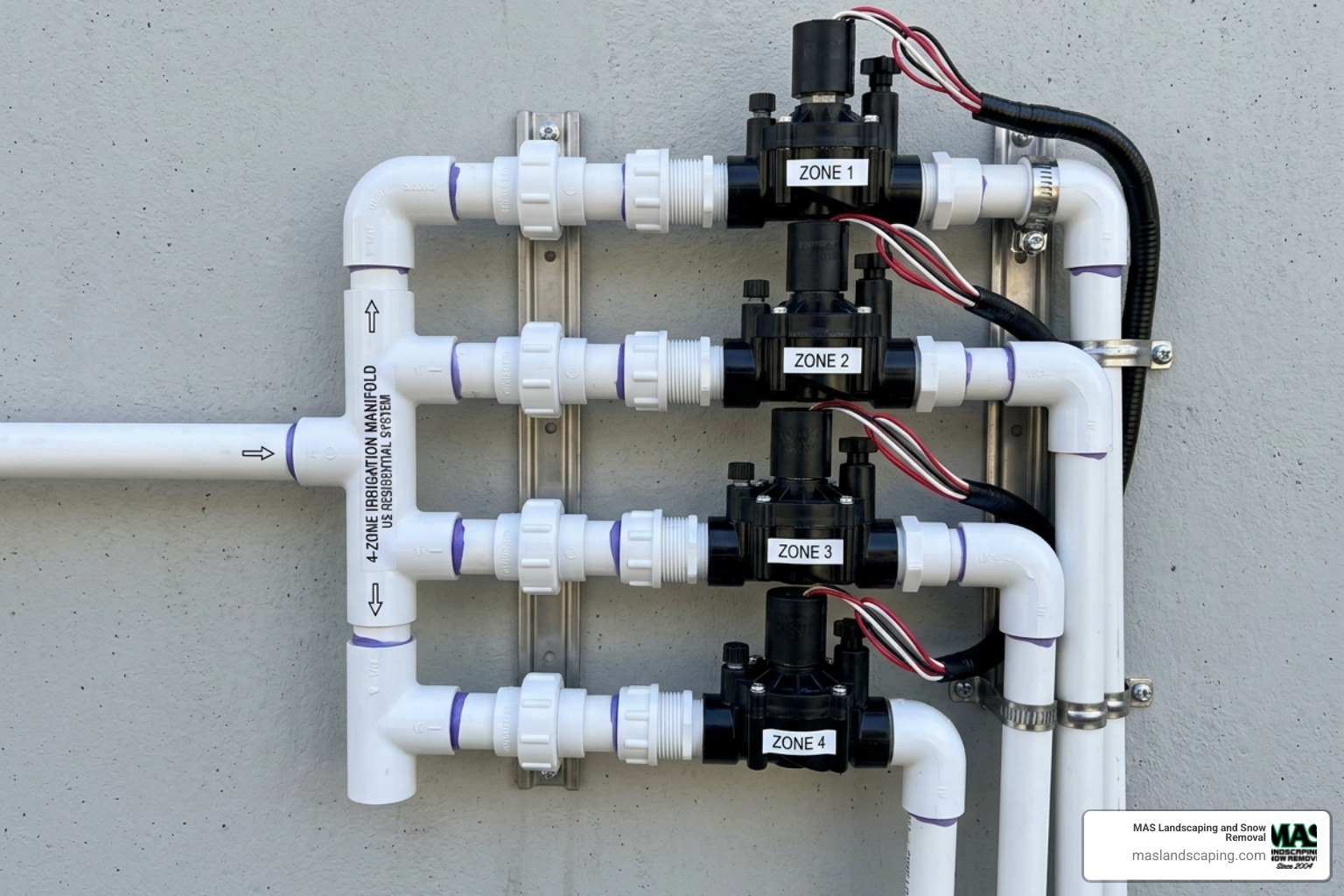
Core Components of a Typical Kit
Most high-quality kits, like those from leading brands, come with a specific set of hardware:
- The Controller (Timer): This is the interface where you program start times and durations. A popular choice for reliability is the Weathermatic SL1600, SmartLine 4-Zone Base Model Controller, which offers 8 start times per program and can run zones for up to nearly 10 hours if needed.
- The Manifold and Valves: Usually pre-assembled in DIY-friendly kits to save you the headache of gluing PVC.
- Sprinkler Heads: These can range from “rotors” (which spin and cover large distances) to “sprays” (fixed heads for smaller spots).
- Tubing/Pipe: Often 3/4-inch or 1/2-inch poly pipe or specialized flexible tubing.
- Valve Box: A protective housing that sits flush with the ground to keep your valves safe from lawnmowers and the elements.
Why a 4 Zone Sprinkler System Kit is Ideal for Medium Yards
In our experience serving areas from Saugus to Lynnfield, we find that 4 zones provide the perfect balance for the typical North Shore property. A single zone often lacks the water pressure to cover a whole yard, while an 8-zone system might be overkill for a standard residential lot.
A 4 zone sprinkler system kit is perfectly suited for:
- Front and Back Split: One zone for the front lawn, one for the back, one for side strips, and one for flower beds.
- Diverse Landscapes: Yards that have a mix of established grass, newly planted shrubs, and delicate perennial gardens.
- Pressure Management: By splitting the yard into four, the system ensures that each head gets maximum pressure, preventing that “limp” spray that fails to reach the edges of your lawn.
Smart Features in a Modern 4 Zone Sprinkler System Kit
Irrigation technology has come a long way since the days of simple mechanical dials. Today’s kits often feature Wi-Fi connectivity, allowing you to control your yard from your smartphone while you’re away on vacation or just sitting on your patio in Melrose.
Smart controllers use “WeatherSense” technology to pull local weather data. If the forecast calls for a heavy downpour in Reading, the system will automatically skip its next cycle. This isn’t just a gimmick; it’s a massive water saver. For those who want the ultimate in smart tech, the Rachio 3: 8-Zone Smart Sprinkler Controller | Rachio is a gold standard, though it’s important to note that many 4-zone specific kits now include these same smart capabilities.
Technical Requirements and Installation Steps
Before you start digging up your yard in Peabody or Danvers, you need to check your “math.” A sprinkler system is only as good as the water pushing through it. Most 4-zone kits have strict requirements for water pressure (measured in PSI) and flow rate (measured in GPM).
For example, a standard Rain Bird Econo system typically requires a faucet that delivers at least 56 PSI and 4.5 Gallons Per Minute (GPM). If your pressure is too low, the heads won’t pop up or rotate. If your flow is too low, you won’t be able to run enough heads per zone to get full coverage.
Faucet-Connected vs. In-Ground Kits
There are two main ways these kits connect to your home:
| Feature | Faucet-Connected Kit | Traditional In-Ground Kit |
|---|---|---|
| Water Source | Standard Outdoor Hose Bib | Main Water Line (requires plumbing) |
| Installation Ease | Very High (DIY friendly) | Moderate to High (requires trenching) |
| Winterization | Easy (disconnect and drain) | Requires compressed air blowout |
| Permits | Usually none required | Often requires backflow inspection |
If you find the technical side of water pressure and flow rates a bit overwhelming, we are always here to help. You can find more info about landscape maintenance services on our site to see how we handle these technical details for our clients.
Step-by-Step Installation Guide
- Plan Your Layout: Use flags to mark where each sprinkler head will go. Aim for “head-to-head” coverage, meaning the spray from one head should reach the base of the next one to avoid dry spots.
- Trenching: Dig narrow paths (about 6-8 inches deep) for your tubing. In our rocky Massachusetts soil, this can be the toughest part!
- Assemble the Manifold: Connect your valves to the water source. If you’re using a kit like the Orbit B-hyve, this might just involve screwing a timer onto your faucet.
- Lay the Pipe: Run your poly pipe through the trenches. Innovative systems like “Blu-Lock” allow you to push the pipe into the fitting without glue or clamps—it’s reportedly 80% faster than traditional methods.
- Install the Heads: Attach your sprinkler heads to the pipe using “funny pipe” or swing joints. This makes it easier to adjust the head height so it’s flush with the grass.
- Flush and Test: Before you bury the pipe, turn the water on to flush out any dirt. Then, install the nozzles and check for leaks.
Maintenance, Winterization, and Troubleshooting
Maintaining a 4 zone sprinkler system kit is a year-round job, especially with the shifting seasons in Middlesex and Essex Counties. A little bit of proactive care goes a long way in preventing “geysers” (broken heads) and dead grass.
Common Troubleshooting Tips
- Low Pressure in One Zone: Usually caused by a leak in the line or a partially clogged valve. Check for “mushy” spots in your lawn that might indicate a broken pipe.
- Heads Not Popping Up: This often happens if dirt gets into the riser. You can usually clean these by pulling the head up manually and flushing it with water.
- Dry Spots: This is often a “nozzle” issue. Use a small brush to clean the filter inside the sprinkler head. You can also find more info about yard clean-up services if your yard needs a professional touch-up beyond just the irrigation.
Seasonal Care and Winterization
In Massachusetts, winterization is non-negotiable. If water stays in your pipes when the ground freezes in Everett or Malden, the ice will expand and shatter your valves and pipes.
The Winterization Checklist:
- Shut Off the Main Valve: Usually located in your basement or a crawlspace.
- Drain the System: Open the manual drain valves at the lowest points of your yard.
- The “Blowout”: For in-ground systems, we highly recommend a professional blowout. This involves using a high-volume air compressor to force every drop of water out of the lines.
- Controller Settings: Set your timer to “Off” or “Rain Delay” to save the programming for spring without trying to run the pumps in the cold.
Cost Analysis and Choosing the Right Kit
Choosing the right 4 zone sprinkler system kit depends on your soil, your plants, and how much “smart” tech you want. If you have heavy clay soil (common in parts of Medford), you’ll want a system that allows for “cycle and soak” — watering for short bursts to let the water sink in rather than running off.
Average Pricing for 4-Zone Systems
Based on internet data, the cost of a 4-zone system can vary wildly depending on whether you go the DIY route or choose a high-end smart system.
Note: These are average costs based on internet data and not actual costs for MAS Landscaping.
- Basic DIY Faucet Kits: $130 – $350. These are great for small yards and connect directly to your hose bib.
- Mid-Range In-Ground DIY Kits: $400 – $850. These include more durable piping and better controllers.
- High-End Smart Systems: $900 – $1,500+. These feature top-tier controllers like the Rachio or Weathermatic and professional-grade heads.
When comparing prices, the “kit” is often just the start. You will likely need to purchase extra poly pipe, specialized tools like pipe cutters, and multiconductor wire separately.
Frequently Asked Questions and Conclusion
At MAS Landscaping and Snow Removal, we’ve seen how a properly installed irrigation system can transform a struggling yard into the envy of the neighborhood. Whether you are in Saugus, Wakefield, or Stoneham, local expertise matters. We understand the local climate, from the humid summers to the brutal freezes, and we design our services to meet those challenges. If you’re looking for help with your broader landscape, check out more info about landscaping services on our site.
What is the maximum coverage area for a 4-zone kit?
Typically, a 4-zone kit can handle between 2,500 and 7,000 square feet. This depends heavily on your water pressure. If you have high pressure (60+ PSI), you can run more heads per zone, covering a larger area. For most medium-sized suburban lots in the North Reading or Reading area, 4 zones are plenty.
Can I install a 4-zone system without professional plumbing?
Yes! Many modern kits are designed for “faucet connection.” They attach directly to your outdoor hose bib. While they aren’t as “hidden” as a system tapped into your main water line, they avoid the need for a licensed plumber and expensive backflow preventer installations.
How much water can a smart 4-zone system save?
By using rain sensors and smart scheduling, homeowners often see water savings of 20% to 50%. By only watering when the soil actually needs it — and skipping the lawn when it’s raining in Somerville or Chelsea — you save money and protect our local water resources.
Mastering your yard doesn’t have to be a chore. With the right 4 zone sprinkler system kit, you can enjoy a lush, green landscape while you spend your weekends enjoying your outdoor space rather than dragging a hose around it. Whether you’re a DIY enthusiast or looking for professional support, an automated system is one of the best investments you can make for your home’s curb appeal.
