



Building a Retaining Wall on a Slope Cost: Top 10 Tips
Building a retaining wall on a slope cost can vary significantly based on several factors. For a quick snapshot:
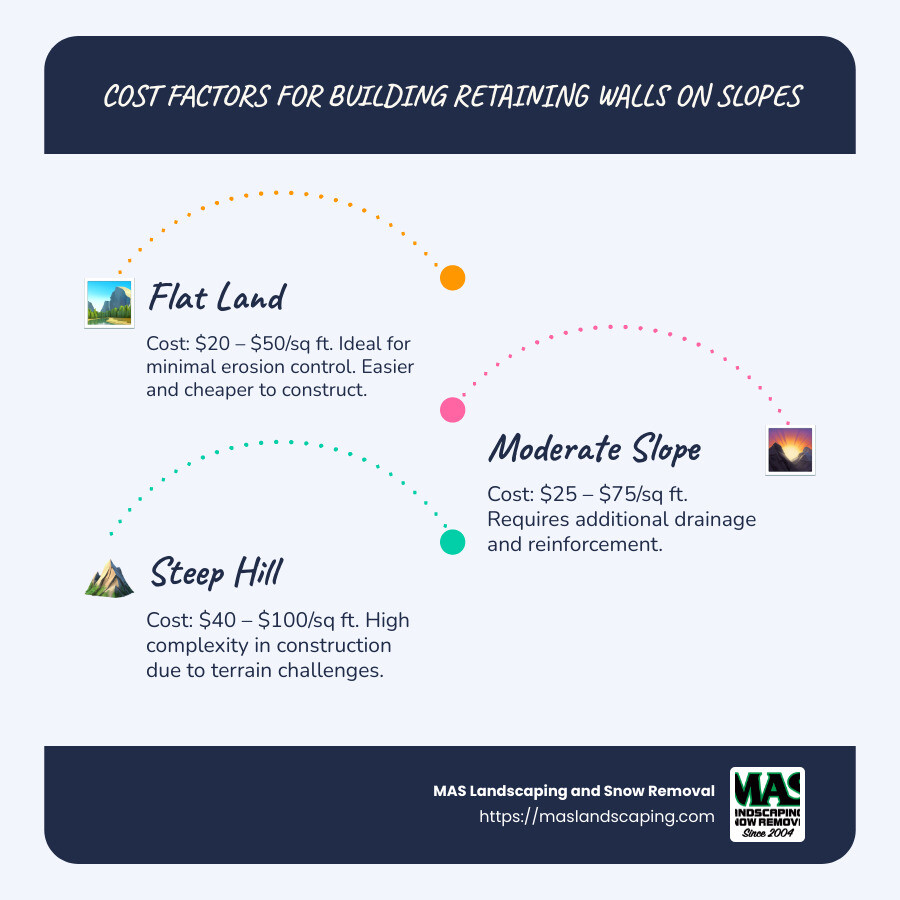
- Flat land: $20 – $50 per square foot
- Moderate slope: $25 – $75 per square foot
- Steep hill: $40 – $100 per square foot
Retaining walls are crucial for maintaining the beauty and functionality of your outdoor space, especially in areas prone to erosion. They play a vital role in preventing soil and water from encroaching on your well-maintained yard, ensuring that your landscape remains intact through varying weather conditions.
Retaining walls are not only practical but also contribute to the overall design of your landscape. By integrating these features, you can transform slopes into usable space. This enables beautiful garden areas, seating spaces, or even terraces—allowing for creativity in your land use.
Building these walls requires expertise, especially on sloped terrains. The right retaining wall can improve your property’s safety, functionality, and curb appeal. We will dig into the costs associated with building retaining walls on slopes and help make this complex process more understandable.
Building a retaining wall on a slope cost vocab to learn:
– Hardscape design services
– Landscape Walls
– Wall construction services
What is a Retaining Wall?
A retaining wall is a structure designed to hold back soil and prevent erosion. Think of it as a sturdy barrier that transforms a sloping landscape into flat, usable land. These walls are essential for both function and aesthetics, especially in hilly areas where soil erosion is a concern.
Purpose of Retaining Walls
Retaining walls serve multiple purposes:
- Erosion Control: They stop soil from washing away, keeping your yard intact even during heavy rains.
- Water Management: By directing water flow, they help prevent flooding and water pooling.
- Landscaping: Retaining walls create visually appealing terraces or garden areas, adding depth and interest to your yard.
- Space Utilization: They transform slopes into flat spaces, perfect for patios, gardens, or play areas.
Types of Retaining Walls
There are several types of retaining walls, each with unique benefits:
- Gravity Walls: Use their weight to hold back soil. Commonly made from concrete or stone.
- Cantilever Walls: Have an “L” shape, using leverage to support the soil. Often constructed from reinforced concrete.
- Anchored Walls: Include cables or supports anchored into the ground for additional strength.
- Sheet Piling Walls: Thin sheets driven into the ground, ideal for tight spaces or soft soil.
- Gabion Walls: Made from wire baskets filled with rocks, offering a rustic look and excellent drainage.
Benefits of Retaining Walls
Retaining walls offer several benefits beyond their primary functions:
- Improved Curb Appeal: They add structure and beauty to your landscape.
- Increased Property Value: A well-designed retaining wall can boost your home’s market value.
- Improved Safety: They stabilize slopes, reducing the risk of landslides or erosion.
- Low Maintenance: With proper installation, retaining walls require minimal upkeep.
Building a retaining wall on a slope can be a significant investment, but the benefits in terms of landscape design and property protection are substantial. Whether you’re looking to manage water flow or create a beautiful garden terrace, retaining walls are a versatile solution to many landscaping challenges.
Factors Affecting the Cost of Building a Retaining Wall on a Slope
When considering the cost of building a retaining wall on a slope, several factors come into play. These elements can significantly impact your budget, so it’s crucial to understand each one.
Wall Size
The size of your retaining wall is a primary cost driver. Length, height, and depth all matter. Longer and taller walls require more materials and labor. For instance, a 100-foot wall that’s 6 feet high costs much more than a 20-foot wall that’s 3 feet high. The size dictates not only materials but also the complexity of the construction.
Materials
Choosing the right materials is vital. Concrete, stone, wood, vinyl, steel, gabion, brick, and rammed earth each come with different price tags and lifespans. Concrete and stone are long-lasting but can be more expensive. Wood is cheaper but may require more maintenance. Gabion walls offer good drainage and a rustic look. Balancing cost with durability and aesthetics is key.
Labor
Professional installation is recommended for retaining walls, especially on slopes. Hourly rates can range from $40 to $80, depending on the project’s complexity. A simple wall on flat ground is cheaper than one on a steep slope. Hiring experienced contractors ensures the wall is built to last, but it increases upfront costs.
Site Conditions
The slope, soil type, and accessibility of the site also affect costs. A steep or uneven slope requires more engineering and labor. Excavation on rocky or clay soil can add to the expense. If the site is hard to access, transporting materials and equipment becomes more costly.
Permits and Regulations
Local building codes often require permits for retaining walls, especially those over a certain height. Permit costs can range from $50 to $450. Inspections may also be necessary, adding to the timeline and budget. Always check local regulations before starting your project.
Drainage and Waterproofing
Proper drainage systems are crucial to prevent water buildup behind the wall, which can lead to failure. Installing drainage costs about $10 to $30 per linear foot. Waterproofing is another consideration, with costs ranging from $2 to $10 per square foot. Both are vital for the wall’s longevity.
Reinforcement
Reinforcement ensures the wall can withstand soil pressure. Rebar and tiebacks might be necessary, particularly for taller walls or those on steep slopes. Engineering needs can add $100 to $220 per hour to your costs. However, this investment is crucial for a stable, lasting structure.
Understanding these factors helps in budgeting effectively for a retaining wall on a slope. Each element plays a role in the overall cost, so planning carefully can save time and money.
Cost Breakdown by Material
When it comes to building a retaining wall on a slope, the choice of materials is crucial. Each material has its own benefits, costs, and installation requirements. Let’s explore the different materials available for retaining walls and what you can expect in terms of cost and performance.
Concrete Retaining Walls
Concrete is a popular choice for its durability and versatility.
- Poured Concrete: Costs range from $20 to $45 per square foot. It offers a sleek look and strong structure but requires skilled labor for installation.
- Precast Panels: These cost $25 to $40 per square foot. They are easy to install and ideal for larger projects.
- Concrete Blocks: Priced between $20 to $35 per square foot, these blocks are versatile and can be stacked easily.
Pros: Long-lasting, low maintenance, and strong.
Cons: Higher upfront cost and requires professional installation.
Stone Retaining Walls
Stone walls provide a natural and timeless look.
- Dry-Stack Stone: Costs vary from $20 to $85 per square foot. No mortar is used, offering a rustic appearance and good drainage.
- Boulder Rock: Priced at $25 to $50 per square foot, these are ideal for shorter walls and require heavy machinery to install.
- Stone Veneer: Offers a natural stone look at $30 to $60 per square foot. Typically used over concrete or block walls.
Pros: Aesthetic appeal, durable, and natural drainage.
Cons: Higher cost and labor-intensive installation.
Wood and Timber Retaining Walls
Wood offers an affordable and warm look.
- Railroad Ties: These are cost-effective, ranging from $10 to $40 per square foot, but have a shorter lifespan.
- Treated Timber: Slightly more expensive, these cost $15 to $45 per square foot and offer better durability than untreated wood.
Pros: Cost-effective, easy to install.
Cons: Requires maintenance and has a shorter lifespan.
Metal Retaining Walls
Metal walls are strong and modern.
- COR-TEN Steel: Costs range from $35 to $135 per square foot. It develops a rust-like appearance that protects it from further corrosion.
- I-Beam: Priced between $35 to $150 per square foot, ideal for supporting heavy loads.
- Sheet Piling: Costs $15 to $50 per square foot. Suitable for thin walls and tight spaces.
Pros: Durable, sleek appearance.
Cons: Expensive and may not suit all climates.
Gabion Retaining Walls
Gabion walls use wire mesh boxes filled with rocks.
- Wire Mesh and Rock Fill: These cost $10 to $40 per square foot. They are quick to install and adapt to shifting landscapes.
Pros: Cost-effective, good for drainage.
Cons: Not suitable for high walls and can be less visually appealing.
Each material offers unique benefits and challenges. Consider your budget, aesthetic preferences, and the specific needs of your slope when choosing the right material for your retaining wall.
Cost Estimator by Project Size
When planning building a retaining wall on a slope, understanding the costs associated with different project sizes is crucial. Here’s a breakdown of what you can expect based on the size of your project.
Small Projects
For smaller retaining walls, typically ranging from 10 to 20 feet in length, costs can vary significantly depending on the height and materials used.
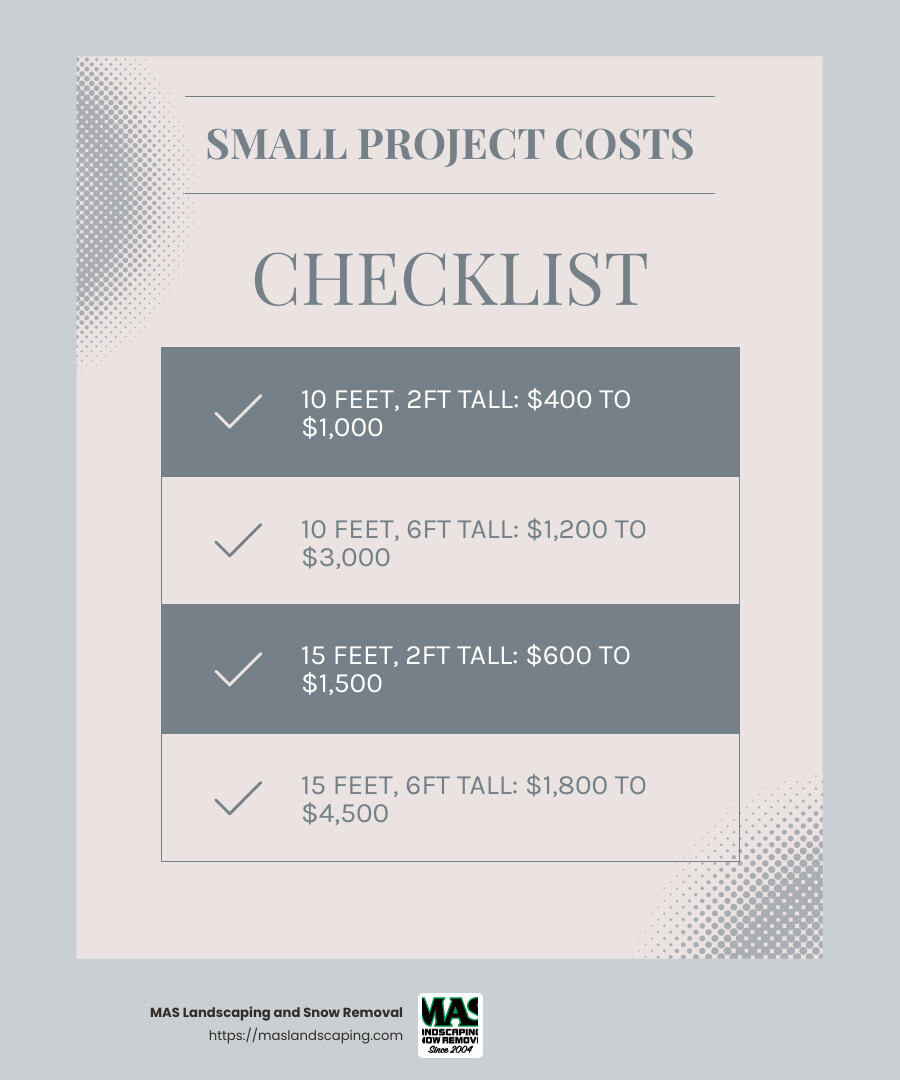
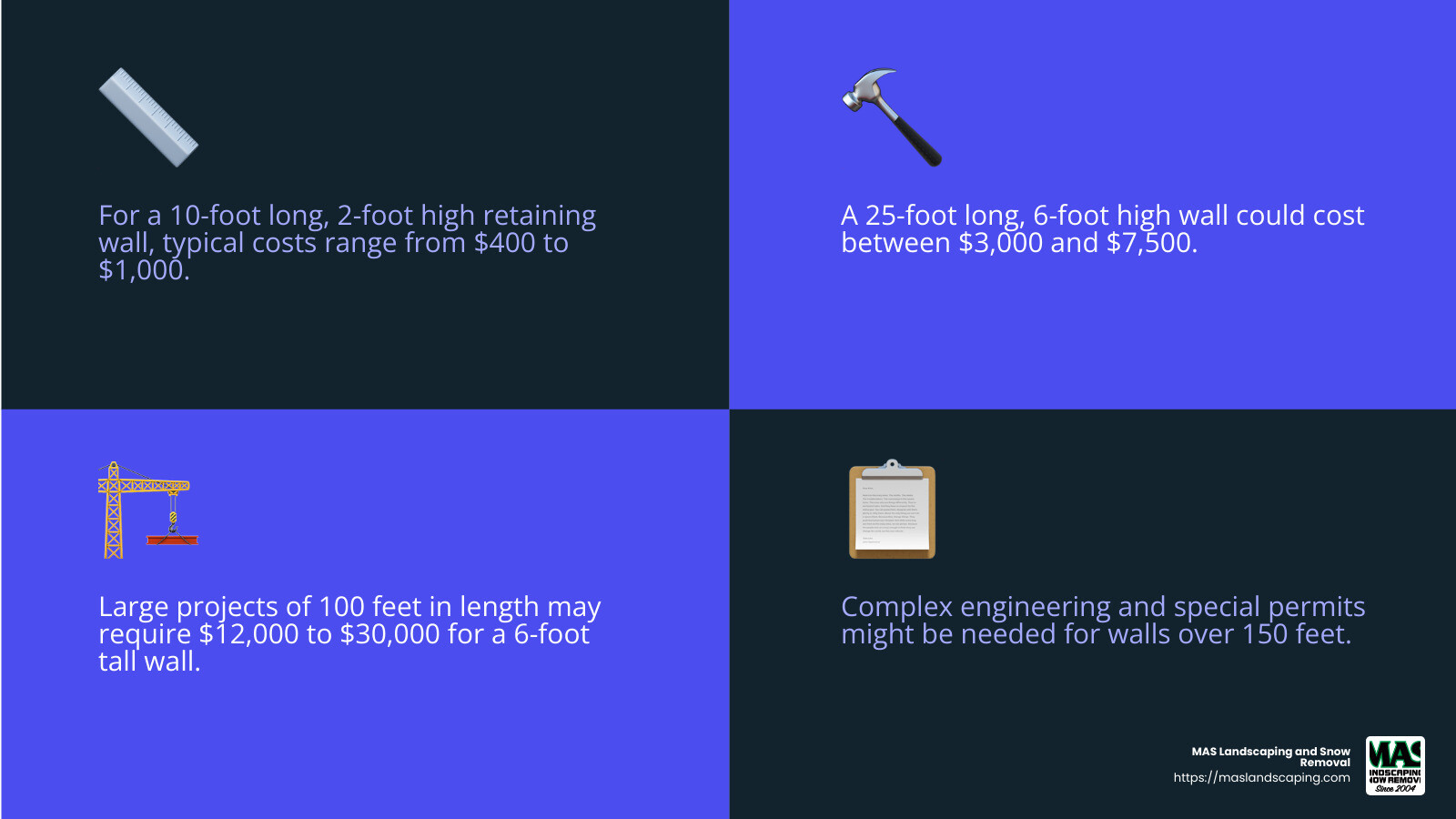
- 10 feet: If your wall is around 2 feet tall, expect to pay between $400 and $1,000. For a 6-foot tall wall, costs can rise to $1,200 to $3,000.
- 15 feet: A 2-foot high wall might cost $600 to $1,500, while a 6-foot high wall could be $1,800 to $4,500.
- 20 feet: Costs for a 2-foot wall range from $800 to $2,000. If you’re going taller, a 6-foot wall could reach $2,400 to $6,000.
Medium Projects
Medium-sized projects, such as those between 25 to 50 feet, require more materials and labor, impacting the overall cost.
- 25 feet: A 2-foot wall costs $1,000 to $2,500, whereas a 6-foot wall might be $3,000 to $7,500.
- 30 feet: Expect costs of $1,200 to $3,000 for a 2-foot wall, and $3,600 to $9,000 for a 6-foot wall.
- 50 feet: For a 2-foot wall, the cost is between $2,000 and $5,000. A 6-foot wall can go up to $6,000 to $15,000.

Large Projects
Large projects, spanning 100 to 200 feet, require significant investment and planning. These projects often involve more complex engineering and may require special permits.
- 100 feet: A 2-foot wall costs $4,000 to $10,000, while a 6-foot wall can range from $12,000 to $30,000.
- 150 feet: Costs for a 2-foot wall are $6,000 to $15,000. For a 6-foot wall, expect to pay $18,000 to $45,000.
- 200 feet: A 2-foot wall comes in at $8,000 to $20,000, and a 6-foot wall can be $24,000 to $60,000.
Key Considerations
- Linear Foot Costs: Generally, costs per linear foot increase with height. Taller walls require more materials and labor.
- Square Foot Costs: These vary based on the complexity and materials used, with rates ranging from $20 to $50 per square foot on average.
When planning your project, consider the scale and specific requirements of your site to get an accurate estimate. Always consult with professionals to ensure a well-planned and executed retaining wall.
Additional Features and Customizations
When building a retaining wall on a slope, adding extra features can improve both the functionality and beauty of your outdoor space. Let’s explore some popular customizations:
Flower Beds
Integrating flower beds into your retaining wall design adds color and life to your landscape. These beds can be built into the wall itself or placed at the top. Expect to pay between $1,000 and $3,000 for this customization. Flower beds not only beautify but also help with soil erosion control.
Landscape Lighting
Lighting transforms your yard into a magical space after dark. It highlights key features like the retaining wall and pathways, while also improving safety. Installing landscape lights can cost between $2,000 and $5,810. LED lights are a popular choice for their long lifespan and energy efficiency.
Murals
A mural on your retaining wall can turn a functional structure into a piece of art. Painted murals typically range from $1,515 to $3,250. This customization allows you to express personal style and make your wall a focal point in your garden.
Outdoor Kitchens
For those who love to entertain, adding an outdoor kitchen near your retaining wall can be a game-changer. This feature can include built-in grills, refrigerators, and even pizza ovens. Costs for outdoor kitchens vary widely, from $6,035 to $14,835, depending on the complexity and materials used.
Patios
Patios provide a perfect space for relaxation and social gatherings. Incorporating a patio into your retaining wall project can cost between $1,500 and $5,550. This addition maximizes your outdoor living area, offering a seamless transition from your home to the garden.
These additional features and customizations not only improve the aesthetic appeal of your retaining wall but also increase the value of your property. Each option offers unique benefits, so consider what aligns best with your lifestyle and budget.
Next, we’ll tackle some of the most frequently asked questions about building retaining walls on slopes.
Frequently Asked Questions about Building a Retaining Wall on a Slope
What is the cheapest retaining wall to build?
When considering cost-effectiveness, concrete blocks often come out on top. They are not only affordable but also durable, lasting between 50 and 100 years. This makes them a popular choice for homeowners looking to build a retaining wall on a slope without breaking the bank. Concrete blocks are also versatile and can be used to construct walls of various heights and designs, adding both function and style to your landscape.
How to calculate the cost of a retaining wall?
Calculating the cost of a retaining wall involves several factors. Start by measuring the square footage and linear footage of the wall you plan to build. The cost will vary based on the materials you choose, the complexity of the design, and labor rates in your area. To get a more precise estimate, consider using a cost estimator tool. These tools take into account the price of materials, labor, and additional features, providing you with a clearer picture of the total expense. Remember to also factor in potential site preparation costs, such as excavation or slope stabilization.
Can you build a retaining wall on a slope?
Yes, you can build a retaining wall on a slope, and it can be a great way to manage uneven terrain. However, the complexity of the project can vary significantly. For simple walls, especially those under 3 feet, a DIY approach might be feasible. But for taller or more complex walls, professional help is recommended. Hiring a professional ensures that the wall is designed and constructed to handle the specific slope management needs, such as drainage and soil stability. Professionals can also steer local regulations and obtain necessary permits, ensuring the project is compliant with building codes.
Understanding these key aspects can help you make informed decisions when planning your retaining wall project. Whether you’re aiming for cost-effectiveness, precise budgeting, or expert construction, knowing your options and the necessary steps is crucial to a successful build.
Conclusion
At MAS Landscaping and Snow Removal, we understand that building a retaining wall on a slope is not just about holding back soil—it’s about enhancing your outdoor space with functionality and beauty. Our commitment to professional service ensures that every project is handled with precision and care, from the initial consultation to the final installation.
Our local expertise in Saugus, MA, and surrounding areas, such as Everett and Malden, allows us to tailor solutions that are perfect for the unique environmental conditions of your property. We know the local climate, soil types, and zoning laws, which means we can efficiently manage every aspect of your retaining wall project. This local knowledge helps us avoid common pitfalls and ensures that your new wall is both compliant and durable.
We pride ourselves on offering personalized solutions. We listen to your needs and preferences to create a retaining wall that complements your landscape and meets your specific goals. Whether you’re looking to prevent erosion, create a terraced garden, or simply add aesthetic appeal, our team is dedicated to bringing your vision to life with quality craftsmanship and attention to detail.
When you’re ready to improve your landscape with a retaining wall, trust MAS Landscaping and Snow Removal to deliver exceptional results. Visit our retaining wall installation page to learn more about how we can help you create a stunning and functional outdoor space. Let’s work together to transform your landscape into a beautiful and lasting masterpiece.
