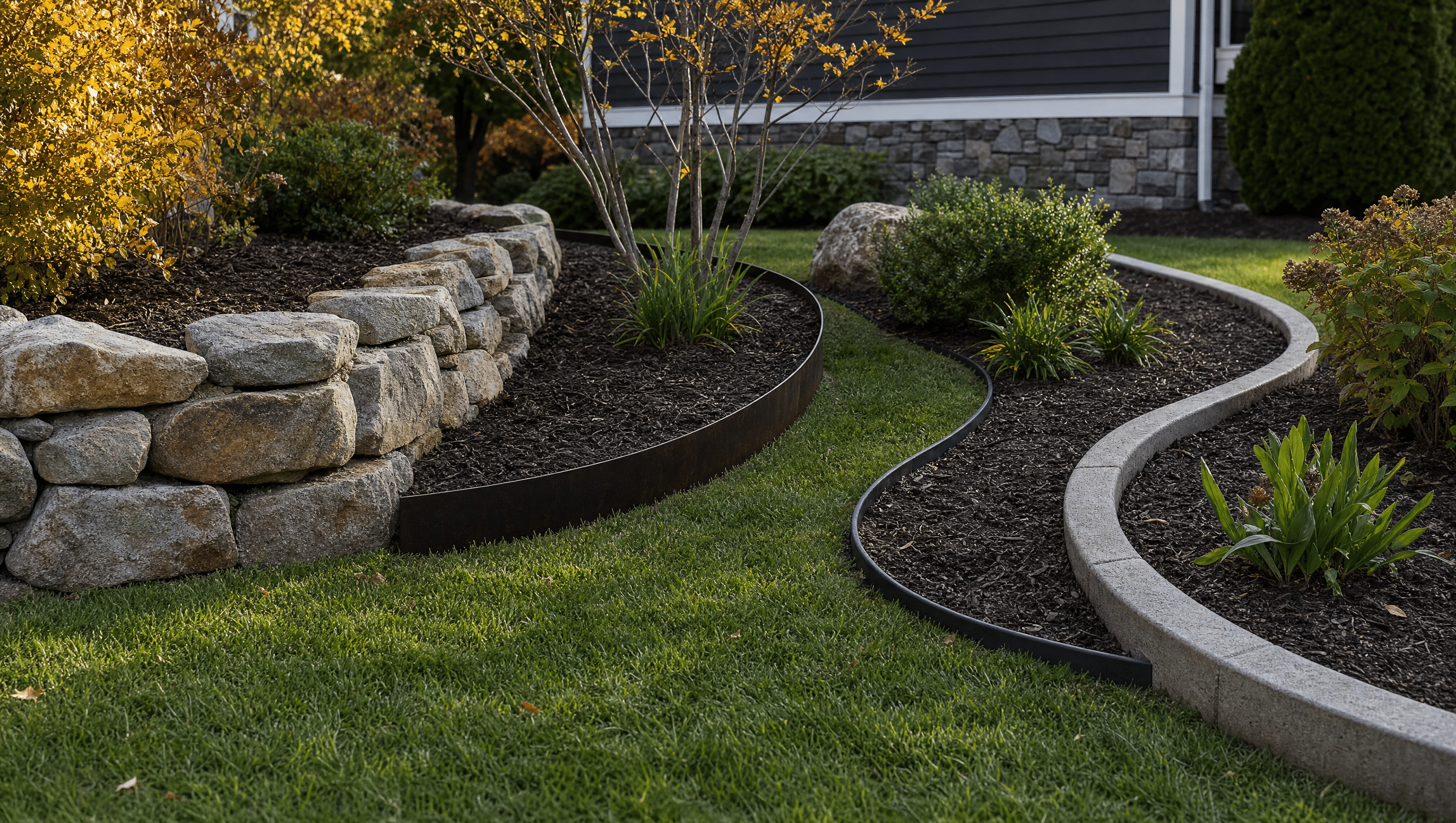



Landscape edging defines the transition between lawn, mulch, planting, gravel, and hardscape. Material choice affects appearance, mowing, curves, freeze-thaw movement, installation depth, and future adjustment. No single edging material is best for every Massachusetts property.
Decide what the edge must accomplish
Some edges are primarily visual. Others need to contain loose material, create a mower-friendly boundary, protect a planting bed, or coordinate with a patio. Identify the job before comparing finishes.
| Material | Strength | Planning concern |
|---|---|---|
| Natural stone | Substantial New England character and strong connection to hardscape | Irregular dimensions, base preparation, joints, and mowing transition |
| Metal | Thin profile and clean curves or straight lines | Anchoring, exposed edges, finish durability, and frost movement |
| Plastic or composite | Flexible curves and relatively light installation | Product quality, anchoring, sun exposure, and visible waviness |
| Concrete | Defined, durable edge with options for units or formed shapes | Base, joints, cracking, drainage, and future reconfiguration |
| Cut bed edge | Minimal material and a natural transition | Requires periodic recutting to remain crisp |
Natural stone edging
Granite, fieldstone, and other stone can connect planting beds with patios, walls, and New England architecture. The visual weight suits broad beds and formal transitions. Installation should account for stone thickness, stable support, consistent alignment, and how a mower or footpath meets the edge.
Irregular stone creates character but can leave openings or uneven heights if the layout is not planned. More uniform cut stone creates a cleaner line at a higher level of material processing.
Metal edging
Metal can make a narrow, crisp separation without becoming a major visual element. It forms curves more cleanly than many rigid materials. Gauge, finish, staking, joint treatment, and the relationship to finished grade matter. An edge that rises or shifts becomes both unattractive and inconvenient.
Plastic and composite edging
Flexible products can suit curved beds and lighter-duty applications. The performance range is broad, so compare profile, thickness, connection method, ultraviolet exposure, and anchoring rather than treating every plastic edging product as equivalent.
Concrete edging
Concrete may be installed as manufactured units or a formed continuous edge. It can create a substantial boundary and coordinate with pavers or masonry. Massachusetts freeze-thaw conditions make base preparation, drainage, joints, and installation details important.
When a natural cut edge is enough
A cleanly cut soil edge between lawn and mulch can look polished without added material. It is easy to reshape as beds evolve. The tradeoff is recurring labor: the edge must be recut as turf and soil move.
Design the mowing transition
Edging should simplify maintenance, not add a narrow strip that still needs hand trimming. Consider finished height, mower-wheel support, bed material, and curves. Tight scallops and abrupt corners increase maintenance regardless of the material.
Coordinate edging with drainage and hardscape
An edge should not block intended surface drainage or trap water against pavement. Where it meets a patio or walkway, plan the joint and elevations together. A disconnected edging line can make an otherwise well-built hardscape look unfinished.
MAS Landscaping designs and installs hardscape and landscape improvements in Saugus and nearby communities. The team can help compare edging and border approaches within the complete layout, grading, planting, and patio plan. Confirm specific material availability for the proposed project.