

Turf Field Cost Estimate: 10 Powerful Insights for 2025 Success
The Ultimate Guide to Turf Field Cost Estimation
Looking for a turf field cost estimate? Here’s what you need to know at a glance:
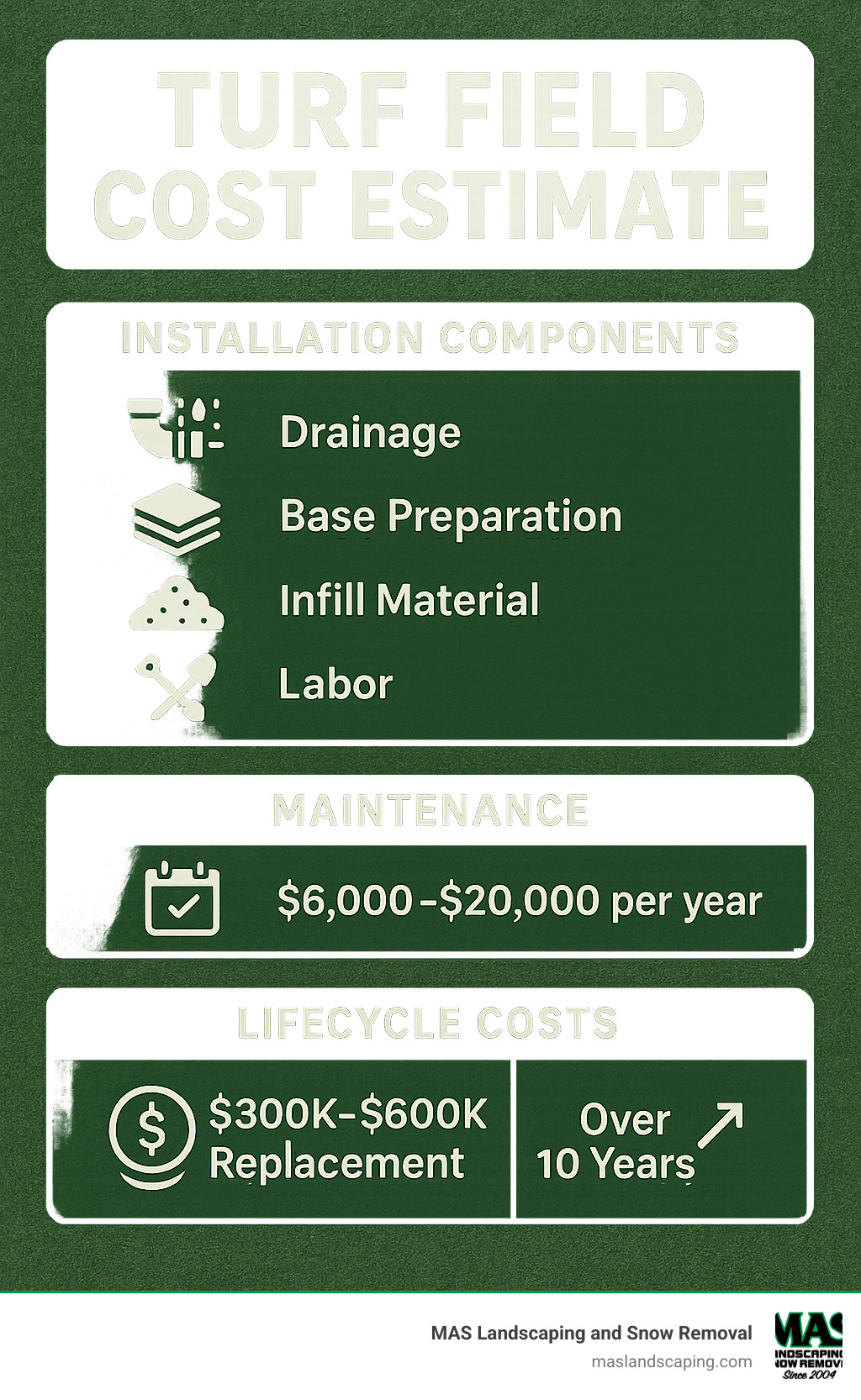
- Installation Range: $550,000-$2,000,000 depending on field size and quality
- Cost Per Square Foot: $8-$20 for complete installation
- Replacement Cost: $300,000-$600,000 when reusing existing base
- Annual Maintenance: $6,000-$20,000 per year
- Expected Lifespan: 8-10 years before major replacement
When it comes to turf field cost estimates, the numbers can make your head spin. Whether you’re planning a new sports complex, upgrading school facilities, or considering options for a community recreation area, understanding the full financial picture is critical for making informed decisions.
The truth is, there’s no one-size-fits-all answer when estimating turf field costs. As one project planner put it: “Google ‘How much does a turf field cost?’ and you’ll find calculations and averages per square foot that vary wildly across websites and providers.”
Behind every estimate lie complex, interdependent factors that affect both upfront and long-term expenses. A complete turf field project involves more than just the green carpet you see on game day – it includes drainage systems, base preparation, infill materials, labor costs, and ongoing maintenance requirements.
For facility managers and decision-makers, the key is looking beyond headline prices to understand the complete lifecycle costs and benefits. While natural grass fields typically cost less initially ($260,000 on average compared to $800,000 for synthetic turf), artificial surfaces can deliver significant savings through reduced maintenance, increased playable hours, and longer seasonal use.
Before diving into specific budget line items, it’s worth noting that a well-planned turf field installation represents a substantial investment that will serve your community for years to come. The decisions you make now about materials, design, and infrastructure will impact both performance and costs for the next decade.
Relevant articles related to turf field cost estimate:
– artificial turf installation cost per square foot
– outdoor turf cost
– cost of turf per square metre
Breaking Down Your Turf Field Cost Estimate
When planning for a new sports field, understanding what goes into a turf field cost estimate can save you from budget surprises down the road. Think of your estimate as a puzzle with several important pieces that fit together to create the complete financial picture.
The major components that make up your investment include the synthetic turf material itself, a proper drainage base system, infill materials that provide stability and cushioning, labor costs for professional installation, and the necessary permits and engineering work. Each element plays a crucial role not just in cost, but in how your field will perform for years to come.
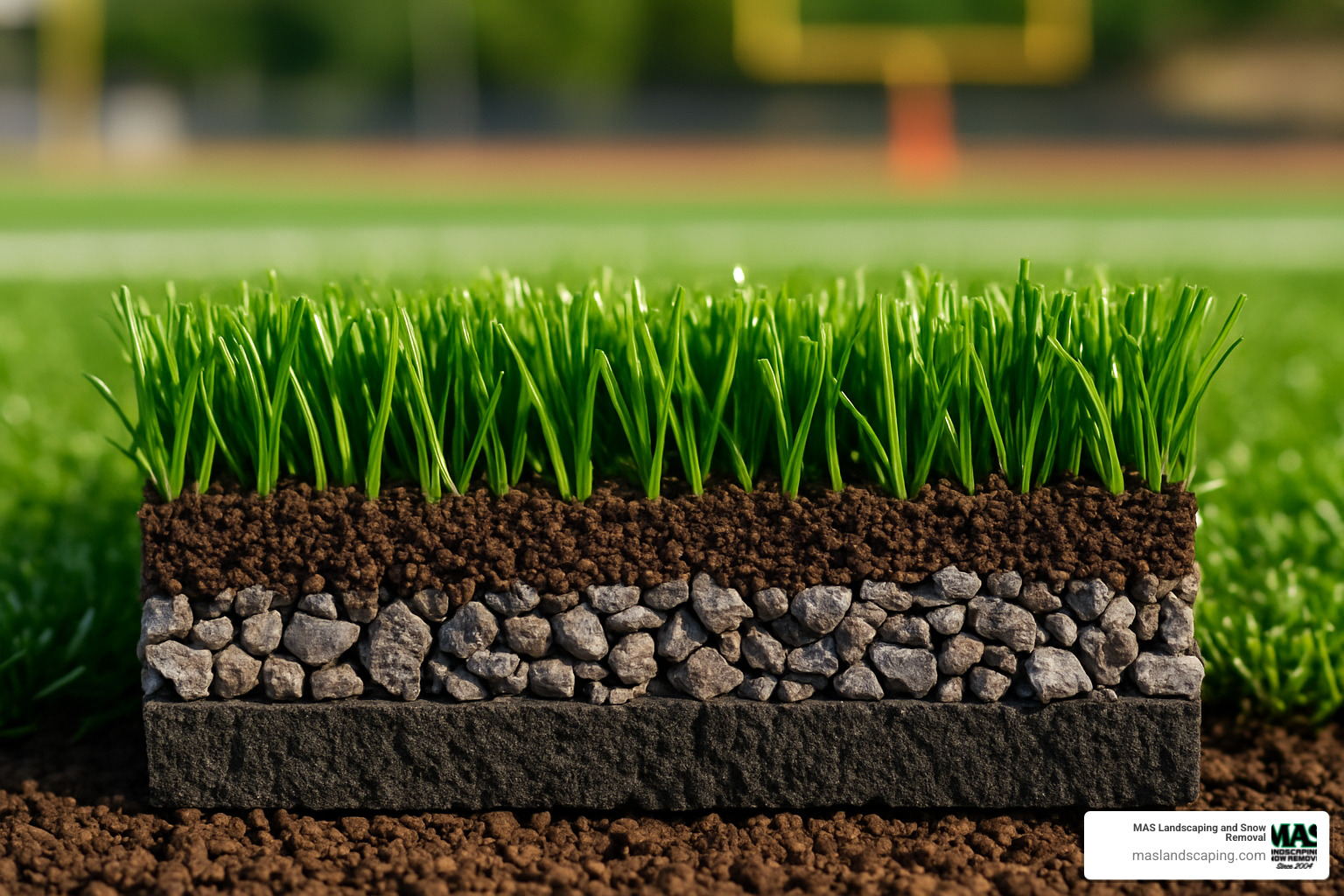
Quality matters tremendously in turf installations. Higher-density turf fibers (what professionals call “face weight”) might increase your upfront costs, but they provide a more natural playing experience and stand up better to heavy use. It’s similar to choosing between economy and premium options for your home – pay a bit more now, or potentially pay much more later in repairs and early replacement.
Average Installation Numbers
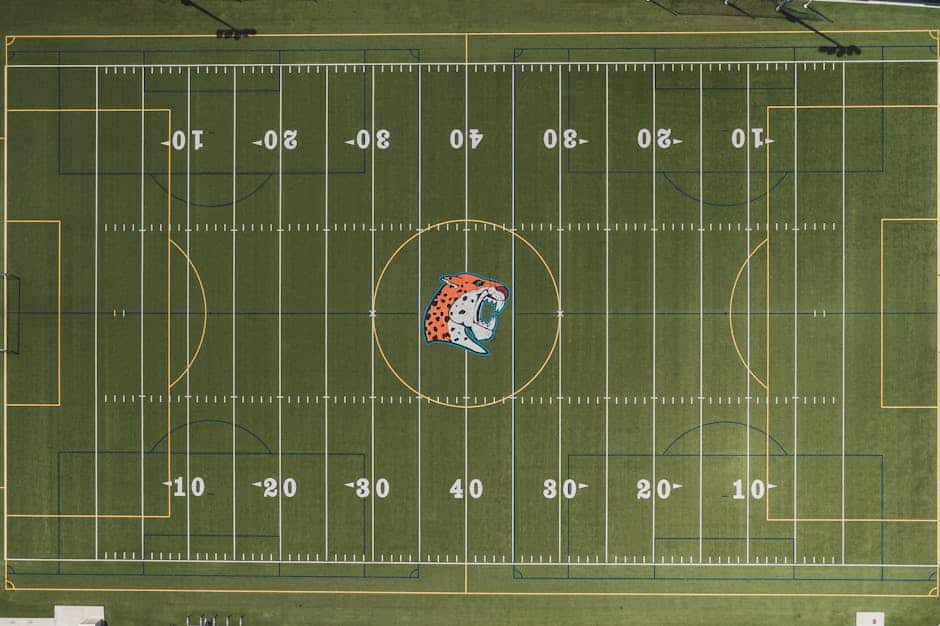
When budgeting for specific sports, the size and requirements of each field type significantly impact your turf field cost estimate. Football fields, which typically cover around 57,600 square feet, represent one of the larger investments. Soccer fields can vary in size but generally fall in a similar price range. Softball fields, being somewhat smaller, usually come in at a lower total cost.
For schools and towns throughout Massachusetts, we’ve observed that costs often trend toward the middle or upper portions of industry averages. This reflects our region’s specific requirements for quality materials that can withstand New England weather extremes, as well as local labor rates and installation standards.
Hidden Line-Items
The surprises in turf field cost estimates often come from items that weren’t considered in the initial planning. I like to call these the “iceberg costs” – what’s visible above the water is just part of the story.
Safety testing is essential but frequently overlooked. G-max testing measures how well your field absorbs impact – critical for player safety and typically required annually. Shock pads installed beneath the turf surface provide extra protection but add to your square footage costs.
Custom field markings and logos create pride and identity but require specialized installation. Perimeter fencing protects your investment and controls access. And don’t forget lighting systems if you plan to host evening events – a substantial investment that dramatically extends usable hours.
In our experience working with communities like Everett, Lynnfield, and Malden, the most successful projects begin with thorough planning that accounts for these potential additions. Having a complete picture from the start helps prevent the dreaded mid-project budget adjustments that can strain relationships and resources.
A professional site evaluation can identify which elements are truly necessary for your specific situation, helping you invest wisely in features that matter while avoiding unnecessary expenses. At the end of the day, a well-planned turf field becomes a community asset that serves athletes and activities for many years to come.
Factors That Influence a Turf Field Cost Estimate
When planning your athletic field project, several key factors can dramatically shift your final turf field cost estimate. Understanding these variables helps you prepare a realistic budget and avoid those painful mid-project financial surprises we all dread.

Field Dimensions & Sport Needs
The size of your field is perhaps the most obvious cost driver, but it’s amazing how many planners underestimate its impact. A regulation football field gobbles up approximately 57,600 square feet of turf, while a full-sized soccer pitch demands around 80,000 square feet. If you’re designing a multi-sport configuration (which many schools and communities prefer for maximum versatility), you’ll need to account for additional space and those specialized markings that make each sport playable.
Each sport also brings its own unique performance requirements to the table. Baseball and softball fields, for instance, often need different turf heights between infield and outfield areas. I’ve seen many smart facility managers opt for a hybrid approach—using artificial turf for those high-traffic infield areas (typically 10-20% of the diamond) while keeping natural grass in the outfield. This balanced approach can deliver the best of both worlds: performance where it matters most and budget relief where possible.
Regional Labor & Material Pricing
Your location plays a surprisingly significant role in your turf field cost estimate. Here in Massachusetts, particularly in communities like Saugus, Melrose, and Medford, we face several regional factors that affect pricing. Our higher-than-national-average labor rates, seasonal construction limitations (thank you, New England winters!), and transportation costs for materials all add up.
These regional variations can tack on an additional $1-$3 per square foot compared to national averages—a difference that quickly compounds across thousands of square feet. This is where working with a local contractor like MAS Landscaping provides a distinct advantage. Our established supplier relationships and intimate knowledge of local conditions help optimize costs without cutting corners on quality.
Custom Add-Ons That Spike Price
Let’s talk about those shiny extras that can quickly escalate your turf field cost estimate. While these features undoubtedly improve functionality and create that wow factor, they come with corresponding price tags:
LED Lighting Systems represent a significant initial investment, but they typically pay for themselves in 3-5 years through energy savings. Grandstands and Bleachers transform a simple playing field into a proper venue where families can comfortably cheer on their athletes. In our cold Massachusetts climate, Heating Systems can be game-changers, extending your playing season by weeks or even months. And those beautiful Logo Inlays and Custom Markings build school pride and create a professional appearance that impresses visitors.
A smart approach? Consider phasing in these improvements over time if budget constraints exist. Start with the essential infrastructure that would be difficult or costly to add later (like proper drainage and base preparation), then incorporate aesthetic and comfort features as additional funding becomes available.
Looking for more detailed information on specific turf costs? Check out our guide to Artificial Turf Installation Cost Per Square Foot for a deeper dive into material pricing.
Artificial Turf vs Natural Grass: Installation, Maintenance & ROI
When evaluating a turf field cost estimate, it’s crucial to compare it against the alternative—natural grass—across the entire lifecycle of the field. This isn’t just about upfront costs; it’s about understanding the complete picture of what you’ll invest over time.
Upfront Build Costs
The initial installation reveals the first major difference between these options:
- Synthetic Turf: $8-$20 per square foot ($640,000-$2,000,000 for a standard football field)
- Natural Grass: $2-$7 per square foot ($260,000-$762,000 for a comparable field)
This price gap often makes school boards and town committees pause. I’ve sat in those budget meetings where the initial sticker shock of artificial turf causes sharp intakes of breath. But smart decision-makers look beyond year one, and that’s where the conversation gets interesting.
Year-by-Year Maintenance
Annual upkeep is where artificial turf begins to shine:
Synthetic Turf: $6,000-$20,000 per year
Natural Grass: $18,000-$50,000 per year
Natural grass is thirsty and demanding. It needs constant mowing, watering, fertilizing, aerating, top dressing, reseeding, and pest management. A typical football field guzzles about 60,000 gallons of water daily during growing season—that’s roughly 1.5 million gallons over a six-month period here in the Northeast.
For our clients in Chelsea, Revere, and surrounding communities, water conservation isn’t just environmentally responsible—it’s becoming an economic necessity. Many towns face increasing water restrictions and rising utility costs, making artificial turf’s minimal water requirements an attractive feature beyond just the direct savings.
10-Year Lifecycle Economics
Looking at the complete decade-long picture presents the most accurate comparison for a turf field cost estimate:
Synthetic Turf Total 10-Year Cost: $770,000-$1,200,000 (including one mid-life resurfacing)
Natural Grass Total 10-Year Cost: $570,000-$950,000 (including periodic renovations)
But here’s where the math gets really interesting—when we factor in usage capacity. Natural grass simply can’t handle continuous play without deteriorating. The numbers tell the story:
Synthetic Turf: Approximately 2,800 hours of use per year (28,000 hours over 10 years)
Natural Grass: Approximately 800 hours of use per year (8,000 hours over 10 years)
This translates to a cost per hour of use:
Synthetic Turf: $25-$52 per hour
Natural Grass: $52-$108 per hour
For Massachusetts schools and municipalities we work with, this increased utilization capacity often becomes the deciding factor. Our New England weather is notoriously fickle—spring thaws and fall rains can turn natural fields into muddy messes that need to be closed for weeks. Meanwhile, properly installed artificial turf fields can handle play almost immediately after heavy rainfall.
As one local athletic director told me, “Our turf field paid for itself in the first five years just by eliminating rainouts and extending our seasons by several weeks on each end.” That kind of reliability is worth its weight in gold for busy sports programs and community recreation departments.
For a deeper dive into the financial comparisons, the Cost Analysis – Sports Turf Alternatives Assessment provides excellent research-backed data that can help inform your decision-making process.
Maintenance, Resurfacing & End-of-Life Expenses
A comprehensive turf field cost estimate must account for the entire lifecycle of the field, including ongoing maintenance, eventual replacement, and disposal costs.
Annual Maintenance Budget Lines
While synthetic turf requires less maintenance than natural grass, it still needs regular care:
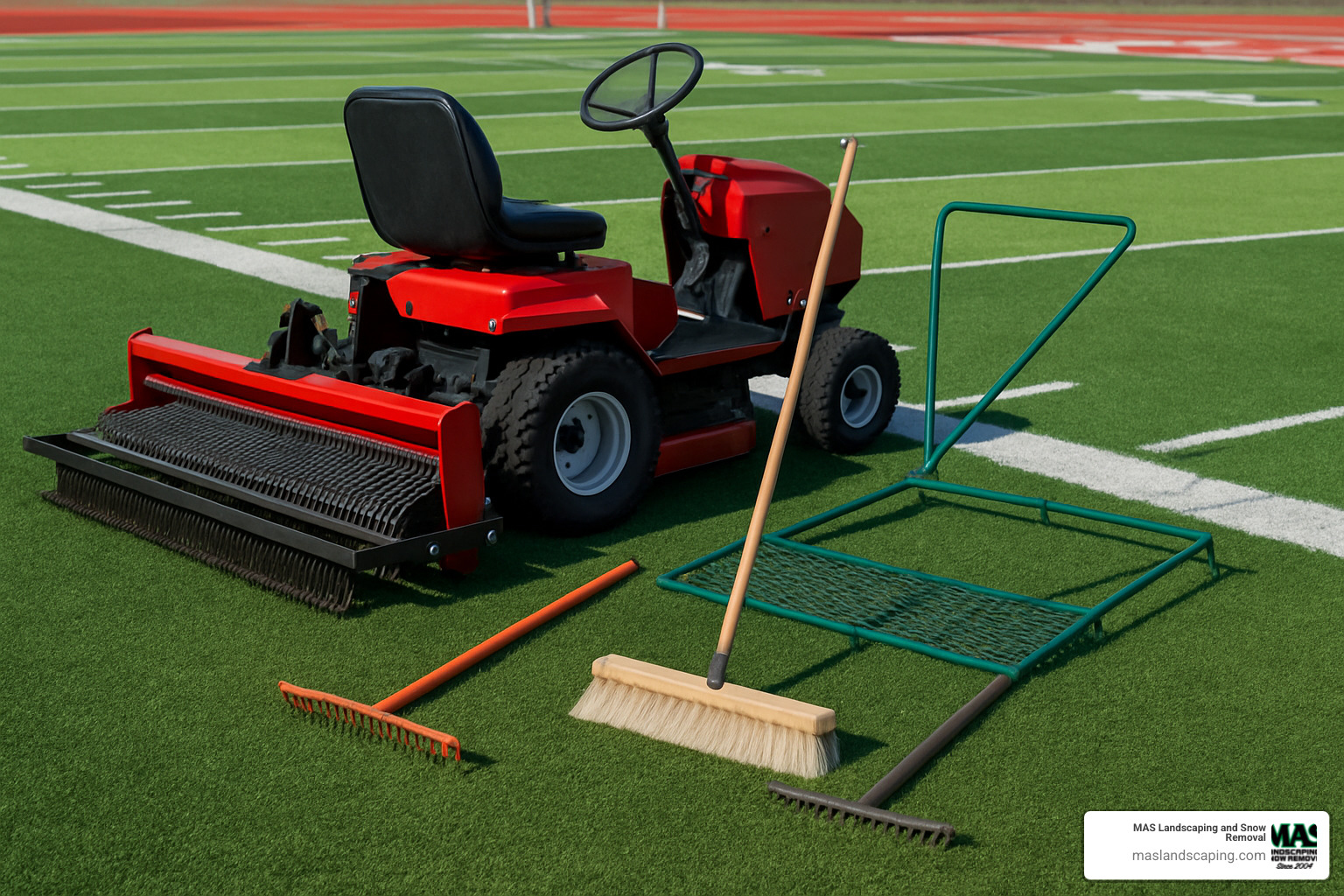
- Regular Grooming: Monthly brushing to maintain fiber position and infill distribution
- Infill Replenishment: Periodically replacing displaced infill material
- Disinfecting and Cleaning: Removing debris and sanitizing surfaces
- G-max Testing: Annual safety testing to ensure proper impact absorption
- Minor Repairs: Addressing seam issues or damaged areas
These maintenance activities typically require specialized equipment costing between $30,000 and $140,000, depending on whether maintenance is performed in-house or outsourced. For most of our clients in Malden, Medford, and nearby communities, a combination approach works best—handling routine maintenance internally while contracting specialized services annually.
Replacement & Disposal Every 8-10 Years
A critical component of any long-term turf field cost estimate is planning for replacement:
- Resurfacing Cost: $300,000-$600,000 (assuming the drainage system and base remain intact)
- Complete Replacement: $550,000-$1,350,000 if base issues exist
- Removal and Disposal: $45,000-$191,000 for disposal alone
The environmental impact and cost of disposal are significant considerations. With approximately 500,000 pounds of material (equivalent to about 15 dumpsters) needing disposal, recycling options should be explored whenever possible.
Mitigating Hidden Costs & Risks
Several strategies can help reduce unexpected expenses in your turf field cost estimate:
- Comprehensive Warranties: Ensure coverage for both materials and installation
- Quality Testing: Regular testing prevents premature failure
- Proper Drainage: Investing in superior drainage prevents costly water damage
- Reclaimable Infill: Using recyclable infill materials can reduce end-of-life disposal costs by up to 90%
We’ve seen how proper planning and quality installation by experienced professionals like our team at MAS Landscaping can prevent many common issues that lead to premature field failure and unexpected costs.
Financing & Cost-Saving Strategies
When staring down a hefty turf field cost estimate, it’s easy to feel overwhelmed. But take heart—there are plenty of creative financing approaches that can make this investment more manageable. We’ve seen numerous Massachusetts communities transform their dream fields into reality through smart planning and resourceful funding strategies.

Grants, Loans & Cooperative Programs
You don’t have to shoulder the entire financial burden alone. Many of our clients in Everett, Lynnfield and neighboring towns have successfully tapped into multiple funding sources:
Municipal bonds often serve as the backbone for public school and community projects, offering favorable interest rates for large-scale investments. One local high school we worked with secured voter approval for a bond that covered 60% of their field renovation.
State recreation grants can provide substantial support—Massachusetts offers several programs specifically designed for community athletic facilities. The Parkland Acquisitions and Renovations for Communities (PARC) grant, for instance, has helped numerous towns offset their turf field cost estimates.
Private sponsorships represent another valuable avenue. Local businesses often jump at the opportunity to support community athletic facilities, especially when recognition options are available. We’ve seen scoreboard sponsorships alone generate $50,000+ toward field funding in some communities.
Don’t overlook cooperative purchasing programs either. By joining forces with neighboring communities or school districts, you can leverage collective buying power for significant discounts on materials and services. Several Middlesex County schools recently saved nearly 15% on their turf field cost estimates through a regional purchasing alliance.
Smart Design Moves That Cut Costs
Strategic planning can dramatically reduce your overall expenditure without sacrificing quality:
Prioritize drainage above all else. A carefully designed drainage system might seem expensive initially, but it prevents catastrophic repairs down the road. We always tell our clients in Saugus and surrounding areas that proper drainage is the foundation of field longevity—skimp here, and you’ll pay dearly later.
Consider phasing your construction if budget constraints exist. Build the essential elements first (field base, drainage, turf), then add amenities like premium seating or advanced scoreboards as additional funding becomes available. One local middle school started with a basic field and added professional-grade lighting two years later when their booster club raised the necessary funds.
Reuse existing infrastructure whenever possible. When converting from natural grass, salvage usable elements like fencing, irrigation components, or lighting foundations. This approach saved one Malden client nearly $75,000 on their turf field cost estimate.
Though more expensive initially, LED lighting investments typically pay for themselves within 3-5 years through dramatic energy savings. Plus, many utility companies offer rebate programs that can offset 20-30% of installation costs. The long-term operational savings make this a smart financial decision for most of our Massachusetts clients.
Using Calculators & Pro Estimates for an Accurate Turf Field Cost Estimate
Getting precision in your budget projections requires the right tools and expertise:
Interactive cost calculators provided by many suppliers offer helpful ballpark figures to start your planning process. Just remember that these tools provide industry averages and may not account for region-specific factors that affect Massachusetts projects.
Nothing replaces professional site surveys when it comes to identifying location-specific challenges that impact costs. The soil composition in Chelsea differs significantly from Revere, for instance, which directly affects excavation and base preparation expenses.

Soil testing reveals crucial information about drainage needs and potential issues that could inflate your turf field cost estimate. This relatively small investment (typically $1,000-$2,500) can prevent tens of thousands in unexpected costs during construction.
Conducting a comparative analysis of similar projects in your region provides realistic benchmarks. We often connect potential clients with previous customers in nearby communities who can share their budgeting experiences and lessons learned.
At MAS Landscaping and Snow Removal, we provide thorough site evaluations for clients throughout Everett, Lynnfield, Malden and surrounding areas. Our team’s familiarity with local conditions means we can develop remarkably accurate estimates based on the specific requirements of your location—not just industry averages that might miss crucial regional factors.
For more detailed information about getting an accurate estimate for your specific project, check out our artificial turf installation estimate guide.
Frequently Asked Questions about Turf Field Cost Estimates
What is the average turf field cost estimate?
When school boards and facility managers ask me about the average turf field cost estimate, I usually explain that for a standard football field, you’re looking at anywhere from $550,000 to $1,350,000 for a complete installation. Breaking this down to square footage, that’s roughly $8-$20 per square foot – quite a range, right?
The wide variation exists because so many factors come into play: the quality of turf you select, how much site preparation your specific location needs, and even where you’re located in the country. For smaller projects like softball fields, you can generally expect costs between $420,000 and $650,000.
I should note that these figures represent industry averages based on market research and not actual costs for MAS Landscaping services. Every project has its unique requirements that can shift these numbers in either direction.
How long does artificial turf last before replacement?
Most artificial turf fields serve communities well for 8-10 years before they need replacement, though I’ve seen high-quality systems stretch to 12-15 years when they’re properly maintained. Think of it like a car – how long it lasts depends on how you treat it!
Several key factors influence your field’s lifespan:
- How intensively and frequently the field gets used
- The quality and consistency of your maintenance program
- Your local climate and weather patterns (Massachusetts winters can be tough!)
- The initial installation quality (cutting corners never pays off)
- The density and material composition of your turf fibers
Here’s some good news for your long-term budget planning: the underlying drainage systems and base layers typically last through 2-3 turf replacements (about 20-25 years). That’s why replacement costs ($300,000-$600,000) are significantly lower than your initial installation – you’re mostly just replacing the carpet on top.
How do maintenance costs compare to natural grass?
This question often seals the deal for many of my Massachusetts clients. The annual maintenance for artificial turf typically runs $6,000 to $20,000, while natural grass fields demand $18,000 to $50,000 each year. The difference becomes even more striking when you consider the complete picture.
Natural grass is thirsty – requiring approximately 1.5 million gallons of water over a growing season. That’s a resource that’s becoming increasingly precious (and expensive). Grass also demands constant attention: regular mowing, fertilizing, aerating, reseeding bare patches, and treating for pests and diseases.
The equipment needed for grass maintenance adds another layer of expense – specialized mowers, spreaders, and irrigation systems that require their own maintenance and eventual replacement.
When I help clients calculate their total turf field cost estimate over a 10-year period, they’re often surprised to find that the maintenance savings can offset a significant portion of the higher initial installation cost. Plus, there’s the added benefit of consistent playability – no more canceling games because of mud or waiting for grass to recover between heavy use periods.
For schools and towns across Everett, Lynnfield, Malden and other Massachusetts communities we serve, this long-term value proposition often makes artificial turf the more economical choice when viewed through a complete lifecycle lens.
Conclusion
Planning a sports field is a journey that extends far beyond the initial turf field cost estimate. While artificial turf fields certainly demand a higher upfront investment compared to natural grass, the math starts making sense when you consider the bigger picture – significantly lower maintenance costs and dramatically increased playable hours throughout the year.
For our Massachusetts communities dealing with unpredictable New England weather, artificial turf fields shine brightest during those rainy spring seasons and muddy fall months when natural fields would be closed. Your community gets more value from every dollar invested when that field can host games and practices regardless of recent rainfall.
The smartest approach is to think of your field as a decade-long investment rather than focusing solely on installation costs. By planning for the complete lifecycle – from initial construction through regular maintenance and eventual replacement – you’ll avoid budget surprises and maximize your return on investment.
At MAS Landscaping and Snow Removal, we’ve helped communities throughout Everett, Lynnfield, Malden, Melrose, Medford, Revere, Saugus, and Chelsea steer these complex decisions. Our deep understanding of local soil conditions, drainage challenges, and municipal requirements allows us to provide realistic estimates and durable installations custom to New England’s unique demands.
Every successful turf project begins with a thorough site evaluation. This critical first step reveals the true condition of your existing space – identifying drainage issues, soil composition challenges, and other factors that significantly impact your budget. With this knowledge, you can develop a comprehensive turf field cost estimate that accounts for all necessary components from base preparation to final installation.
Whether you’re just beginning to explore options or ready to break ground on your turf field project, we’re here to help you make informed decisions that balance upfront costs with long-term value. Our team brings local expertise and personalized attention to every project, ensuring your new field will serve your community for years to come.
For more information about our landscaping and turf installation services, please visit our full-service landscape installation page or contact us directly to discuss your specific project needs.