




Why Hand Tools Are Essential for Brush Clearing
Hand tools for clearing brush are the practical choice for reclaiming overgrown areas without the expense or disruption of heavy machinery. If you are dealing with vines, brambles, or young saplings on a Greater Boston property, the right manual tools can make the work more predictable, more selective, and often safer around fences, gardens, and tight corners.
For homeowners and property managers in places like Everett, Lynnfield, Malden, Saugus, Melrose, Medford, Revere, and Chelsea, hand tools are especially useful because many yards include:
- Narrow side yards and gate access that will not fit large equipment
- Slopes, retaining walls, and uneven ground where traction is a concern
- Established landscaping you want to keep (ornamentals, perennials, fruit trees)
- Noise-sensitive neighborhoods where quiet work is appreciated
Best Hand Tools for Clearing Brush:
- Machetes: For vines and small brush.
- Axes and Hatchets: For small trees and woody growth.
- Loppers: For branches up to 3 inches thick.
- Bush Hooks: For heavy thickets and saplings.
- Scythes: For mowing weeds and grass.
- Woodsman’s Pal: A multi-purpose tool for cutting and digging.
A major advantage of hand tools is control. Instead of flattening everything in the path of a machine, you can remove nuisance vegetation while leaving desirable plants intact. That matters when you are clearing along property lines, around sheds, near stone walls, or under low-hanging limbs where accidental damage can happen quickly.
Hand tools also shine for staged cleanup. Many overgrown areas are a mix of vegetation types (soft weeds, vine tangles, thorny canes, and woody stems). With a small set of hand tools, you can switch methods as conditions change and work in layers:
- Cut and pull vines and surface growth to reveal what is underneath.
- Reduce brush height so you can see footing and obstacles.
- Limb and cut thicker stems into manageable lengths.
- Consolidate debris into piles for removal or chipping.
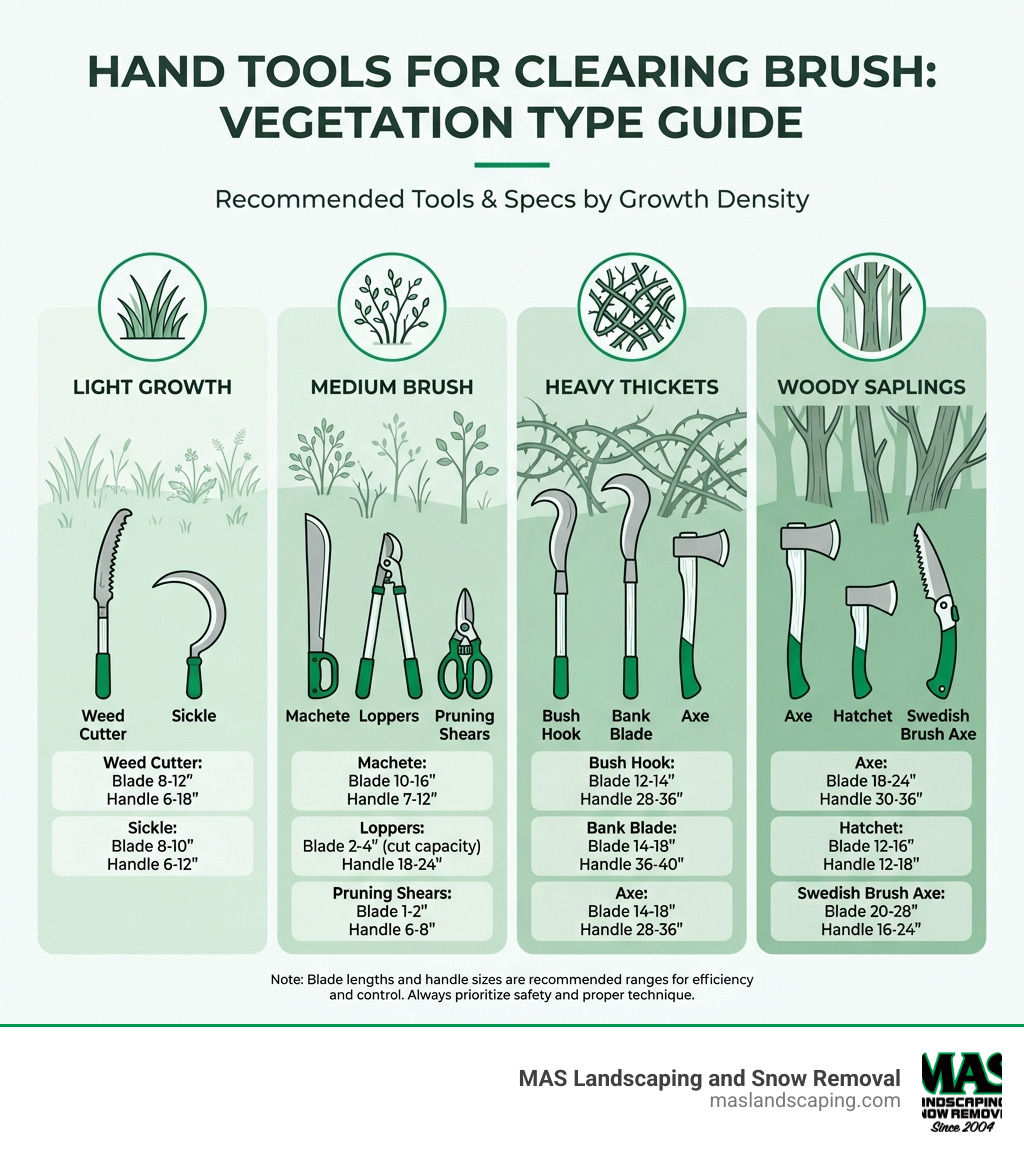
Hand tools for clearing brush terms to remember:
Essential Hand Tools for Clearing Brush
Selecting the right hand tools for clearing brush depends on vegetation density. Key features like blade material and handle length determine efficiency and comfort.
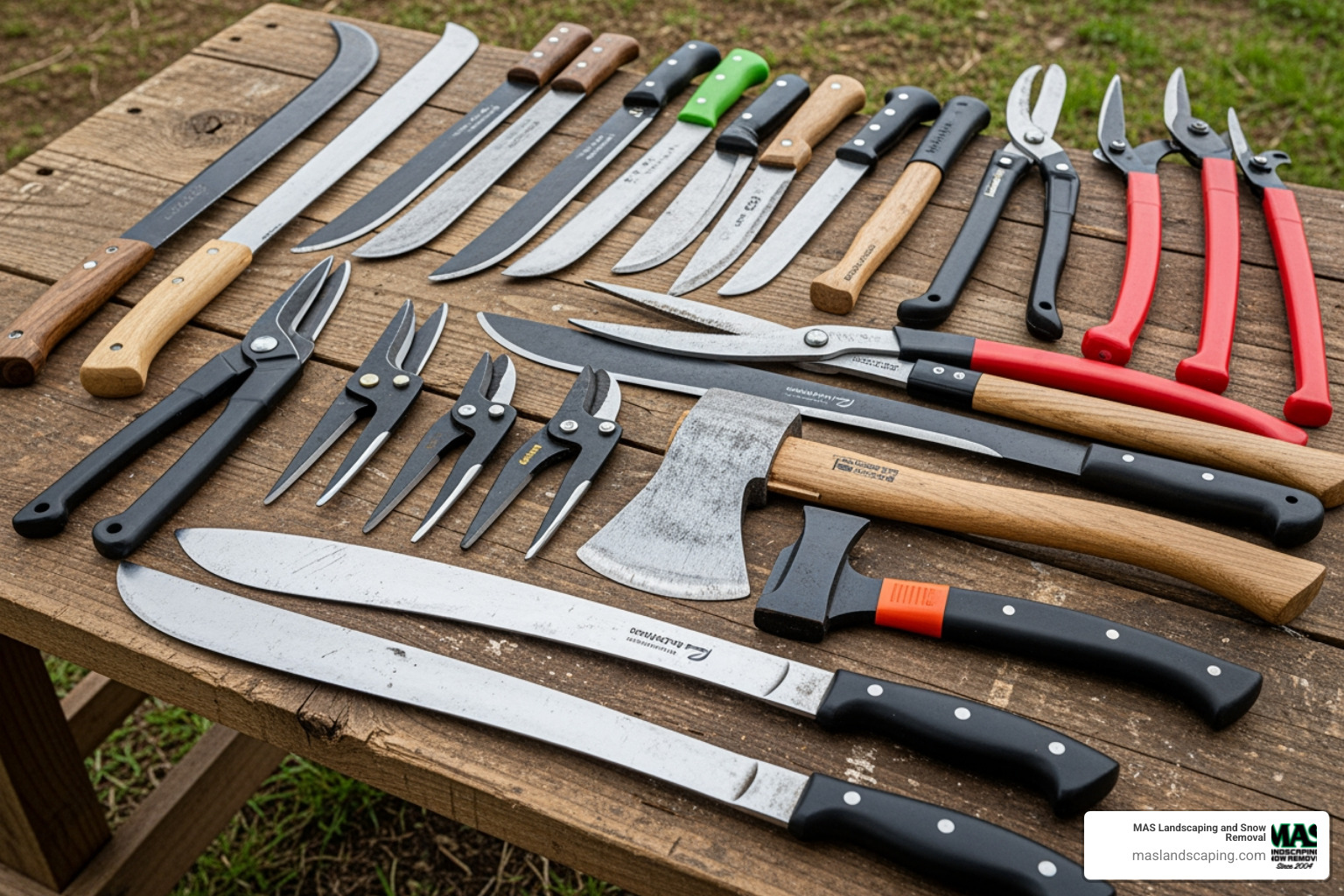
Heavy-Duty Cutting with Axes and Hatchets
Axes and hatchets are best for felling small trees, chopping thick bushes, and breaking up roots. They provide significant chopping power and are budget-friendly, though they require physical exertion and lack precision. Look for high-carbon steel blades and a handle length that balances leverage with control. Your Arsenal for the Wild: Essential Equipment to Clear Brush and Small Trees
Precision Trimming with Loppers and Shears
Loppers and shears are ideal for branches up to 3 inches. Their long handles provide leverage for overhead cuts and reaching into dense foliage.
| Feature | Bypass Loppers | Anvil Loppers |
|---|---|---|
| Cutting Action | Scissor-like blades | Single blade against flat anvil |
| Best For | Live wood; clean cuts | Dead, dry wood |
| Cut Quality | Precise, promotes health | Can crush live stems |
Gear-driven loppers increase cutting power, while rust-resistant steel ensures longevity. Clean blades after use and keep metal parts oiled. Say Goodbye to Yard Mess: A Comprehensive Guide to Brush and Debris Removal
Versatile Machetes and Woodsman’s Pals
Machetes are excellent for clearing weeds and vines quickly. The Woodsman’s Pal is a robust alternative for cutting, chopping, and digging. While fast for light growth, they are less effective on thick timber. Always maintain a firm grip and use a slicing motion. For more tips, see how to clear brush with a machete.
Specialized Hand Tools for Clearing Brush and Thickets
Dense thickets require tools engineered for power and reach. Overgrown Property Cleanup
Bank Blades and Bush Hooks
Bank blades and bush hooks use heavy heads and 36-40 inch handles to generate momentum for cutting through dense brush and saplings. They are ideal for clearing fence lines and establishing trails. While powerful, they pose safety risks like glancing blows, so controlled swings and shin guards are essential. Sharpen with a mill bastard file and finish with a whetstone.
Scythes and Weed Cutters
Scythes are efficient for mowing large areas of grass and weeds quietly. Brush scythes feature shorter, sturdier blades for tougher vegetation. Weed cutters (grass whips) are lightweight and cut on both forward and return strokes. These tools are eco-friendly but require practice to master the rhythmic sweeping motion. Land Clearing Near Me Guide
Key Features to Consider When Choosing Your Arsenal
Buying the right hand tools for clearing brush is not only about choosing a tool type. Small differences in steel, handle length, and ergonomics can determine whether a job takes an hour or an afternoon, and whether you finish comfortably or with sore wrists and shoulders.
Ergonomics and comfort
- Grip shape and texture: Look for non-slip grips that stay secure with gloves and sweat.
- Vibration and shock: Heavier chopping tools can transfer impact into your hands and elbows. A well-shaped handle and proper technique reduce fatigue.
- Balance: A tool that feels front-heavy may cut aggressively but can wear you out faster.
Blade material and edge retention
- High-carbon steel: Often holds a sharp edge well and bites into woody material.
- Rust-resistant steel: Helps in damp conditions, but still benefits from cleaning and oiling.
Regardless of steel type, the edge matters more than almost anything else. A sharp tool is typically safer because it requires less force, which reduces slips and uncontrolled swings.
Handle length: reach vs. precision
- Longer handles: Provide leverage and keep your hands farther from thorns and dense growth. Great for bank blades, bush hooks, and some loppers.
- Shorter handles: Offer better precision in tight spaces, such as near fences, foundations, and ornamental plantings.
If you are clearing near stones, edging, or roots you want to preserve, prioritize control over raw leverage.
Tool weight and momentum
- Lightweight tools: Faster for repetitive work like vines and weeds, and easier to use overhead.
- Heavier tools: Can power through thicker stems using momentum, but cause faster fatigue if the tool is too heavy for your strength and pace.
A practical approach is to match weight to the thickest material you expect to cut most often, not the rare worst-case stem.
Handle construction and durability
- Durable construction: Brush work involves impacts, twisting stems, and occasional strikes against soil or hidden rocks.
- Secure head attachment: Check that heads are tightly seated and fasteners are solid before each session.
Planning around defensible space and property safety
While Massachusetts does not have the same wildfire framework as some western states, many property owners still use defensible space concepts to reduce risk and improve access around structures. For guidance on how spacing and fuel reduction is commonly approached, review Cal Fire’s defensible space guidelines. Use those ideas as general best practices, then apply them realistically to your local conditions, lot size, and municipal requirements.
Choosing tools with the right reach, edge durability, and comfort makes it easier to keep up with ongoing maintenance so brush does not return as quickly.
Safety and Maintenance for Longevity
Safety First:
- Maintain a firm, two-handed grip on heavy tools.
- Use controlled, slicing motions rather than hacking.
- Wear gloves, safety glasses, and shin guards.
- Transport tools with blades pointed down and away from the body.
Maintenance:
- Cleaning: Remove sap and moisture after every use.
- Oiling: Lightly oil metal parts to prevent rust.
- Sharpening: Use a mill bastard file for the initial edge and a whetstone to refine it. Always maintain factory bevels and use file guards to protect your hands.
Frequently Asked Questions about Hand Tools for Clearing Brush
When should I use hand tools versus power machinery?
Use hand tools for steep terrain, limited access, precision pruning, or in noise-sensitive residential areas. They are cost-effective for smaller jobs and have zero emissions. Power machinery is better for large acreage, very thick woody material, or when speed is the primary priority.
A simple rule of thumb:
- If you can carry debris out by hand in a reasonable number of trips and you need precision, hand tools are usually the better starting point.
- If you are dealing with long fence lines, thick sapling regrowth, or acreage where hauling brush becomes the main time sink, professional equipment and a crew can be more efficient.
What are the best multi-purpose hand tools for clearing brush?
- Woodsman’s Pal: For cutting, chopping, digging, and pulling.
- Machete Axe: Combines reach with chopping power.
- Billhook: Versatile for dividing plants, cutting shoots, and tackling vines.
If storage space is limited, prioritize one chopping/slicing tool plus a pair of loppers. That combination covers most common backyard brush types (vines, canes, and small woody stems) without needing a large tool collection.
What is the average cost of professional brush clearing services?
Based on internet data, the average cost for professional brush clearing services typically ranges from $150 to $3,000 per acre, depending on vegetation density, disposal needs, and terrain. For projects with very heavy growth, difficult access, or extensive hauling and disposal, internet pricing can reach $10,000+ per acre in some markets.
Note: These are average costs based on internet data and not actual costs for MAS Landscaping. For an accurate estimate for your project in Everett, Lynnfield, Malden, Melrose, Medford, Revere, Saugus, or Chelsea, contact us for a consultation.
Conclusion
With the right hand tools for clearing brush, you can efficiently manage overgrown vegetation. From axes to loppers, each tool serves a specific purpose in property maintenance. While hand tools offer precision and control, some projects require professional intervention.
MAS Landscaping and Snow Removal, based in Saugus, MA, serves Everett, Lynnfield, Malden, Melrose, Medford, Revere, and Chelsea. We provide professional yard clean up and brush removal to transform your outdoor space. Contact us today for local expertise and personalized service.
