




Why Adding a Sprinkler Zone Can Transform Your Lawn
Adding a sprinkler zone to your existing irrigation system is one of the most effective ways to fix dry patches, cover newly landscaped areas, and make sure every part of your yard gets the right amount of water.
Here’s a quick overview of how to do it:
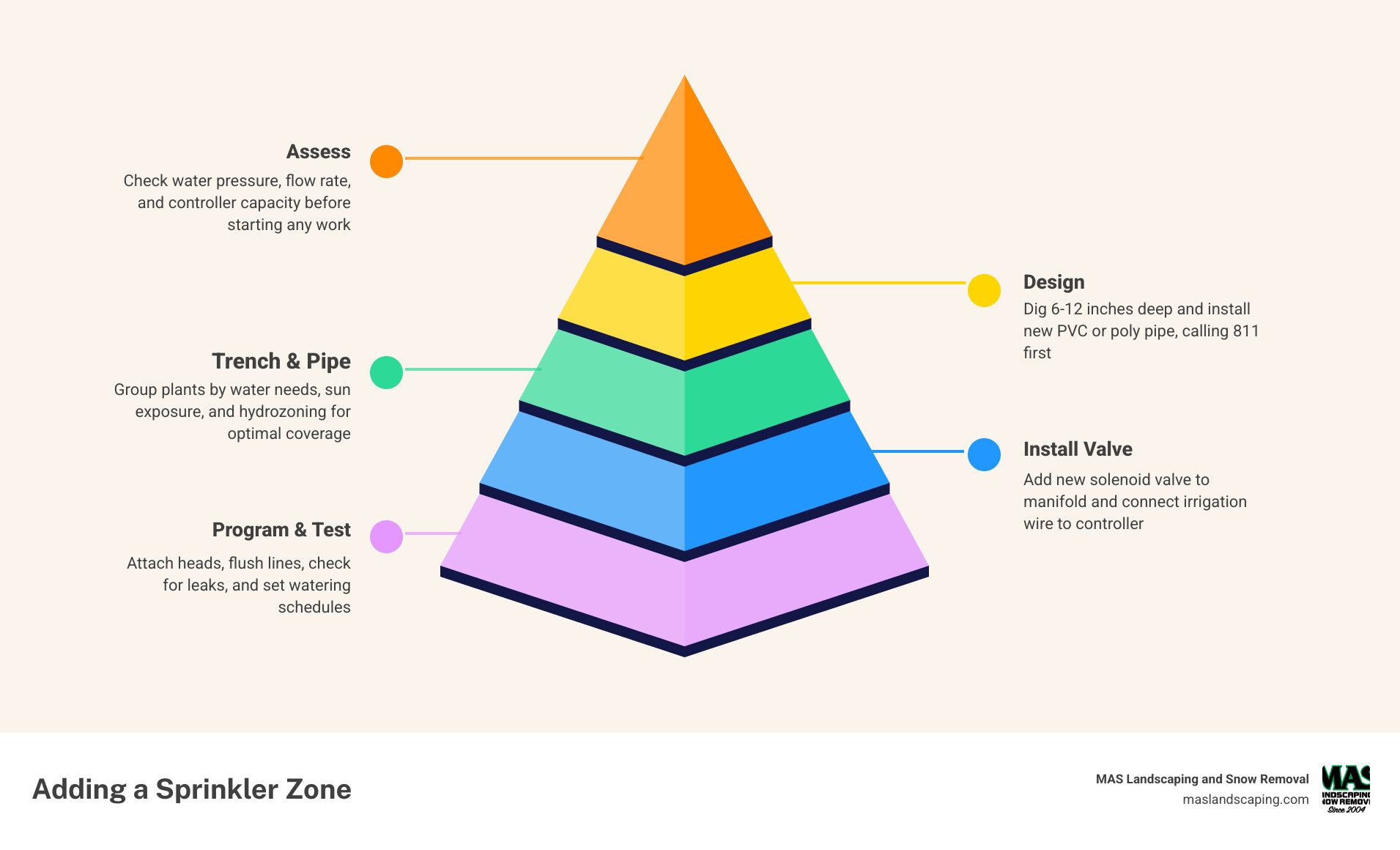
- Assess your system — check water pressure, flow rate, and controller capacity
- Design the new zone layout — group plants by water needs and sun exposure
- Trench and install pipe — dig 6–12 inches deep and run new PVC or poly pipe
- Install the valve and wire it — connect a new solenoid valve back to the controller
- Attach sprinkler heads and test — flush lines, check for leaks, and verify coverage
It sounds straightforward — and it often is. But a lot of homeowners put it off longer than they should.
One common story: a homeowner disconnects a backyard zone and spends the next three years dragging a hose around manually. Sound familiar? If your yard has grown, changed, or just never had quite enough coverage, you’re not alone.
The good news is that expanding your irrigation system is a manageable project — whether you tackle it yourself or bring in a professional. This guide walks you through every step.
Assessing Your System Before Adding a Sprinkler Zone
Before we start digging, we need to make sure the existing system can actually support another zone. This is the step that saves the most headaches later.
A sprinkler system is only as good as its weakest link. If pressure is already marginal, the controller is full, or the valve box is packed tighter than a junk drawer, the new zone may underperform from day one.

Here is what we check first:
Water pressure and flow rate
Two numbers matter most:
- Static pressure, usually checked with a pressure gauge on an outdoor faucet
- Flow rate, usually measured in gallons per minute, or GPM
Pressure tells us how forcefully water can move. Flow tells us how much water is available. You need both.
If you add too many heads to one zone, pressure drops, heads may pop up weakly, and coverage gets patchy. That is one of the main reasons homeowners end up adding sprinkler zone capacity in the first place: the original zone was overloaded.
As a rule, we design around real-world performance, not wishful thinking. A clean layout plan and honest zoning matter more than fancy parts. This is also why resources like Mastering Residential Sprinkler System Layout Planning: A Comprehensive Guide emphasize measuring and pressure testing before installation.
Existing controller capacity
Next, we look at the timer or controller.
Ask:
- Is there an unused station terminal available?
- Does the controller support additional zones?
- Is it an older model worth replacing anyway?
Some homeowners assume they must keep the old controller forever. Not necessarily. If all stations are full, upgrading to a larger or smart controller may be the simplest path. In many cases, a smart controller also improves efficiency. Research shows smart irrigation with digital zoning can reduce water use by up to 40% compared with traditional schedules.
Valve box and manifold space
Every new physical zone needs its own valve unless you are using a specialty single-wire solution, which we cover later.
Check:
- Is there room to add another valve at the manifold?
- Can we extend the manifold, or do we need a separate valve box?
- Are the existing pipes and fittings in good shape?
A cramped manifold is common in older systems. Sometimes the cleanest solution is not forcing one more valve into the original box, but installing a new valve box closer to the new irrigation area.
Wiring availability
A traditional valve setup usually needs:
- One dedicated zone wire per valve
- One shared common wire
If there is already spare irrigation wire in the ground, great. If not, you may need to run new wire or consider a single-wire dual-zone device. Always use waterproof wire connectors underground. Regular wire nuts belong nowhere near wet soil unless you enjoy repeat digging.
What problems justify a new zone?
Homeowners usually need another zone for one or more of these reasons:
- New lawn, garden bed, or landscape area
- Dry spots caused by poor original coverage
- Low pressure because one zone has too many heads
- Need to separate turf from shrubs or drip irrigation
- Different sun exposure across the yard
- Different soil conditions
- Desire for better water efficiency and scheduling
For example, turf should not usually share a zone with shrubs or drip lines. They need different run times and often different pressure. If one area bakes in full sun and another stays shaded most of the day, they also should not be forced onto the same schedule.
Good irrigation works like good meal planning: not everything belongs in one pot.
For ongoing yard health after irrigation upgrades, it also helps to coordinate watering with broader lawn care and maintenance practices.
How to Add Sprinkler Zone in 5 Simple Steps
Once we know the system can support expansion, we can move into installation.

If you would rather skip the trenching workout, our team can help through local service support and planning similar to what homeowners look for when searching for lawn care services near me.
Step 1: Designing Your New Sprinkler Zone Layout
This is where the project is won or lost.
Start by mapping the area that needs coverage. Mark:
- Lawn edges
- Beds and planting islands
- Walkways and patios
- Trees and shrubs
- Sunny vs shaded sections
- Existing sprinkler heads and lines
The goal is hydrozoning, which means grouping plants with similar water needs together.
A good new zone usually separates:
- Turf from shrubs
- Drip irrigation from spray irrigation
- Sunny areas from shady areas
- Sandy spots from heavier soils when possible
A few design rules matter a lot:
Use head-to-head coverage
Each sprinkler head should throw water to the next head. That overlap prevents dry strips.
Do not mix head types in one zone
Research is clear here: spray heads, rotors, and rotary nozzles have different precipitation rates and pressure needs. Spray heads apply water much faster than rotors, so mixing them in one zone leads to uneven watering.
Use:
- Spray heads for smaller lawn sections
- Rotors for larger open areas
- Drip for beds, shrubs, and narrow planting areas
Match the zone to available pressure
Do not design a zone with more heads than the water supply can support. If needed, split one big area into two smaller zones.
A practical discussion from this homeowner thread about adding a zone to an existing system highlights a common mistake: trying to force new turf areas onto an existing shrub zone. That creates poor watering for both. Separate uses almost always perform better.
Step 2: Trenching and Pipe Installation
Now we get dirty.
Before digging, call 811 to have underground utilities marked. That one phone call can prevent a very memorable afternoon for all the wrong reasons.
For most residential irrigation additions, trenches are typically:
- At least 6 inches deep
- Often 6 to 12 inches deep depending on local conditions and routing
In colder climates like ours in eastern Massachusetts, burying pipe with freeze conditions in mind matters. The exact depth can depend on the setup, but shallow, poorly protected lines are more vulnerable to damage.
You will usually need:
- PVC or poly pipe compatible with the existing system
- Tee fittings and elbows
- Primer and solvent cement for PVC, if applicable
- Pipe cutters
- Shovel or trenching tool
- Flags or marking paint
Best practices:
- Keep trench routes as straight as practical
- Use sweeping turns where possible
- Avoid unnecessary fittings
- Protect pipe from sharp rocks
- Leave enough slack or flexible connection at heads
If you are tying into an existing mainline, shut off the water first and drain the line before cutting. Clean cuts matter. Crooked cuts and rushed glue joints are future leak generators.
Step 3: Installing the New Valve and Wiring
Each traditional new zone needs a dedicated valve connected to the mainline and controller.
At this stage, we:
- Tie a new valve into the manifold or install a new remote valve box
- Connect the valve inlet to the pressurized mainline
- Connect the valve outlet to the new lateral zone pipe
- Run irrigation wire from the valve back to the controller
- Use waterproof connectors for all underground splices
The standard wiring setup is simple:
- One wire from the valve solenoid to the common wire
- One wire from the valve solenoid to the new station wire
Then inside the controller:
- Common wire goes to the common terminal
- Station wire goes to the new zone terminal
Label everything. Seriously. A labeled valve box is a gift to your future self.
If there is no spare wire available, you have three options:
- Run new irrigation wire
- Install a larger multi-zone controller and new wiring
- Use a single-wire dual-zone device if conditions make sense
Step 4: Connecting Sprinkler Heads and Testing
With the pipe in place, install the heads or drip components for the new zone.
Use the same head type throughout the zone. Set heads level with finish grade so they pop up correctly and do not become lawnmower snacks.
Before attaching final nozzles, flush the lines. This step removes dirt and debris left from cutting and trenching. Skipping it can clog new heads immediately.
Then test for:
- Leaks at fittings and valve connections
- Proper head rotation or spray pattern
- Head-to-head coverage
- Overspray on pavement or siding
- Low spots that collect water
If coverage is inconsistent, we adjust nozzle arc, radius, or spacing before backfilling completely.
After installation, good watering habits still matter. If you are trying to keep new turf and older lawn areas healthy together, our general lawn maintenance guidance pairs well with irrigation improvements.
Step 5: Programming the Controller for the New Sprinkler Zone
The physical install is only half the job. The schedule has to make sense too.
Modern smart controllers are especially useful when adding sprinkler zone capacity because they can adjust for weather, season, and plant type more easily than older timers.
Program the new zone based on:
- Plant type
- Head type
- Sun exposure
- Soil type
- Slope and runoff potential
A few examples:
- Turf in sunny areas may need more frequent seasonal adjustment
- Shrub or drip zones usually run differently than lawn zones
- Clay soil may benefit from cycle-and-soak watering to reduce runoff
- Sandy soil often needs shorter, more frequent watering
Seasonal reprogramming is important in Massachusetts. What works in July will likely overwater in spring or fall.
Smart irrigation can make this easier, and proper zoning supports a healthier landscape overall, especially when coordinated with broader lawn care and landscaping goals.
Comparing Traditional Valves vs. Single-Wire Dual-Zone Devices
Sometimes the plumbing is easy, but the wiring is the problem. That is where single-wire dual-zone devices come in.
These devices allow two independently controlled valves to work through one existing field wire path on many 24-volt irrigation systems. They are often used when:
- A zone wire is broken
- There is no easy path to run new wire
- The controller has an open station, but the field wiring is limited
- Landscape disruption from new wire trenching would be excessive
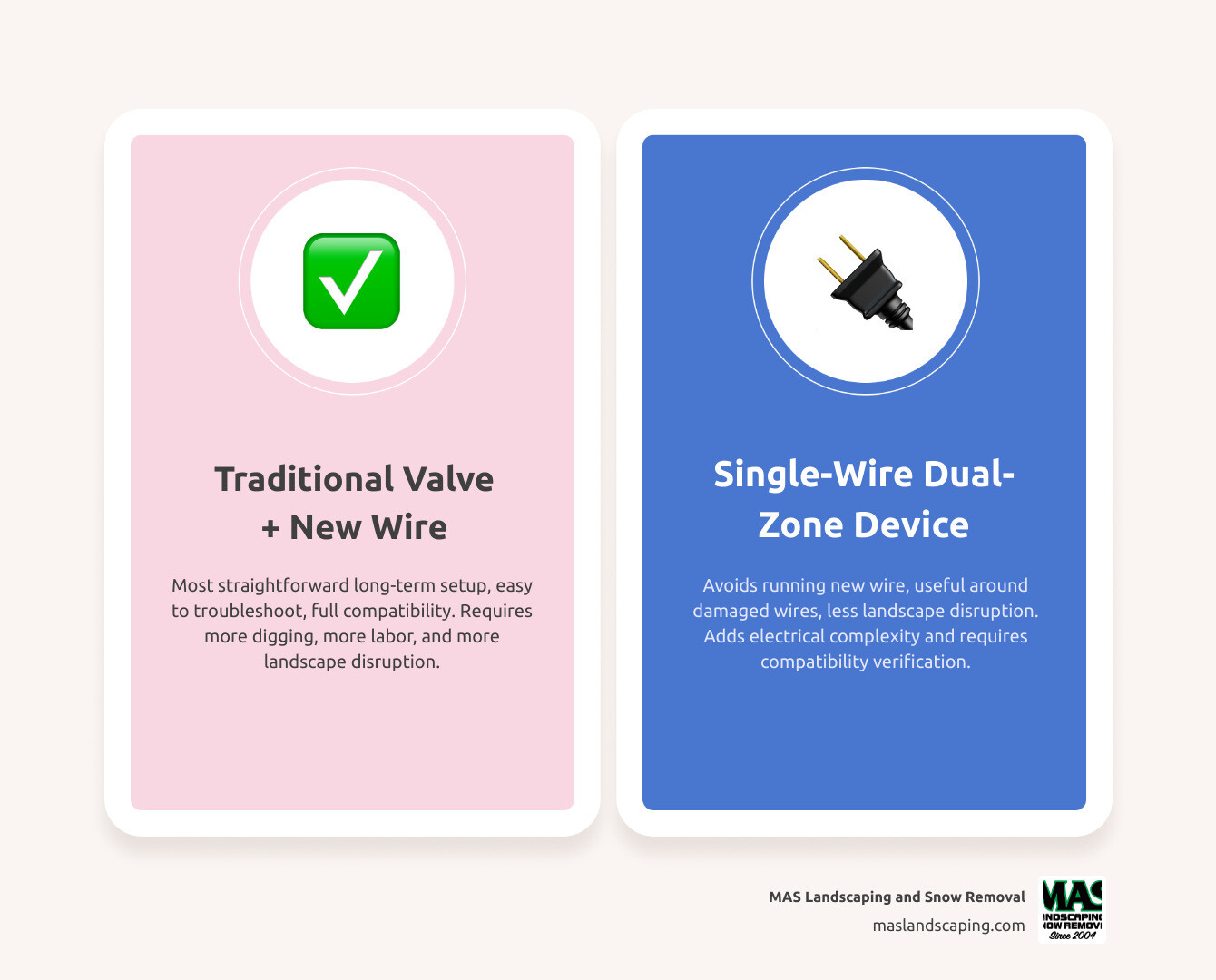
Here is the simple comparison:
| Option | Pros | Cons | Best use case |
|---|---|---|---|
| Traditional new valve and new wire | Most straightforward long-term setup, easy to troubleshoot, full compatibility | More digging, more labor, more disruption | Best when you can access the manifold and run wire normally |
| New valve with spare existing wire | Clean and reliable, minimal extra complexity | Only works if spare conductors already exist | Best when controller and field wire both have open capacity |
| Single-wire dual-zone device | Avoids running new wire, useful around damaged wires, less landscape disruption | Adds electrical complexity, compatibility must be verified, not always the best first choice | Best when wiring access is the main obstacle |
A few important notes:
- These devices can be very useful, but they are not magic.
- They solve wiring problems, not pressure problems.
- You still need a properly sized new valve and a correctly designed zone.
- You must confirm controller compatibility and available station capacity.
For many homeowners, a traditional valve and wiring setup is still the best long-term solution because it is simpler to service later. But where hardscaping, driveways, or established landscaping make rewiring difficult, a dual-zone device can be a smart workaround.
If you are unsure which route makes sense, working with an experienced lawn care company or irrigation professional can save time and repeat repairs.
Cost Estimates and Maintenance for New Irrigation Zones
Understanding the Investment
The cost to add a zone varies widely based on:
- Size of the new area
- Number and type of heads
- Whether a new controller is needed
- Whether spare wire already exists
- Difficulty of trenching
- Location of the nearest manifold or mainline
- Whether hardscape, roots, or utilities complicate the route
Based on internet data cited across irrigation guides, homeowners often see a broad average range of about $500 to $5,500 for adding a new zone, with many projects falling somewhere in the middle depending on complexity. Those are general web averages, not pricing for MAS Landscaping and Snow Removal.
DIY can lower out-of-pocket cost, but only if the design, pressure calculations, wiring, and installation are done correctly. Research on residential irrigation planning suggests DIY can save a meaningful amount on labor, but it also increases the risk of issues like weak pressure, poor coverage, leaks, and mixed head types.
For a general background on internet-reported ranges, see How Much To Add A Zone To Sprinkler System? A Comprehensive Guide.
In our area, another factor is seasonal care. New irrigation work should be coordinated with spring startup, mid-season checks, and fall shutdown. That is one reason homeowners often combine irrigation improvements with broader seasonal services like lawn care fall clean up or ongoing support similar to what people look for under best lawn care service near me.
Annual maintenance tasks after installation
Once the new zone is live, do not forget it exists until something turns your lawn into a rice paddy.
We recommend this maintenance checklist:
- Inspect heads weekly during peak watering season for clogs, tilt, or damage
- Run each zone manually once a month to confirm proper operation
- Check valve boxes for standing water, corrosion, or loose wire connections
- Adjust controller schedules seasonally
- Clean or replace nozzles as needed
- Watch for dry spots, runoff, or overspray
- Test rain or weather sensors if installed
- Winterize before the first hard freeze
- Schedule spring startup to verify all zones, including the new one, are operating correctly
Backflow devices may also require testing under local rules, so follow municipal requirements in your service area.
Frequently Asked Questions about Adding Sprinkler Zones
Can I add a new zone without digging up my entire yard?
Yes. In most cases, you only need localized trenching where the new pipe and wire will run. You do not have to excavate the whole lawn.
If wire access is the main obstacle, a single-wire dual-zone device may help avoid running all-new wiring. There are also above-ground smart watering solutions marketed as no-dig options, but those are generally a different category from expanding a traditional in-ground irrigation system.
How do I know if my current controller can handle an extra zone?
Open the controller and check for:
- An unused station terminal
- Capacity in the programming menu
- Power and compatibility for another 24-volt valve
If all station terminals are already in use, you may need a larger controller or a second controller. In many cases, upgrading to a smart controller is the better long-term move.
If you already have a multi-zone setup and want to understand controller planning better, our guide on how to master your yard with a 4-zone sprinkler system kit is a helpful next read.
Why is my water pressure lower after adding a new zone?
Usually because one of three things happened:
- Too many heads were added to the zone
- Pipe size is too small for the demand
- The system already had limited available flow and pressure
It can also happen if there is a partially closed valve, leak, clogged filter, or debris in the line.
The fix is not always “turn it up.” Usually it means reducing demand, splitting the area into another zone, correcting leaks, or redesigning the layout.
Conclusion
Adding sprinkler zone capacity is one of the smartest upgrades you can make when your yard has outgrown its original irrigation plan. The key is to assess the system first, design the zone correctly, install the right valve and wiring, and program it for the way your landscape actually uses water.
At MAS Landscaping and Snow Removal, we bring the kind of personalized service and local experience that matters in communities around Saugus, Everett, Lynnfield, Malden, and nearby Massachusetts service areas. We understand how New England seasons, soil conditions, and changing landscapes affect irrigation performance over time.
If you want more practical outdoor care guidance, explore our Lawn Care Services Ultimate Guide. If you are ready for help with irrigation planning or a yard upgrade, you can also Request a Professional Consultation.
