

Pea Gravel or River Rock Gravel: Which One Is Right for You?
River rock gravel is a naturally smooth, rounded stone formed by years of water erosion — and it’s one of the most popular landscaping materials for drainage, pathways, garden beds, and water features.
Here’s a quick side-by-side to help you decide:
| Feature | Pea Gravel | River Rock Gravel |
|---|---|---|
| Size | ~3/8 inch | 1/2 inch to 6+ inches |
| Texture | Small, smooth, rounded | Smooth, rounded, heavier |
| Best for | Walkways, dog runs, playgrounds | Drainage, dry creek beds, garden beds |
| Foot comfort | High | Low to medium (larger sizes) |
| Drainage | Good | Excellent |
| Maintenance | Low | Very low |
Both materials are low-maintenance, long-lasting alternatives to mulch — but they serve different purposes and suit different projects.
If you’re a homeowner in the Greater Boston area trying to figure out which stone is right for your yard, you’re in the right place. This guide breaks down the differences, the best uses for each, and how to make a smart choice for your specific project.

Understanding River Rock Gravel vs. Pea Gravel
When we talk about stone for your yard, it is easy to get overwhelmed by the terminology. Is it a pebble? Is it a cobble? Is it just “dirt with attitude”? In landscaping, river rock gravel and pea gravel are cousins, but they have very different “personalities.”
Both stones are the result of a natural formation process involving water. Over decades or even centuries, the constant flow of rivers and streams tumbles these rocks against one another. This natural “rock tumbler” effect wears down sharp edges, resulting in a smooth texture and rounded edges that feel much better in the hand (or under a paw) than crushed stone.
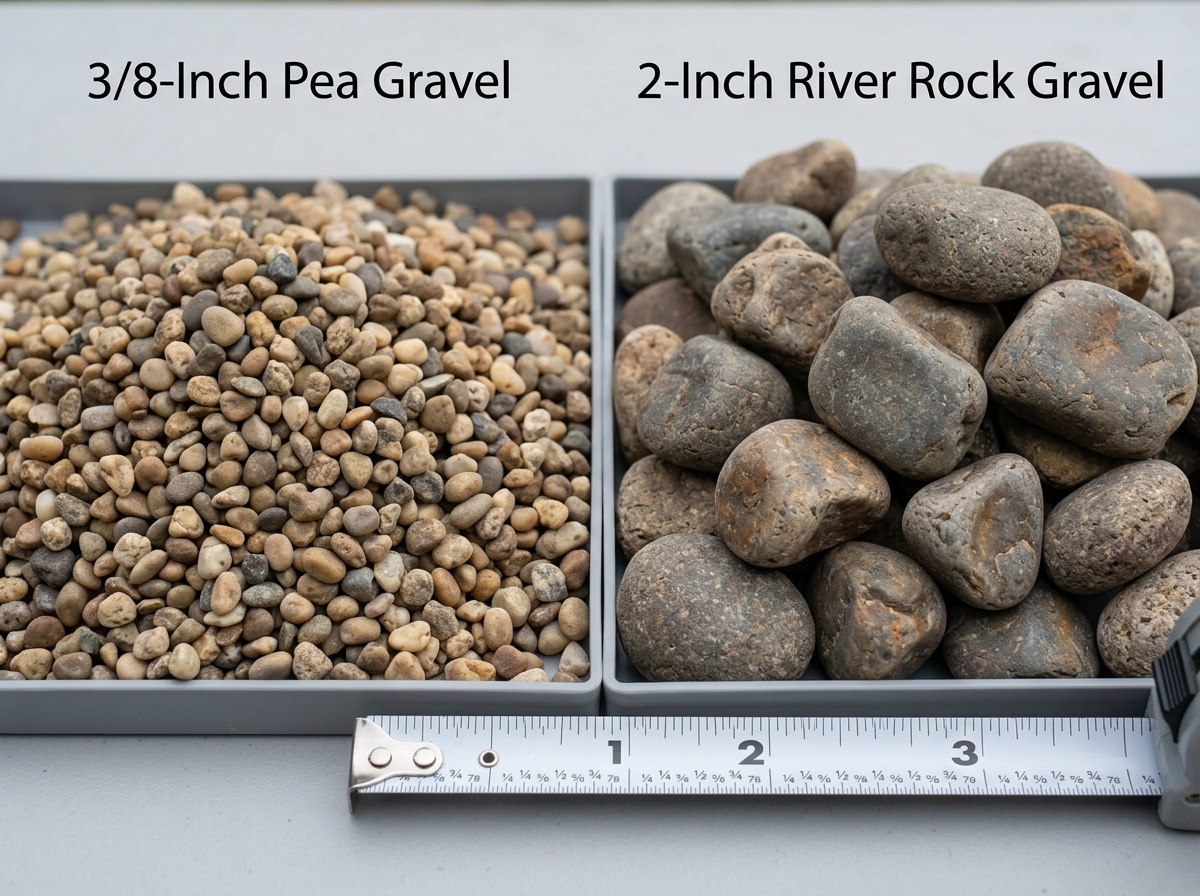
The primary difference lies in their size. Pea gravel is the “baby” of the family, typically screened to about 3/8 of an inch. River rock gravel, on the other hand, is a broader category that can range from half an inch to over six inches in diameter. Because they are washed and screened, they are generally free of “fines” (the dust and tiny particles found in crushed stone), which makes them superior for certain functional tasks.
| Feature | Pea Gravel | River Rock Gravel |
|---|---|---|
| Common Size | 3/8″ | 1″ to 3″ (Standard) |
| Texture | Smooth, uniform | Smooth, varied shapes |
| Compaction | Does not compact | Does not compact |
| Primary Use | High-traffic paths | Drainage & Decoration |
If you are planning a large project, understanding these nuances is vital. You can find more details on how these fit into our bulk landscaping materials offerings to ensure you get the right volume for your Essex or Middlesex County home.
Defining the Characteristics of River Rock Gravel
River rock gravel is often the “supermodel” of the stone world. It features a beautiful palette of earth tones, including tans, whites, browns, and soft grays. Depending on the size you order, it might be referred to by several names:
- Egg Rock: Typically 1 to 2 inches in size (roughly the size of a hen’s egg).
- Pebbles: Smaller variations, often used in decorative pots.
- Cobble Stone: Larger stones, usually 3 to 6 inches or more, used for dramatic visual impact.
Because it is a natural product, no two loads are identical. It is quarried from different veins and locations, meaning you will see a delightful variety in every scoop. It is important to note that when delivered, the stone may have a light coating of dust or sand from the screening process. A quick spray with a hose or a good New England rainstorm will rinse it off, revealing the rich, natural colors underneath. For more on the specific geological formation, you can check out this guide on River Gravel / Pea Gravel.
When to Choose Pea Gravel Over Larger River Rock Gravel
While we love the look of big stones, bigger isn’t always better. Pea gravel is the champion of comfort. Because of its 3/8-inch size, it is small enough to shift slightly underfoot, making it much easier to walk on than 2-inch “Egg Rock.”
We often recommend pea gravel for:
- Walkways and Patios: It creates a crunching sound that provides a bit of home security while remaining easy on the feet.
- Dog Runs: The rounded edges won’t hurt your pup’s paws.
- Playground Surfaces: It provides a clean, durable surface that doesn’t track mud into the house.
One thing to keep in mind: because these stones are round, they do not “interlock” like crushed stone. They will always have a bit of “roll” to them. If you want a surface that stays perfectly flat and hard, you might consider different materials, but for a natural, permeable path, pea gravel is hard to beat.
Primary Applications and Benefits in Landscaping
Why choose stone over something like wood mulch? For starters, river rock gravel is a “one and done” solution. Unlike mulch, it doesn’t decompose, it doesn’t fade significantly in the sun, and it won’t blow away during a Nor’easter.
The benefits are numerous:
- Erosion Control: The weight of the stone keeps soil in place on slopes.
- Pest Deterrence: Termites and carpenter ants love wood mulch; they find river rock quite boring (and inedible).
- Weed Suppression: When installed correctly with a barrier, it makes life very difficult for weeds.
- Longevity: It lasts essentially forever. You might need to top it off every few years if stones get buried, but it never needs a full replacement.
For those looking at structural uses, our complete natural rock retaining wall guide explains how larger stones can be used to manage elevation changes on your property.
Enhancing Drainage and Water Features
In areas like Malden and Saugus, where we get plenty of rain, drainage is a major concern for homeowners. River rock gravel is a functional powerhouse here. Because the stones are rounded and “clear” (meaning no sand or dust to clog the gaps), water flows through them with ease.
This makes them the perfect choice for:
- French Drains: Moving water away from your foundation.
- Dry Creek Beds: Creating a beautiful landscape feature that doubles as a path for stormwater runoff.
- Pond and Fountain Borders: The smooth texture complements water perfectly.
If you are looking for larger stones for these features, you might consider River Rock (3″-6″ Clear) to ensure the water moves quickly without washing the stones away.
Creating Durable Pathways and Borders
Beyond the functional, there is the purely aesthetic. Stone provides a crisp “edge” to your landscape. Using river rock gravel as a border around your house or garden beds creates a high-contrast look that makes your plants pop. It acts as a permanent frame for your yard, providing a clean, polished appearance year-round. If you’re interested in a professional touch for your paths, see our more info about walkway installation.
Installation and Maintenance Best Practices
We have seen many DIY projects go south because the homeowner skipped a few crucial steps. To get the most out of your stone, you can’t just dump it on the grass and hope for the best.
- Use Geotextile Fabric: This is non-negotiable. A high-quality, non-woven landscape fabric prevents the stones from sinking into the soil and keeps weeds from poking through from below.
- Install Borders: Because rounded stones like to wander, you need a sturdy border—think plastic, metal, or even concrete landscape blocks—to keep them contained.
- Depth is Key: We recommend a depth of 2 to 4 inches. Too thin, and you’ll see the fabric; too thick, and it becomes difficult to walk through.
For larger projects involving heavy lifting and structural elements, you might wonder how much does a boulder retaining wall cost to build. While boulders are different from gravel, the principles of drainage and stability remain the same.
Calculating Coverage for Your Project
The most common question we get is: “How much do I actually need?”
Here are the industry standard statistics to help you plan:
- One cubic yard of river rock gravel covers approximately 100 square feet at a 3-inch depth.
- One ton of common river rock covers about 90-100 square feet at a 2-inch depth.
- Larger rocks (5 inches+) have less coverage, usually 50-75 square feet per ton.
To be precise, you can use a cubic yard calculator to input your specific dimensions. We always suggest ordering about 10% extra to account for settling and depth variations.
Long-Term Maintenance Tips
While we call it “low maintenance,” it isn’t “no maintenance.” To keep your stone looking sharp:
- Debris Removal: Use a leaf blower on a low setting to remove fall leaves. If you let them sit, they decompose and turn into soil—which is exactly where weeds like to grow.
- Refreshing the Stone: Every few years, you might want to rake the stones to redistribute them, especially in high-traffic areas.
- Power Washing: If your stone is in a shaded area, it might develop a bit of moss or algae. A quick spray with a pressure washer (or a hose with a bit of vinegar) will bring back the original shine.
For more hands-on help, our team offers landscape maintenance services to keep your property in top shape throughout the seasons in Reading and Wakefield.
Average Pricing and Sourcing for Bulk Stone
Buying stone in bags from a big-box store is fine for a tiny flower pot, but for a real landscaping project, you want bulk delivery. It is more cost-effective and saves your lower back from the agony of lugging 40-pound bags.
When we talk about bulk stone, we usually measure it by the ton or the cubic yard. For reference, one ton of gravel is roughly 0.7 cubic yards. If you are in Saugus or Lynnfield, our stone delivery services can bring the material right to your driveway.
Factors Affecting the Cost of River Rock
Several things influence the final price on your invoice:
- Quantity: Ordering in bulk often triggers discounts.
- Sourcing: Stones that have to travel from further away (like exotic Mexican Beach Pebbles) will naturally cost more than locally sourced New England river stone.
- Delivery Distance: Fuel and time are factors, so local suppliers are usually the best bet.
- Special Services: Some trucks can “tailgate spread” the gravel on a driveway, though this depends on the driver’s discretion and site conditions.
For professional contractors or large-scale residential projects, you can often find a Contractor Instant Quote for River Rock to help with bidding.
Estimated Price Ranges for Bulk Materials
To give you an idea of what to expect, we have compiled some average price ranges. Please note: These are average costs based on internet data and not actual costs for MAS Landscaping. Prices in the Northeast can vary significantly based on the season and availability.
| Material Type | Estimated Price Range (Per Ton) |
|---|---|
| Standard River Gravel (#34) | $75 – $250 |
| Common “Egg Rock” (1-2″) | $140 – $450 |
| Premium/Exotic Pebbles | $180 – $550+ |
| Pea Gravel (3/8″) | $60 – $200 |
As you can see, the high end for specialty or hand-picked stones can be more than 3x the cost of standard drainage gravel. Always get a specific quote for your location in Essex or Middlesex County to ensure accuracy.
Frequently Asked Questions about River Rock
How much river rock do I need for 100 square feet?
For a standard decorative application, you want a depth of about 2 inches. At this depth, one ton of river rock gravel will cover exactly 100 square feet. If you prefer a thicker, more lush look at 3 inches deep, you will need about 1.3 tons or one full cubic yard.
Does river rock attract pests like mulch does?
No! This is one of the biggest selling points. Wood mulch is basically a “Welcome” sign for termites, ants, and earwigs because it provides food and a damp environment. River rock is inorganic, meaning pests can’t eat it. It also dries out faster than mulch, making it a less hospitable home for bugs.
Can I use river rock for a driveway?
You can, but there is a catch. Because river rocks are smooth and rounded, they don’t interlock. When you drive a heavy vehicle over them, they tend to shift and “plow” like marbles. If you want a stone driveway, we usually recommend a crushed, angular gravel for the base and perhaps a very thin layer of small river stone on top for aesthetics. However, for a functional, high-traffic driveway, crushed stone is usually the safer bet.
Conclusion
Choosing between pea gravel and river rock gravel comes down to how you plan to use your space. If you want a soft, walkable path for your morning coffee stroll in Medford or a safe spot for your dog in Everett, pea gravel is your best friend. If you want a dramatic, low-maintenance garden bed or a functional drainage solution in Melrose, river rock is the way to go.
At MAS Landscaping and Snow Removal, we pride ourselves on helping our neighbors in Saugus, MA, and the surrounding areas navigate these choices. We don’t just deliver stone; we provide the local expertise to ensure your hardscaping is as functional as it is beautiful. Whether you need a few tons of “Egg Rock” or a complete backyard redesign, we are here to provide personalized, professional service.
Ready to upgrade your curb appeal? Transform your outdoor space with our professional landscaping services and let us handle the heavy lifting!