




Why Parking Lot Snow Plowing Matters for Your Business
Parking lot snow plowing is the systematic removal of snow and ice from commercial parking areas to maintain safe access for customers, employees, and emergency vehicles. It’s not just about moving snow; it’s about keeping your business running when winter weather tries to shut you down.
When snow falls, your parking lot becomes either a welcoming entrance or a dangerous liability. Icy lanes deter customers, and employees can’t safely reach the building. A single slip-and-fall lawsuit can cost tens of thousands of dollars.
Statistics show that median salt application rates for parking lots are approximately 3 times higher than for roads, meaning many businesses over-apply expensive materials or get inconsistent results. However, modern parking lot snow plowing uses smart preparation, efficient techniques, and the right equipment to keep your property safe without breaking the bank.
Whether you manage a small retail lot or acres of commercial parking, understanding professional snow management protects your customers, your business, and your bottom line. This guide covers everything from pre-season prep to choosing the right services, helping you learn the methods that work best for any lot size.
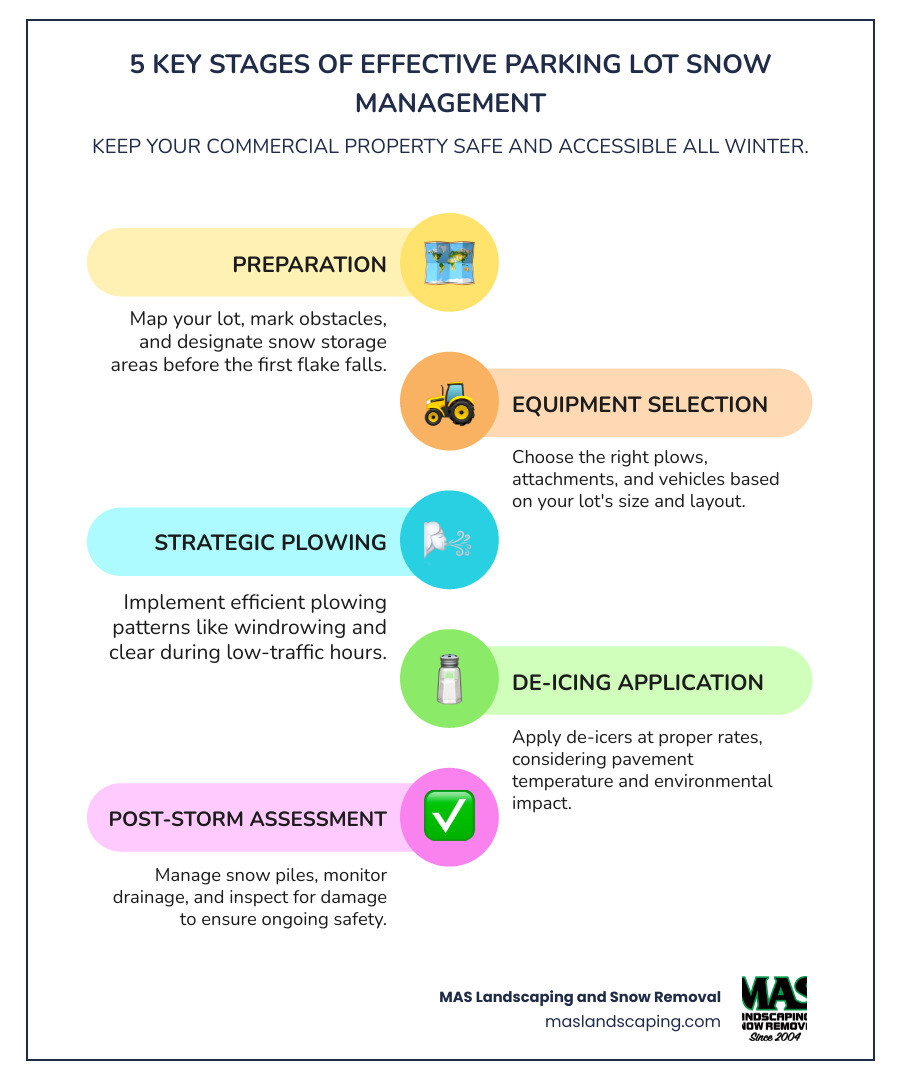
Quick parking lot snow plowing definitions:
Before the First Flake Falls: Strategic Pre-Storm Preparation
The secret to effortless parking lot snow plowing is strategic pre-storm preparation. It’s about knowing your property, anticipating challenges, and having a clear plan long before a storm hits.
We begin with a thorough lot assessment and site mapping. This involves creating a detailed map identifying obstacles like light poles, curbing, drains, and fire hydrants. We also designate snow storage areas, carefully selecting spots that won’t block traffic or sightlines and have good drainage to prevent refreezing. To guide our operators and protect your property, we install snow stakes to mark pavement edges and hidden obstacles.
A pre-season communication plan is also essential. It ensures property owners, tenants, and our team are aligned on the snow removal strategy, trigger depths, and specific lot requirements. Clear communication prevents misunderstandings and ensures a smooth operation. You can find More info about commercial snow management on our website.
Preparing Your Lot for Efficient Plowing
As a property owner, you can also prepare your lot for efficient plowing. Start by clearing debris like trash or fallen branches that can become hidden hazards. Performing repairs, such as filling potholes, helps prevent further damage during plowing. Trimming low-hanging branches prevents them from being caught by equipment. Most importantly, communicate parking rules to tenants, encouraging them to move vehicles when a storm is predicted. This allows for a more thorough clearing. For more insights, refer to Keeping surfaces clear for winter parking lot and sidewalk maintenance.
Understanding Local Regulations
Navigating winter maintenance also means understanding local regulations in our service areas like Everett, Lynnfield, and Malden. Most by-laws prohibit pushing snow onto public roadways or sidewalks. Noise restrictions might also apply to nighttime plowing in certain areas.
ADA compliance is non-negotiable. Accessible parking spaces, ramps, and pathways must be cleared and de-iced promptly. Failure to do so can lead to significant liability issues, as slip-and-fall incidents are a major concern. A comprehensive Snow Removal Plan and Procedure helps mitigate these risks by documenting your commitment to safety.
Gearing Up: Essential Equipment for Parking Lot Snow Plowing
Effective parking lot snow plowing relies on having the right tools. Snow removal professionals use a variety of vehicles and plows to tackle the diverse challenges of commercial lots in Everett, Saugus, Malden, and surrounding towns.
Our fleet includes commercial-grade pickup trucks for agility in smaller lots and wheel loaders or skid-steers for greater power in larger areas. Plow types are equally varied, but for maximum efficiency, angle plows and snow pushers are often preferred over basic straight or V-plows.
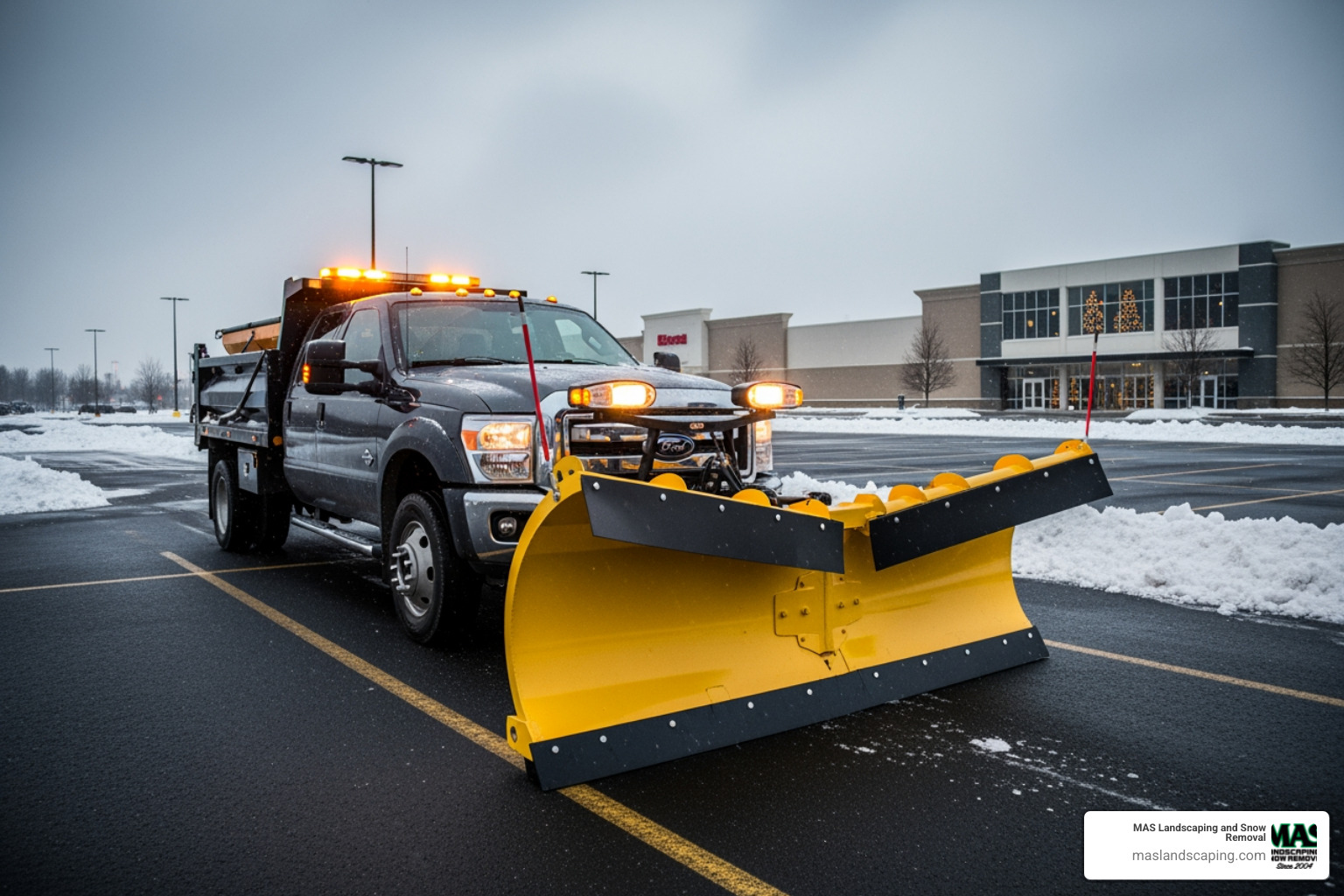
Core Plowing Equipment and Their Uses
Here’s a breakdown of the primary equipment for parking lot snow plowing:
- Straight Plows: Simple and robust, these fixed blades are good for pushing snow straight ahead on initial passes but are less efficient for moving large volumes to the side.
- Angle Plows: These plows can be hydraulically angled, making them highly efficient for moving snow to the side in long, continuous passes (windrowing).
- Snow Pushers (Containment Plows): These large, box-like attachments are excellent for clearing large, open areas quickly by containing and pushing high volumes of snow.
- Backdrags: This is a technique, not a plow type, used to pull snow away from buildings, loading docks, and other tight spots. It’s essential for detailed clearing but is a slower process.
| Plow Type | Efficiency | Best Use Cases |
|---|---|---|
| Straight Plow | Moderate, good for direct pushing | Initial cuts, smaller lots with limited windrowing space |
| Angle Plow | High, especially with wings | Medium to large lots, creating windrows, continuous snow movement |
| Snow Pusher | Very High for bulk snow movement | Large, open parking lots, stacking snow, moving high volumes |
Enhancing Efficiency with Plow Attachments
To maximize efficiency, plow attachments are game-changers.
- Plow Wings: These extend an angle plow’s width, increasing the clearing path. Research shows angle plowing with wings is about 30% more efficient per pass than wingless plowing and 50% more efficient than a standard pusher. Wings provide superior containment, reducing the need for back-cleaning and saving time and fuel. See an Animated demonstration of plow efficiency in action.
- Backdrag Edges: These attachments improve performance when pulling snow backward, critical for clearing tight spots.
- Urethane Cutting Edges: Often preferred over steel, these edges are gentler on asphalt, reducing damage, and are quieter for nighttime operations.
For more on handling challenging conditions, explore our insights on More info about heavy-duty snow removal.
The Latest in Snow Removal Technology
We accept technology to improve our services. GPS tracking and Automated Vehicle Location (AVL) systems allow us to monitor our fleet for efficient routing and service verification. Advanced weather monitoring provides hyper-local forecasts, including pavement temperatures, to optimize de-icing. Liquid de-icing systems and multi-functional plows also represent the cutting edge in versatility and efficiency.
The Art of the Plow: Core Techniques and Strategies
Successful parking lot snow plowing is an art form, requiring skilled operators who use strategic thinking to move snow efficiently and safely.
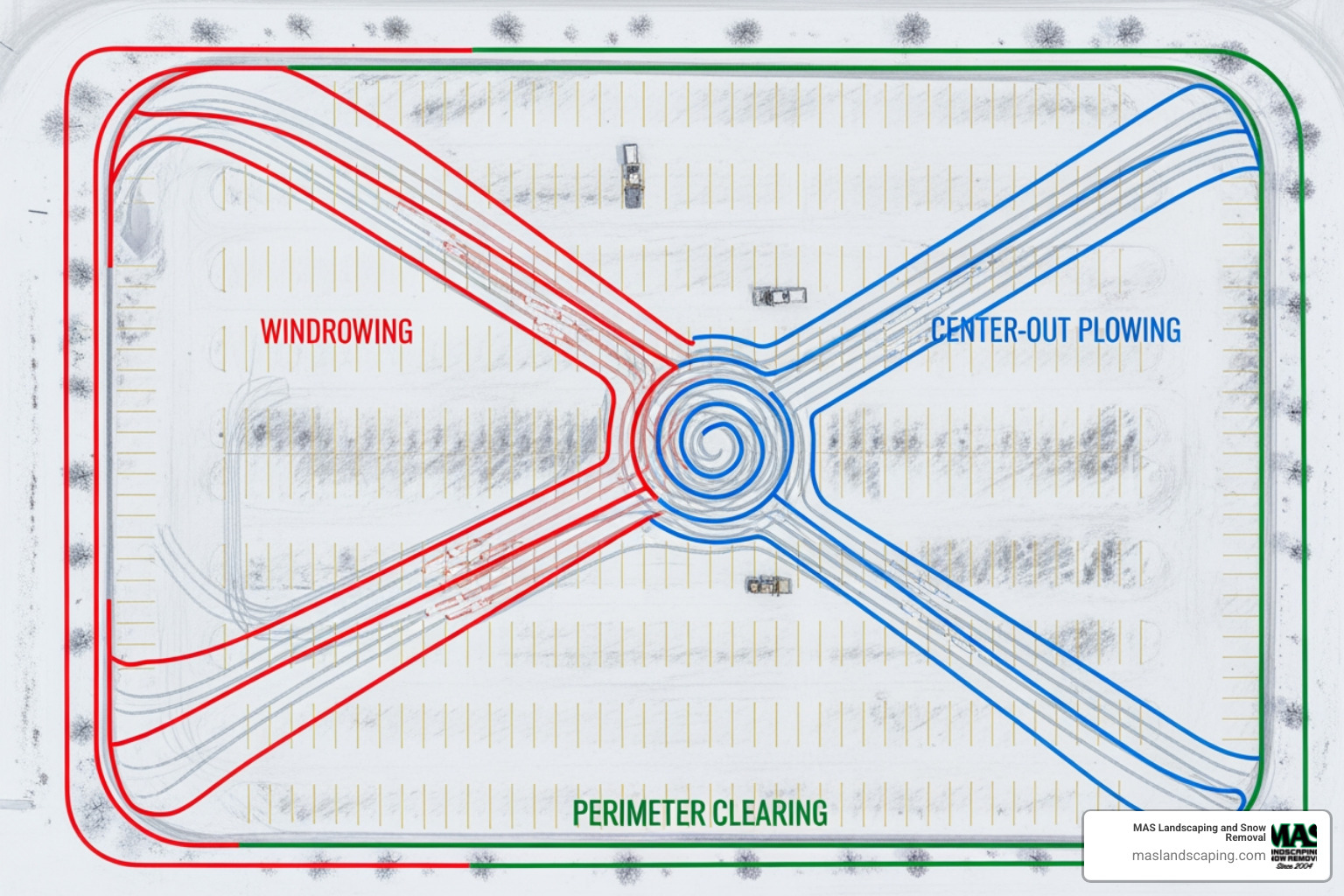
Common plowing patterns include windrowing (pushing snow into a continuous row), center-out plowing (pushing from the middle to the perimeter), and plowing with the grade to aid movement and drainage. Navigating obstacles like light poles and cart corrals is where experience shines. Our operators use precise techniques like backdragging to clear snow without causing damage, aided by pre-season marking.
Mastering Primary Parking Lot Snow Plowing Methods
Here are the primary methods used in parking lot snow plowing:
- Angle Plowing: Highly efficient for moving snow to one side, creating windrows. With wings, it clears a wider path and reduces passes, making it ideal for large, open areas.
- Straight Plowing (Pushing): Simple and effective for pushing snow directly into designated piles. It’s often used with snow pushers for bulk snow movement.
- Backdragging: Essential for clearing tight spaces like building entrances and around parked vehicles by pulling snow backward before pushing it away.
- Stacking: Crucial for lots with limited space, this involves using loaders to lift and pile snow high in designated areas, requiring careful planning for stability and drainage.
How Lot Size and Layout Dictate Your Strategy
The size and layout of a parking lot determine the most efficient parking lot snow plowing method.
- Small Lots (e.g., convenience stores): Agility is key. We rely on angle plows for precise windrowing and backdragging to clear tight spaces. Snow is typically stacked in a corner.
- Large Lots (e.g., big-box stores): High-capacity equipment like snow pushers and angle plows with wings are used to clear wide swaths quickly and create large, stacked piles.
- Complex Layouts (e.g., medical centers): These require a combination of equipment. Angle plows handle main lanes, while skid-steers and backdragging clear tighter areas and entrances.
For a deeper dive into managing complex commercial properties, read our More info about commercial property snow removal.
Best Practices for Efficient Parking Lot Snow Plowing
- Start Plowing at Trigger Depth: We typically begin at two to four inches of snow to prevent compaction and ice.
- Plow During Low-Traffic Hours: Plowing overnight minimizes disruption and allows for a more thorough clear.
- Clear Entrances and Exits First: Prioritizing access points is crucial for safety and business continuity.
- Work from the Building Outwards: This moves snow away from structures and clears main traffic areas first.
- Avoid Piling Snow on Landscaping or Blocking Sightlines: Snow piles are placed in designated areas to maintain visibility and protect property.
After the Plow: Snow Management and De-Icing
Once the plows have finished, snow management and de-icing are crucial for maintaining safety and preventing refreezing. This stage focuses on managing snow piles and combating ice.
The Science of Salting and De-Icing
The strategic use of de-icing agents is a science. While median salt application rates for parking lots are about three times higher than for roads, over-application is costly and environmentally harmful.
- Pavement Temperature is Key: Pavement temperature, not air temperature, dictates salt effectiveness. For example, salt needs increase almost six-fold as pavement temps drop from -1°C to -9°C. Dry salt is ineffective below 15°F (-9.4°C).
- Bare Pavement Regain Time (BPRT): This is how quickly a surface becomes bare after treatment. Aggressive BPRT targets (e.g., 1 hour vs. 6 hours) can increase salt usage by up to six times. Realistic expectations save salt and money.
- Pre-wetting Salt: Applying a liquid de-icer to dry salt makes it work faster, stick better, and can reduce application rates by about 20%.
- Liquid De-icers: Salt brine, calcium chloride (CaCl2), and magnesium chloride (MgCl2) are effective for anti-icing (pre-treatment) and work at lower temperatures than rock salt.
- Environmental Impact: We strive to minimize the negative impact of salt on waterways and vegetation by using best practices and calibrated application.
For more on our approach, see our More info about commercial snow clearing page.
Integrating De-Icing with Your Plowing Strategy
An effective strategy integrates de-icing with plowing:
- Plow First, Then Salt: This is the golden rule. Plowing removes the bulk of the snow, allowing de-icers to work on the thin layer left behind, which requires far less salt.
- Application Rate Guidelines: We use precise guidelines based on pavement temperature and weather, and we calibrate our spreaders to prevent over-application.
- Treating High-Traffic Areas: Entrances, main lanes, sidewalks, and ADA ramps are prioritized for de-icing to ensure optimal traction and safety.
- Sidewalks and Entrances: These pedestrian zones require special attention, often managed by dedicated teams. Learn more about our services here: More info about commercial sidewalk snow removal.
DIY vs. Pro: When to Hire a Commercial Snow Removal Service
Many property owners wonder whether to handle parking lot snow plowing themselves or hire a professional. The answer often lies in the true costs and risks involved.
- Time Commitment: Plowing is a significant time commitment, requiring availability 24/7, often at night.
- Equipment Cost: Commercial-grade equipment is a substantial investment, plus ongoing fuel, repair, and storage costs.
- Liability and Insurance: This is a critical factor. Without proper insurance, a slip-and-fall incident can lead to major legal and financial trouble. Professionals carry their own liability insurance, mitigating your risk.
- Inconsistent Results: DIY efforts can leave hazardous patches of snow and ice.
- Scalability: A small plow can’t handle a major blizzard on a large commercial lot. Professionals have the fleet and manpower to scale up for any storm.
Considering these factors, hiring a professional service is often the more cost-effective and less stressful option. Learn more with our More info about commercial snow removal contracts.
Calculating the True Cost of Snow Removal
When considering professional parking lot snow plowing, it’s key to understand pricing models. These are average costs based on internet data and not actual costs for MAS Landscaping.
- Per-Push Rates: Charges for each dispatch, ranging from $150 to over $450 depending on the lot and snow depth.
- Per-Event Rates: Tied to accumulation thresholds (e.g., 2-4 inches), ranging from $200 to over $600 per event.
- Seasonal Contracts: A fixed price for the entire winter, providing budget predictability. Costs can range from $500 to over $5,000 per acre for a full season.
Pricing factors include lot size, trigger depth, included services (de-icing, hauling), and location.
Choosing the Right Snow Removal Contractor
Selecting the right contractor in areas like Everett, Saugus, and Medford, MA, is crucial. Here’s what to look for:
- Experience and Reliability: Look for a contractor with a proven track record and references.
- Proper Insurance: Ensure they carry comprehensive liability insurance to protect your business.
- Equipment Fleet: Do they have a well-maintained, diverse fleet suitable for your lot?
- Communication Plan: A clear plan for weather monitoring and storm updates is vital.
- Local Knowledge: A local contractor like MAS Landscaping understands regional weather patterns and by-laws.
- MAS Landscaping Expertise: We offer professionalism, personalized service, and local expertise to ensure your property is safe and accessible.
For a comprehensive guide, see our A guide to choosing commercial snow removal contractors.
Frequently Asked Questions about Parking Lot Snow Plowing
How much does it cost to have a commercial parking lot plowed?
Costs vary widely based on lot size, location, snowfall amount, and contract type. A single plow can range from $150 to over $450, while seasonal contracts can be several thousand dollars. These are average costs based on internet data and not actual costs for MAS Landscaping.
What is the most efficient way to plow a parking lot?
The most efficient method combines a strategic plowing pattern, like windrowing with an angle plow, with the right equipment, such as a plow with wings. Efficiency is maximized by starting from the center or building and pushing snow to pre-designated storage areas in long, continuous passes.
How do I prevent damage to my parking lot during plowing?
Prevent damage by hiring an insured, professional contractor, marking all curbs and obstacles with snow stakes before the season, and using plows with urethane or rubber cutting edges. A pre-season site walk-through with your contractor is essential.
Conclusion
We’ve covered a lot of ground, from pre-storm preparation to the science of de-icing, all aimed at helping you steer the complexities of parking lot snow plowing. The key takeaways are clear: thorough preparation, employing proper techniques, ensuring safety for everyone on your property, and understanding the value of professional service are paramount.
For comprehensive and reliable snow management in the Everett, MA area, and surrounding towns like Lynnfield, Malden, Medford, Revere, Saugus, and Chelsea, ensuring your property is safe and accessible all winter is our priority. Don’t let winter weather disrupt your business operations or create unnecessary liabilities. Partner with a team that understands the unique demands of commercial snow removal.
Contact us for your commercial snow plowing needs today and experience a winter without worries.
