

Precast concrete retaining wall panels: Top in 2025
Why Precast Concrete Retaining Wall Panels Matter for Your Property
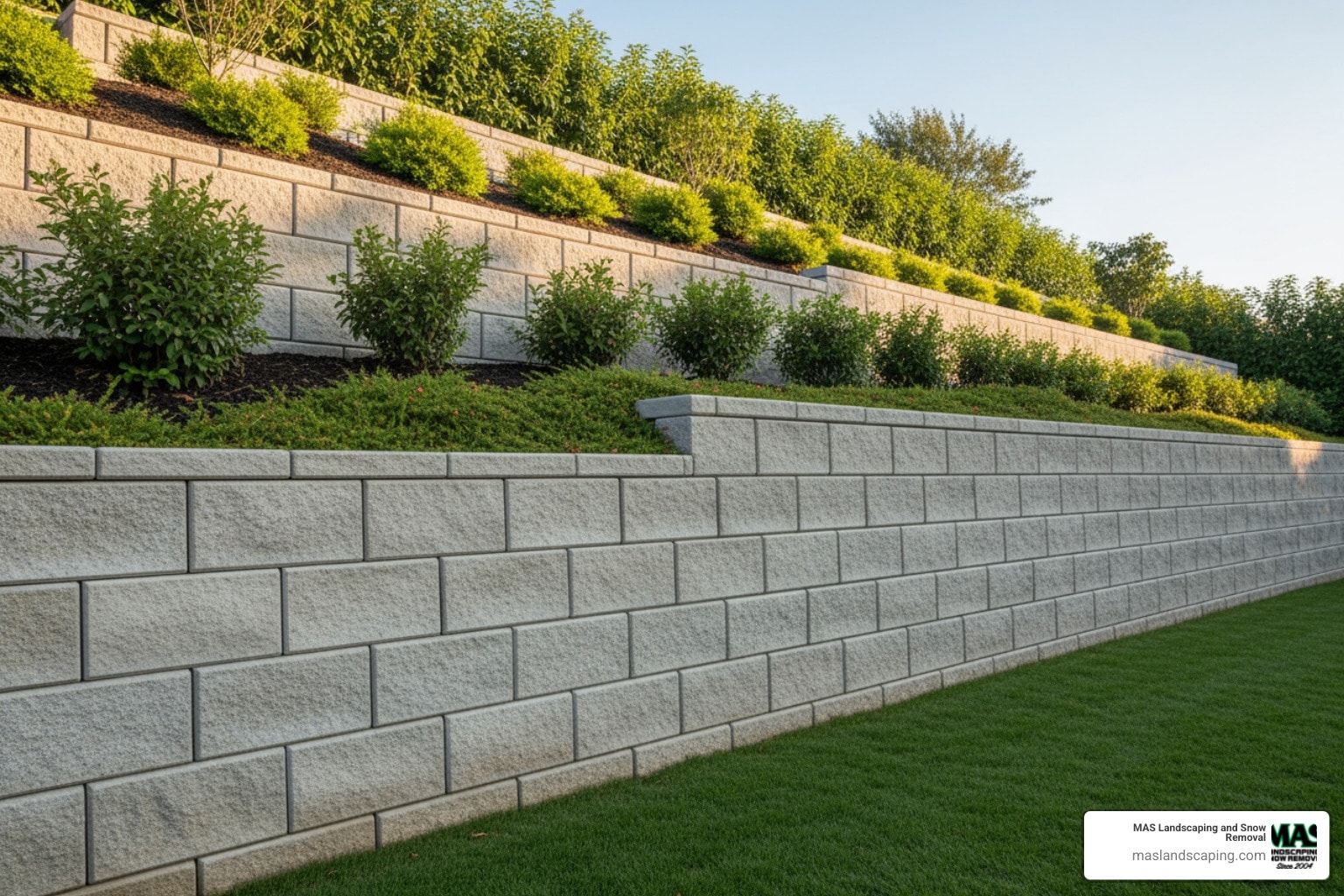
Precast concrete retaining wall panels are engineered wall sections manufactured off-site in a controlled factory environment, then transported and installed at your property. Unlike traditional walls that are poured and cured on-site, these panels arrive ready to install, offering faster construction, consistent quality, and proven strength. They’re used to hold back soil, create level areas on slopes, prevent erosion, and add functional beauty to residential and commercial landscapes.
Quick Answer: What You Need to Know
- What they are: Large concrete wall sections made in a factory, not on your property
- Key advantage: Installation is 50% faster than traditional concrete walls
- Strength: Made with high-strength concrete (3,000+ PSI) in controlled conditions
- Durability: Last decades longer than timber walls with minimal maintenance
- Versatility: Available in numerous textures, colors, and sizes
- Cost: More upfront than timber, but lower lifetime cost due to longevity
Many property owners in the Greater Boston area face challenges with sloped yards, soil erosion, or a lack of usable outdoor space. While a retaining wall is often the solution, not all walls are created equal. Traditional on-site walls can take weeks to complete, with weather delays and inconsistent quality, while timber walls often rot within a decade.
Precast concrete retaining wall panels solve these problems. Because they’re manufactured in a factory, quality is consistent and weather delays are minimal. Installation happens in days, not weeks, resulting in a wall that’s stronger, looks better, and lasts longer than alternatives.
Since 2006, developers, engineers, and homeowners have trusted precast systems for their strength and speed. For your hardscape retaining walls project, this means less disruption to your property and a finished product you can count on for decades.
What Are Precast Retaining Walls and Why Choose Them?
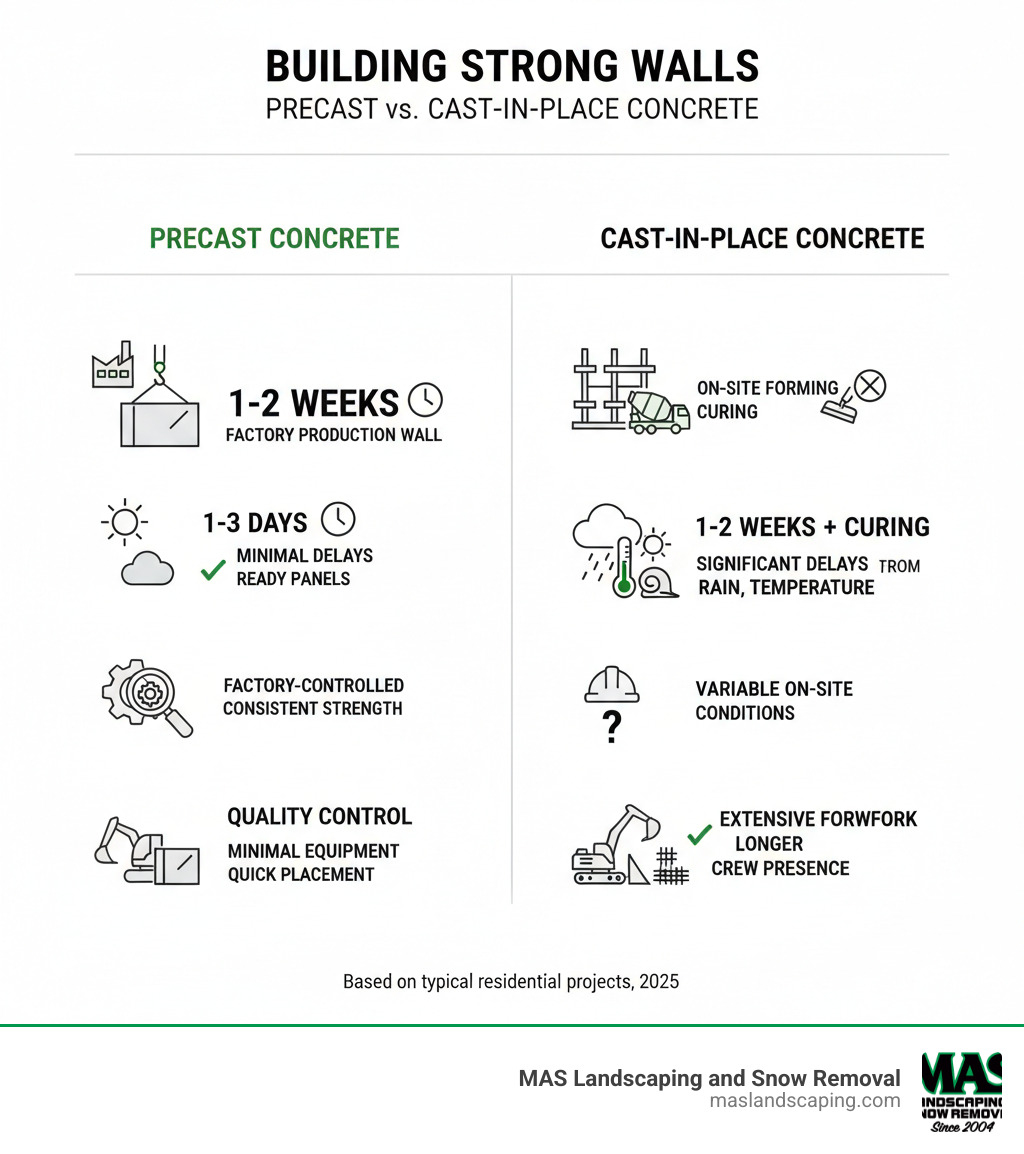
Precast concrete retaining wall panels offer a modern approach to construction. Instead of building a wall from scratch on your property, these panels are precision-engineered in a factory. In this controlled environment, temperature, humidity, and material quality are perfected. The concrete is mixed to exact specifications, reinforced, and cured under ideal conditions. The finished panels are then delivered to your Saugus, Melrose, or Everett property, ready for immediate installation.
This process eliminates the major drawbacks of traditional cast-in-place walls, which require extensive on-site formwork, mixing, and weeks of curing time vulnerable to weather delays. Compared to timber walls, which may last only 5-10 years before succumbing to rot and pests, precast concrete is a superior long-term investment. It is built to last for decades, easily withstanding New England’s freeze-thaw cycles and requiring minimal maintenance.
These engineered systems are the go-to choice for developers and architects who need quality, speed, and predictability, as highlighted by the National Precast Concrete Association. At MAS Landscaping, we use these systems to transform challenging properties throughout Lynnfield and Malden, turning slopes into usable terraces and solving erosion problems permanently.
Key Benefits of Using Precast Concrete Retaining Wall Panels
Choosing precast concrete retaining wall panels offers significant advantages for your project.
Speed: With off-site manufacturing, installation is incredibly fast—often finishing in days what takes weeks with traditional methods. This means less disruption and quicker access to your new space.
Weather Independence: Panels are made in climate-controlled factories, so rain and cold don’t cause production delays. We install finished products, not pour concrete in questionable weather.
Minimal Site Disruption: The process is cleaner, with fewer materials and smaller equipment footprints on your property, ensuring a more streamlined construction phase.
Superior Strength: Panels are made from high-quality, air-entrained concrete with a minimum strength of 3,000 PSI, designed to handle significant loads and harsh conditions.
Longevity and Durability: Engineered to withstand New England’s climate, these walls resist freeze-thaw cycles, heavy rain, and soil movement without the risk of rot or pest damage.
Low Maintenance: Once installed, the wall requires virtually no upkeep. No sealing or replacing boards is needed, saving you time and money for years to come.
For more information about our approach, see our hardscaping services page.
Environmental and Sustainability Aspects
Precast concrete retaining wall panels are also an environmentally responsible choice.
Reduced Waste: Factory production is highly efficient, with precise mixing and optimized reinforcement that significantly cuts down on material waste compared to on-site work.
Use of Recycled Materials: Many systems incorporate recycled materials in backfill or aggregate, reducing the project’s environmental footprint.
Long-Term Sustainability: A wall that lasts 50+ years avoids the environmental cost of multiple demolition and replacement cycles required for less durable materials like timber.
Lighter Site Impact: Faster construction and less heavy equipment use result in less soil compaction, disruption to vegetation, and machinery emissions.
We believe in creating outdoor spaces that work in harmony with nature. Learn more on our hardscaping and softscaping page.
Exploring the Types of Precast Concrete Retaining Wall Panels
Precast concrete retaining wall panels come in various types, ensuring a perfect fit for any project in Saugus or Everett.
Modular Block Systems: These large, heavy concrete blocks often weigh a ton or more, creating stability through their sheer mass (a gravity wall system). Some systems can build walls up to 12 feet high without geogrid reinforcement and come in many stone-like textures and colors.
Large-Format Panels: These supersized wall sections are designed for rapid installation, with heights ranging from 4 to nearly 20 feet. Many require no traditional concrete footings, significantly reducing installation time and cost.
Mechanically Stabilized Earth (MSE) Walls: For exceptionally tall walls or major infrastructure, these systems combine precast facing panels with layers of soil reinforcement (like steel strips or geogrid). This creates an incredibly stable structure capable of handling massive loads, commonly used for highways and bridge abutments.
Gravity Wall Systems: This category includes many modular block systems. They rely on their own mass and interlocking design to resist soil pressure—a simple and effective engineering principle.
Cantilever Walls: While often cast-in-place, precast versions exist. They use a reinforced stem and a large footing that acts as a lever to resist soil pressure, making them efficient for medium-height walls.
Our guide on block walls for landscaping covers more on these systems.
Aesthetic and Customization Options
Today’s precast concrete retaining wall panels offer stunning and versatile design options.
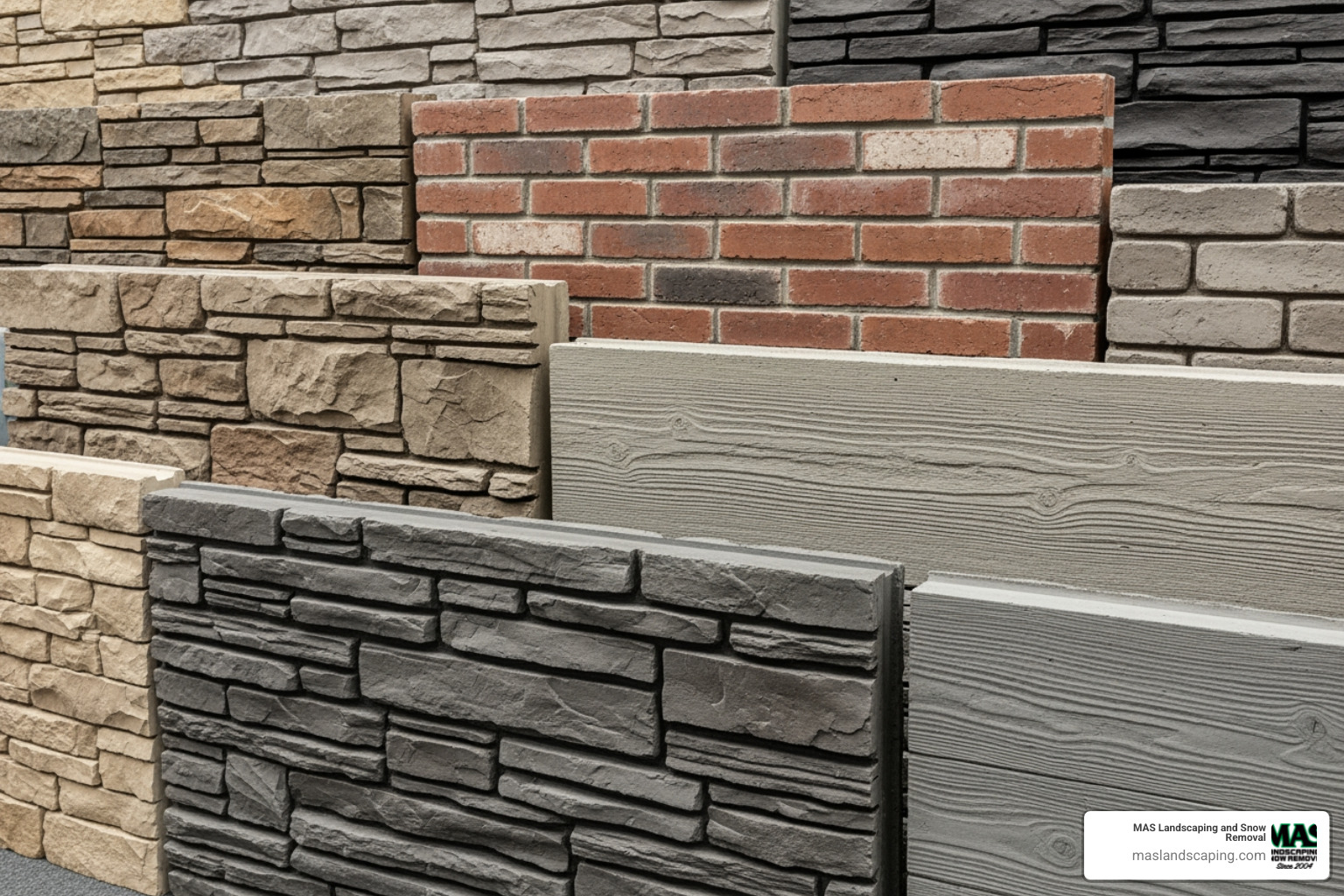
- Finishes and Textures: Go far beyond plain gray with realistic natural stone textures, classic brick patterns, or even wood grain finishes that provide the look of timber without the maintenance.
- Color: Panels can be integrally colored or surface-treated to match any design palette, from earthy tones that blend in to bold colors that make a statement.
- Integrated Features: Transform your wall into a multi-functional element with built-in lighting for ambiance or built-in seating for a permanent garden resting spot.
- Shape and Form: Precast systems easily accommodate gentle sweeping curves, tight radius turns, and crisp 90-degree corners, allowing for organic or geometric designs.
We can help you create decorative retaining walls that improve your outdoor space.
Systems for Different Project Scales
Precast concrete’s versatility makes it suitable for projects of all sizes across the Greater Boston area.
- Residential Projects: Ideal for creating level terraces on sloped yards in Lynnfield or Medford, preventing erosion, and defining patios or gardens.
- Commercial Developments: Used in Malden and Chelsea to manage grade changes for parking structures, retail centers, and industrial parks, maximizing usable land.
- Highway Infrastructure: The go-to choice for bridge abutments, grade separations, and roadway support, meeting rigorous safety standards.
- Water Management: Provides durable solutions for retaining earth along waterways and in flood defense systems.
Learn more about our work on larger projects with our commercial hardscape services.
Design and Installation: From Blueprint to Reality
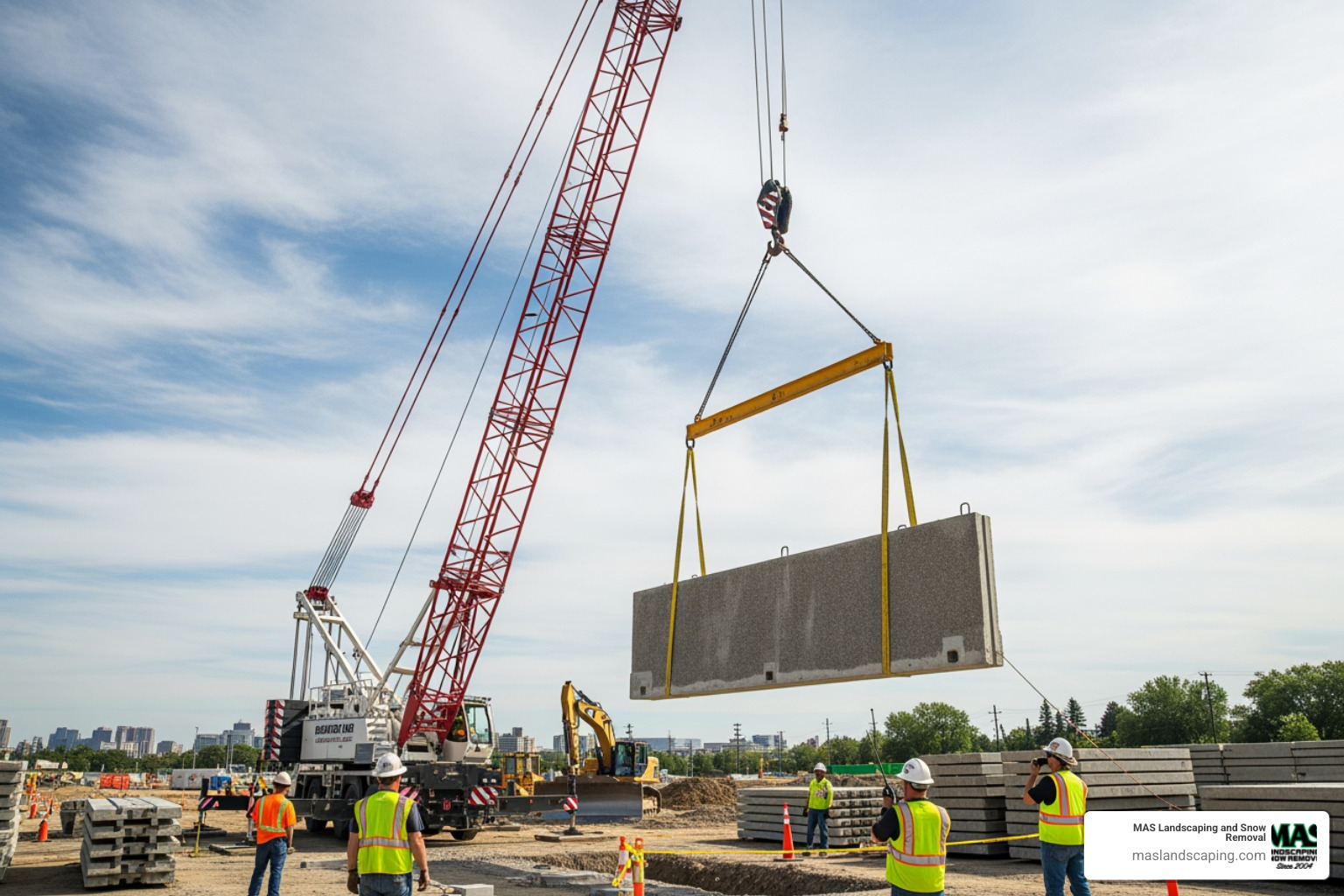
Changing a sloped yard in Saugus or Lynnfield with a precast concrete retaining wall panel system is an efficient, impressive process. At MAS Landscaping, we’ve refined this to ensure minimal disruption and maximum quality.
The process begins with crucial site preparation. Our crew excavates to the precise depth required for a stable foundation. Next, we install and compact a gravel base, which provides a level platform that prevents settling and ensures long-term stability. A proper foundation is the key to a wall’s longevity.
Drainage systems are another critical component. We install drainage behind the wall to prevent hydrostatic (water) pressure from building up, which can compromise the wall’s integrity over time. For taller walls or those supporting heavy loads, we may add geogrid reinforcement by layering specialized fabric into the backfill to add tensile strength. However, some advanced precast systems can reach heights of 9-12 feet without any geogrid due to their interlocking design and mass.
Our expertise in retaining wall installation ensures the right approach for your project.
Key Design Factors for Precast Concrete Retaining Wall Panels
Designing a precast wall system requires careful engineering based on several factors:
- Soil Analysis: The soil type on your property (clay, sand, etc.) dictates the foundation design and drainage requirements.
- Wall Height: Taller walls must resist exponentially greater forces, requiring more robust engineering.
- Surcharge Loads: We account for any additional weight the wall must support, such as driveways, patios, or buildings.
- Seismic Considerations: Walls are engineered to handle potential seismic activity in our region.
- Right-of-Way Limits: In tight urban spaces like Malden, we select systems that fit within property constraints.
- Water Pressure: Proper drainage design is essential to manage groundwater and rainfall, preventing pressure buildup.
These factors are part of our comprehensive hardscape design services.
The Installation Process vs. Traditional Methods
Installing precast panels is dramatically faster and more predictable than building a traditional cast-in-place wall. Unlike traditional methods that require extensive on-site formwork, concrete pouring, and weeks of curing time, the precast process is streamlined. Panels arrive at your property fully cured and ready to be set in place by a crane. This approach eliminates on-site mixing, minimizes labor, avoids weather delays, and reduces overall project time by as much as 50%.
Learning how to build a landscaping wall with blocks can offer insight, but professional installation guarantees proper engineering and longevity.
A Comparative Look at Cost, Durability, and Maintenance
When planning a retaining wall for your property in Saugus or Everett, it’s crucial to consider the long-term value of your investment. Precast concrete retaining wall panels offer a superior combination of upfront value and lasting performance.
Choosing a material is about balancing initial cost with lifetime value. While some options are cheaper upfront, they often come with higher maintenance and replacement costs. Precast concrete is an investment in durability and peace of mind.
| Feature | Precast Concrete Panels | Cast-in-Place Concrete | Timber Walls |
|---|---|---|---|
| Initial Cost | Moderate to High | Moderate to High | Low |
| Installation Speed | Fast | Slow | Fast |
| Lifespan | 50-100+ years | 50-100+ years | 5-10 years |
| Maintenance | Very Low (occasional cleaning) | Low (crack repair possible) | High (rot, pest treatment, replacement) |
| Design Flexibility | High (textures, colors, curves, integrated features) | Moderate (can be shaped, but complex on-site) | Low (limited to wood aesthetic, linear) |
Durability in Harsh Climates: Engineered for New England weather, precast concrete panels easily resist our region’s freeze-thaw cycles, which can destroy other materials.
Resistance to Rot and Pests: Unlike timber, concrete is impervious to rot, decay, and insects like carpenter ants or termites. This eliminates the need for chemical treatments and worries about structural failure.
Minimal Upkeep: A precast concrete wall is virtually maintenance-free. An occasional power wash is all that’s needed, saving you significant time and money over the wall’s long life.
Understanding the Cost of Precast Walls
Several factors influence the final cost of a precast concrete retaining wall panel project:
- Material Cost: This covers the factory-made panels. While the upfront cost may be higher than timber, it reflects a product engineered for decades of performance.
- Installation Labor: This is skilled work requiring experienced crews for proper site prep, foundation work, and placement of heavy units.
- Equipment Rental: Cranes and excavators are necessary for safe and efficient installation, enabling a project to be completed in days instead of weeks.
- Site Accessibility: Challenging access on a property in Malden or Lynnfield may require more time or specialized equipment.
- Wall Size and Complexity: A simple, short wall will cost less than a tall, curved wall with custom features like integrated lighting.
Please note: Average costs can range from $50 to over $150 per square foot installed, but these are estimates based on national data and can vary significantly based on your specific project and location. For a detailed price breakdown, see our insights on the cost for a concrete retaining wall.
While precast concrete may require a larger initial investment than timber, its longevity makes it far more cost-effective over time. You would likely replace a timber wall 5-10 times over the lifespan of a single precast wall.
Frequently Asked Questions about Precast Concrete Retaining Walls
We often get questions from property owners in Saugus, Lynnfield, and surrounding towns about precast concrete retaining wall panels. Here are answers to the most common inquiries:
How high can a precast concrete retaining wall be built?
The maximum height depends on the specific precast system, soil conditions, and overall engineering. Gravity wall systems, which use large, heavy blocks, can often reach 9-12 feet without needing soil reinforcement. For even taller applications, Mechanically Stabilized Earth (MSE) walls are used. These systems combine precast panels with soil reinforcement grids and are engineered for major civil projects like highway supports. An engineer must always determine the appropriate height and system for your project.
Do precast retaining walls require a concrete footing?
Not always. This is a key advantage of many precast systems. Large-block gravity walls are often designed to be placed directly on a properly prepared and compacted gravel base. This speeds up installation and can reduce overall project costs compared to traditional cast-in-place walls, which almost always need a poured concrete footing. However, the final foundation requirements for your wall in Everett or Lynnfield will be determined by the engineering plans, which consider soil type, wall height, and load requirements.
Can precast walls be installed on a slope or with curves?
Absolutely. The versatility of precast concrete retaining wall panels is one of their greatest strengths. Modular blocks and panel systems are engineered to accommodate both gentle, sweeping curves and tight-radius turns. This makes them an ideal solution for terracing a sloped yard in Medford or Revere to create more usable, flat areas for patios, gardens, or lawns. The panels can follow the natural contours of your property while providing the necessary structural support to prevent erosion. Learn more about hardscaping a sloped yard and see how precast solutions can transform difficult terrain.
Your Partner for Strong, Lasting Hardscapes

A completed hardscape project is more than just construction; it’s a change of how a property functions and feels. At MAS Landscaping and Snow Removal, we turn the challenges of sloped yards and eroding soil across Saugus, Lynnfield, and Malden into beautiful, lasting solutions.
Precast concrete retaining wall panels are a reliable, high-performance tool. Their key benefits include:
- Strength: To withstand New England’s harsh weather.
- Speed: Faster installation means less disruption to your life.
- Aesthetics: A wide range of textures and colors for a beautiful finish.
- Durability: An investment that lasts for decades, unlike timber.
We’ve served the Greater Boston area for years, and we know every property is unique. A backyard in Chelsea has different needs than a commercial site in Everett. We take the time to understand your specific goals and vision before recommending a solution.
Whether you’re a homeowner wanting more usable space or a commercial property manager needing reliable site development, we bring the expertise and attention to detail to make your project a success.
For expert consultation and installation of retaining walls and other hardscape features in the Saugus, MA area and surrounding communities, trust the professionals at MAS Landscaping and Snow Removal. Learn more about our retaining wall installation services and let’s start the conversation about changing your outdoor space.