




What Is Patio Paver Sealing — and Should You Do It?
Patio paver sealing is the process of applying a protective coating to your paved outdoor surfaces to guard against stains, weeds, fading, and weather damage — and for most homeowners, it’s one of the smartest maintenance steps you can take.
Quick answer: Here’s what you need to know at a glance:
| Question | Answer |
|---|---|
| Do I need to seal my pavers? | Not required, but highly recommended |
| When to seal new pavers? | Wait 60–90 days after installation |
| How often to reseal? | Every 3–5 years |
| Best weather conditions? | Dry, 50–90°F, no rain for 24 hours |
| DIY or hire a pro? | Either works — prep is the key |
Your paver patio takes a beating year-round. In Greater Boston, that means hot summers, freezing winters, and plenty of freeze-thaw cycles in between. Without a protective seal, porous concrete and brick pavers absorb moisture, oil, and dirt — leading to staining, cracking, and weed growth over time.
The good news? Sealing your pavers is a straightforward process when you know the steps. Done right, it enhances color, locks in joint sand, and keeps your patio looking sharp for years.
This guide walks you through exactly how to do it — in five clear steps.
Patio paver sealing terms to learn:
Why Patio Paver Sealing is Essential for Your Landscape
If you’ve recently invested in a beautiful new outdoor space in Saugus or Lynnfield, you might be wondering: should you seal your paver patio? While it isn’t strictly mandatory for the structural integrity of the stone, it is the single most effective way to preserve the “day one” look of your investment.
Think of sealer as a protective shield. Concrete and brick pavers are naturally porous, meaning they act like a sponge for spilled red wine, motor oil, or fallen leaves that can leave permanent tannins behind. According to The Expert Guide to Sealing Pavers, sealing creates a barrier that prevents these liquids from penetrating the surface.
Beyond stain resistance, there are several key benefits to consider:
- Color Enhancement: Many sealers act as a “color booster,” bringing out the rich, vibrant tones of the stone that can otherwise look chalky or faded after a few seasons of UV exposure.
- Joint Stabilization: High-quality sealers help bond the sand between your pavers. This “locks” the stones in place, preventing shifting and reducing the amount of sand that washes away during heavy Massachusetts rainstorms.
- Freeze-Thaw Protection: In our local climate, water that seeps into unsealed pavers can freeze and expand, causing micro-cracks. Sealing keeps that moisture out.
- Weed and Pest Prevention: By hardening the joint sand, you make it much harder for weeds to germinate or for ants to build unsightly mounds between your stones.
Before you dive in, there are 10 things you need to know before paver sealing, such as ensuring your pavers are old enough to have finished “breathing” out natural mineral salts.

Choosing the Right Sealer: Water-Based vs. Solvent-Based
Selecting the right product is half the battle. If you pick the wrong one, you might end up with a patio that’s too slippery or a look that doesn’t match your home’s aesthetic. Use our buyer’s guide to choosing the best paver sealer to help narrow it down.
Here is a breakdown of the two primary categories:
| Feature | Water-Based Sealer | Solvent-Based Sealer |
|---|---|---|
| Appearance | Often a natural look or matte finish | Typically a wet look or high gloss |
| Breathability | High; allows moisture to escape | Lower; forms a thicker film |
| Odors/VOCs | Low odor; environmentally friendly | Strong chemical odor; high VOCs |
| Application | Easier to apply; soap and water cleanup | Requires more care; needs xylene for cleanup |
| Durability | 2–3 years | 3–5 years |
Film-Forming vs. Penetrating
When selecting the right sealant, you’ll also choose between “film-forming” and “penetrating” varieties. Film-forming sealers create a physical layer on top of the stone (think of it like a clear coat on a car). These provide the most protection and the highest gloss but can be slippery when wet. Penetrating sealers soak into the stone itself, providing protection from within without changing the texture of the surface.
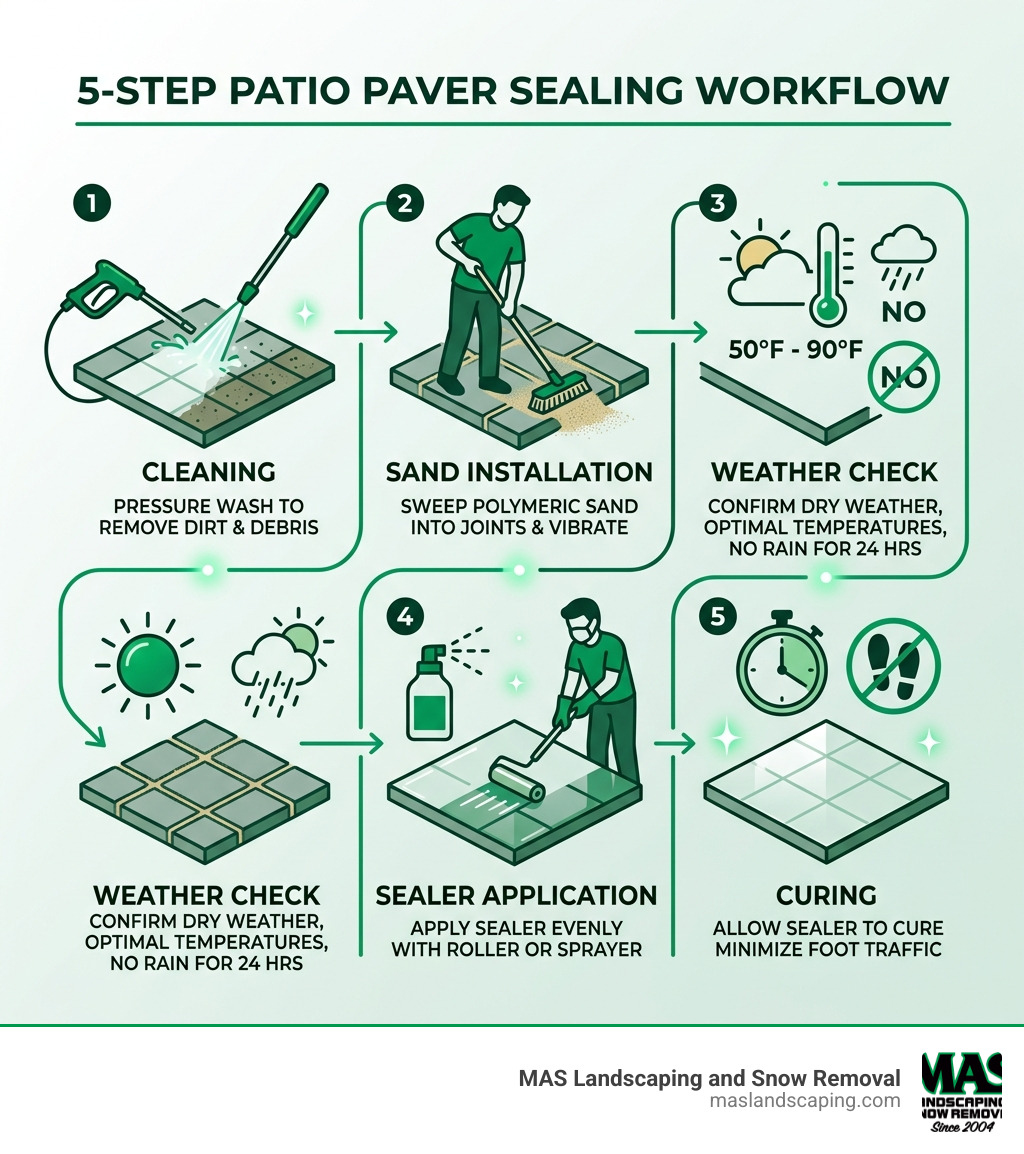
The 5-Step Guide to Sealing Patio Pavers
Ready to get to work? Following a consistent how-to-seal-patio-pavers workflow is essential for professional-grade results. According to experts at Angi, skipping the preparation steps is the leading cause of sealer failure.
Step 1: Deep Cleaning and Preparation
You cannot seal a dirty patio. If you do, you are essentially “laminating” the dirt, stains, and weeds under a permanent coat of acrylic.
Start by removing all furniture and sweeping away loose debris. Next, use a professional cleaning approach or a high-quality pressure washer. Be careful not to use too much pressure (stay under 1500 PSI), as you don’t want to pit the surface of the stones.
Focus on:
- Efflorescence: Look for a white, powdery substance. This is a natural salt migration. Use a specialized efflorescence cleaner to remove it before sealing.
- Stains: Treat oil or grease spots with a degreaser.
- Organic Growth: Kill any moss or algae with a mild bleach solution (1 part bleach to 3 parts water) or a dedicated biocide.
Check out these 5 methods for paver sealing preparation to ensure your surface is pristine.
Step 2: Joint Sand Installation
Once the pavers are clean and completely dry, it’s time to address the joints. We recommend using polymeric sand, which contains special additives that harden when misted with water.
Sweep the sand into the joints until they are filled to about 1/8 to 3/8 inch below the paver surface. Use a plate compactor or a rubber mallet to vibrate the pavers, which helps the sand settle. Sweep away every bit of excess sand from the surface of the pavers—any sand left behind will be glued there forever once you seal!
As noted in LA POPULARITÉ DE LA BASE HYBRIDE EXPLOSE!, modern hybrid bases and sands offer superior stabilization. Mist the sand lightly to activate it, and let it cure for at least 24 hours before moving to Step 3. Learn more about how to seal paving joints for the best stability.
Step 3: Weather and Temperature Check
In Massachusetts, the weather is our biggest hurdle. You need a “Goldilocks” window:
- Temperature: Between 50°F and 90°F. If it’s too cold, the sealer won’t cure; if it’s too hot, it will dry too fast and leave streaks.
- Dryness: The pavers must be bone-dry. We recommend waiting at least 24 to 48 hours after rain or cleaning.
- Forecast: Ensure there is no rain in the forecast for at least 24 hours after application.
Applying concrete paver sealer on a damp surface is a recipe for a “blush” or white haze, which is incredibly difficult to fix.
Step 4: Sealer Application
For most DIY projects, a low-pressure pump sprayer is the best tool for the job. Work in small sections (about 50–100 square feet at a time).
- Saturate the joints: Ensure the sealer gets into the sand to help with stabilization.
- Back-roll: Use a 3/8″ or 1/2″ nap foam roller to spread out any puddles and ensure an even coat. This prevents “lap marks” where the sealer overlaps.
- Two thin coats: It is always better to apply two thin coats than one thick one. Wait about 2–4 hours between coats (check your specific product label for exact timing).
Step 5: Curing and Post-Care
Patience is a virtue here. While the sealer might feel dry to the touch in an hour, it hasn’t fully “cross-linked” or hardened.
- Foot Traffic: Wait at least 24 hours.
- Furniture: Wait 48 hours before sliding heavy chairs or tables back into place.
- Vehicles: If you are sealing a driveway, wait a full 72 hours before driving on it.
For long-term care, consult our paver restoration guide to keep that finish looking fresh.
Professional vs. DIY: Costs and Common Mistakes
Many homeowners in Everett and Reading tackle this as a weekend project. However, it’s important to understand the potential pitfalls. One of the most common reasons to avoid the wrong local pros is that inexperienced applicators often trap moisture under the sealer, resulting in a permanent white haze that requires expensive chemical stripping to remove.
The Cost Factor
Based on internet data, the average cost for professional patio paver sealing typically ranges from $1.50 to $9.00 per square foot. Please note that these are average costs based on general market data and do not represent actual costs for MAS Landscaping services.
If you choose the DIY route, you’ll save on labor but need to factor in:
- High-quality sealer ($50–$150 per gallon)
- Polymeric sand
- Cleaner/Degreaser
- Sprayer and roller rental
If you’re searching for paver patio sealer companies near me, a professional team has the commercial-grade pressure washers and high-solids sealers that last significantly longer than “big box” store alternatives.
Frequently Asked Questions about Patio Paver Sealing
When should I seal new pavers after installation?
Do not seal them immediately! New concrete pavers undergo a process called efflorescence, where salt and minerals migrate to the surface. According to The Expert Guide to Sealing Pavers, you should wait 60 to 90 days (and sometimes up to a full year) before sealing. This allows the pavers to “breathe” and ensures you don’t trap those white mineral deposits under the sealer.
How often should I perform patio paver sealing?
For most homes in the Essex and Middlesex County areas, a maintenance schedule of every 3 to 5 years is ideal. You can perform a simple “water bead test” to check: pour a glass of water on your patio. If it beads up and sits on the surface, your sealer is still working. If it soaks into the stone and darkens it, it’s time for a refresh.
Does patio paver sealing prevent weeds and stains?
Yes, but it isn’t “magic.” Sealing makes the surface much more resistant to oil and food spills, giving you more time to wipe them up before they stain. It also hardens the sand, which makes it much more difficult for weed seeds to take root. However, you should still perform basic maintenance, like blowing off organic debris and occasional rinsing, to keep the surface clear.
Conclusion
Patio paver sealing is more than just an aesthetic choice; it’s a long-term investment in the durability and value of your home. Whether you want that vibrant “wet look” or a subtle matte finish, the protection provided by a high-quality sealer is unmatched, especially in our challenging New England climate.
At MAS Landscaping and Snow Removal, we bring local expertise to every project across Saugus, Danvers, Peabody, and the surrounding North Shore communities. We understand the specific challenges our weather poses to hardscapes and use professional-grade materials designed to last.
Ready to revitalize your outdoor living space? Contact us for professional patio installations or maintenance advice tailored to your specific landscape needs. Let us help you keep your patio beautiful, functional, and protected for years to come!
