




What Does a Retaining Wall Cost Per Foot?
Retaining wall cost per foot is one of the most common questions homeowners ask before starting a landscaping project — and the answer depends on several key factors like material, wall height, and site conditions.
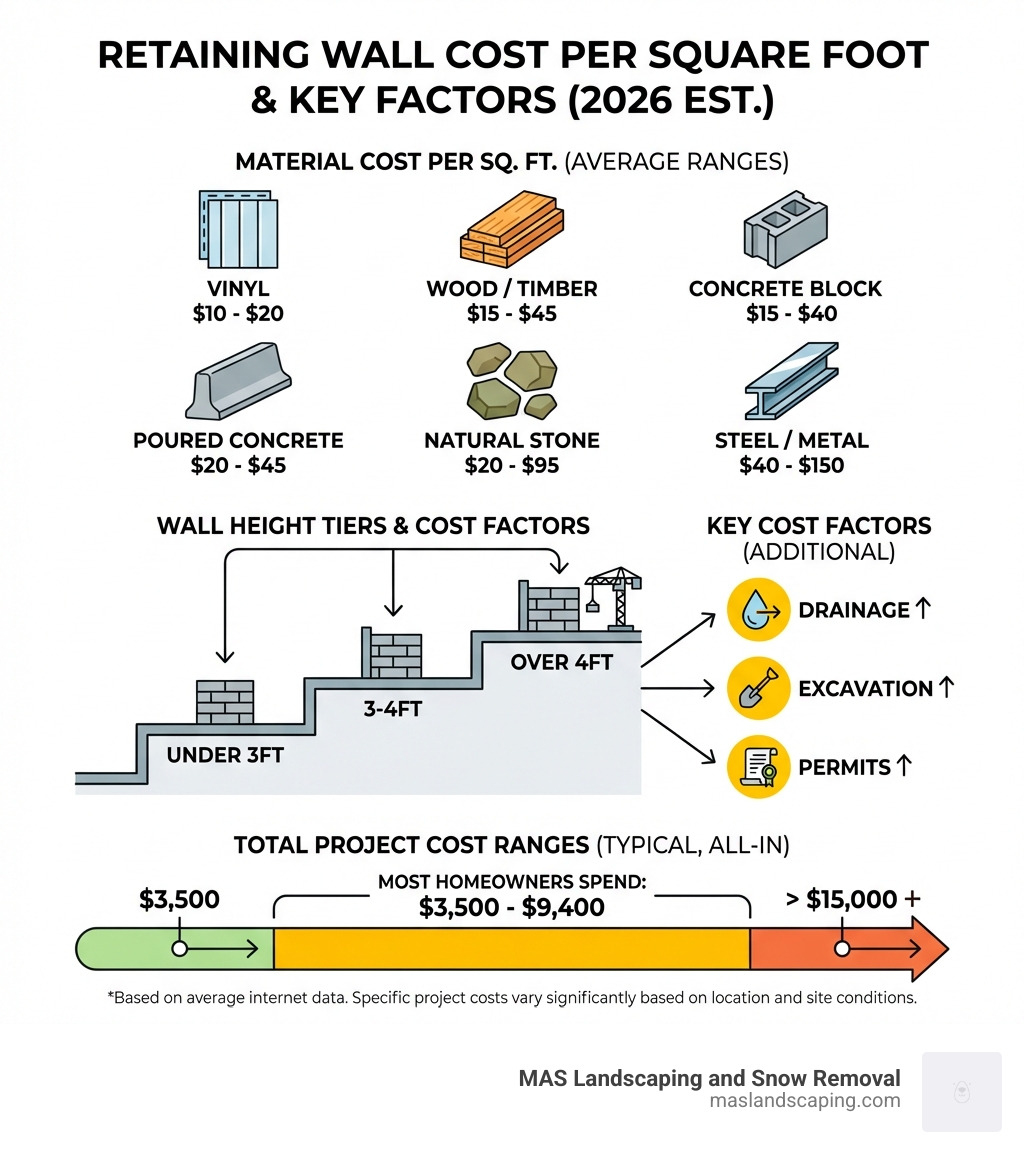
Here’s a quick-reference summary based on average internet data:
| Material | Average Cost Per Square Foot |
|---|---|
| Vinyl | $10 – $20 |
| Wood / Timber | $15 – $45 |
| Concrete Block | $15 – $40 |
| Poured Concrete | $20 – $45 |
| Natural Stone | $20 – $95 |
| Steel / Metal | $40 – $150 |
Note: These are average costs based on internet data and do not represent actual pricing from MAS Landscaping and Snow Removal. Your specific project cost will vary.
Most homeowners spend between $3,500 and $9,400 total, with a national average around $6,000 to $6,300 for a professionally installed retaining wall.
Sloped yards are more common than you might think in the Greater Boston area — and they come with real headaches. Soil washes away after heavy rain. Slopes are hard to mow. And that beautiful backyard space? Half of it might be too steep to use.
A retaining wall solves all of that.
It holds back soil, controls water runoff, prevents erosion, and creates flat, usable space where there wasn’t any before. It can also dramatically improve your property’s curb appeal and value.
But before you commit to a project, you need to understand what it actually costs. Material choice, wall height, drainage requirements, permits, and labor all play a role — and costs can range wildly depending on your specific situation.
This guide breaks it all down clearly, so you can budget with confidence.
Simple Retaining wall cost per foot glossary:
Understanding the Retaining Wall Cost Per Foot
When we talk about the price of a new wall, we usually look at the Retaining wall cost per foot in two different ways: square feet and linear feet. Understanding the difference is vital for your budget.
A “square foot” measures the entire face of the wall (length multiplied by height). A “linear foot” only measures the length along the ground. Since a 6-foot tall wall requires significantly more material and labor than a 2-foot wall, most professionals and internet data sources prefer the square foot measurement for accuracy.

Based on general internet data, project minimums for professional contractors often range from $1,500 to $3,000. This covers the cost of mobilizing heavy equipment, ordering materials, and getting a crew to your site in towns like Lynnfield or Saugus.
Average National Pricing Ranges
If you are searching for a ballpark figure, internet averages suggest that a professional installation typically falls between $20 to $150 per square foot. For a standard residential project, total costs often range from $3,500 to $15,000 or more.
It is important to remember that labor usually accounts for 40% to 60% of your total investment. Professionals often charge $50 to $75 per hour, reflecting the specialized skill and physical intensity required to move tons of stone or concrete. To see how these numbers apply to different sizes, check out this retaining wall cost guide.
| Wall Height | 10 Linear Feet | 50 Linear Feet | 100 Linear Feet |
|---|---|---|---|
| 2 Feet (20 sq ft) | $400 – $3,000 | $2,000 – $15,000 | $4,000 – $30,000 |
| 4 Feet (40 sq ft) | $800 – $6,000 | $4,000 – $30,000 | $8,000 – $60,000 |
| 6 Feet (60 sq ft) | $1,200 – $9,000 | $6,000 – $45,000 | $12,000 – $90,000 |
Note: High-end ranges reflect premium materials like natural stone and complex site conditions.
Why Costs Vary by Project Size
The taller the wall, the more complex the engineering. Most walls under 3 feet are considered “gravity walls,” relying on their own weight to hold back soil. However, once you cross the 4-foot mark, the pressure behind the wall (hydrostatic pressure) increases exponentially.
Taller walls require:
- Deeper footings and more excavation.
- Geogrid soil reinforcement.
- Structural engineering plans.
- More robust drainage systems.
Whether you are building a small garden border or a massive slope stabilizer, the retaining wall installation process must be tailored to the height and the “surcharge load” (the weight of anything sitting on top of the hill, like a driveway or a shed).
Cost Breakdown by Material Type
Your choice of material is the biggest “lever” you can pull to change your total cost. While some materials are cheaper upfront, they may require more maintenance or have a shorter lifespan.
When selecting materials, we recommend visiting local suppliers like Product and Supplies Data: Home Depot Concrete and Masonry Materials or specialized masonry yards in Middlesex County to see the textures and colors in person.
Wood and Timber Retaining Wall Cost Per Foot
Pressure-treated timber is often the most budget-friendly option. According to internet data, wood walls typically cost between $15 to $45 per square foot.
While they offer a beautiful, natural look that blends into New England gardens, they have a shorter lifespan of 10 to 40 years. To maximize their life, we focus heavily on waterproofing the backside of the wood. If you’re a DIY enthusiast, you can learn more about how to build a retaining wall with landscape timbers to understand the labor involved.
Concrete and Natural Stone Retaining Wall Cost Per Foot
Interlocking concrete blocks (segmental walls) are the most popular choice for modern homes in areas like Melrose and Reading. They are durable, easy to install, and come in various styles. Poured concrete is another high-strength option, often used for driveways or foundations.
Internet data suggests these materials range from $25 to $120 per square foot. Natural stone, while the most expensive, offers a timeless aesthetic and can last over 100 years. You can find a detailed breakdown in our guide on the cost for concrete retaining wall.
Specialized Materials: Gabion, Vinyl, and Steel
For a more industrial or modern look, specialized materials are becoming more common:
- Vinyl: Lightweight and rust-proof, costing $10 to $60 per square foot.
- Gabion: Wire mesh baskets filled with rocks. These are excellent for drainage and cost $10 to $120 per square foot. Learn more about gabion fence cost for similar structural projects.
- Steel: Often used for a “Corten” rusted aesthetic, these are incredibly strong but can be pricey, ranging up to $150+ per square foot.
Key Factors Influencing Your Total Investment
Beyond the wall itself, several “hidden” factors can drive up your Retaining wall cost per foot.
Drainage and Waterproofing Requirements
Water is the #1 enemy of a retaining wall. If water gets trapped behind the wall, it creates massive pressure that can cause even the strongest concrete to bulge or collapse.
A proper drainage system usually includes:
- French Drains: A perforated pipe surrounded by gravel to whisk water away.
- Weep Holes: Small openings in the wall face to let water escape.
- Waterproofing: A membrane applied to the back of the wall.
Internet data indicates that adding a professional drainage system can cost $10 to $85 per linear foot. This is a non-negotiable expense for anyone building a retaining wall on a slope cost considerations.
Engineering and Permit Costs
In many Massachusetts towns, including Everett and Malden, you are required to get a permit for any wall over 3 or 4 feet tall.
- Permits: Usually cost between $50 and $450.
- Engineering: If a wall is tall or supports a heavy load, a structural engineer must sign off on the plans. Fees can range from $500 to $2,000 or more.
We always recommend checking with the National Concrete Masonry Association (NCMA) or local building departments to ensure your project is code-compliant.
DIY vs. Professional Installation: Is It Worth the Savings?
It is tempting to look at the labor costs and think, “I can do that myself!” While a small garden wall (under 2 feet) is a great weekend project, larger walls are a different beast entirely.
When to Hire a Professional
We generally advise hiring a pro if:
- The wall is taller than 3 feet.
- You need to move more than a few tons of material.
- The wall is near a house foundation or driveway.
- You don’t have experience with do landscapers build retaining walls and structural integrity.
Professional teams have access to heavy machinery like excavators and plate compactors, which are essential for a stable foundation. They also provide warranty protection, giving you peace of mind that your investment won’t wash away in the next Nor’easter.
Potential Risks of DIY Failures
A failed retaining wall is a massive liability. If a DIY wall collapses, it can damage your home, your neighbor’s property, or even cause injury. The cost to demolish and rebuild a failed wall is often double the original price.
Using the right techniques is crucial. From choosing the right block by block constructing a retaining wall that lasts method to ensuring the base is perfectly level, there is very little room for error. You can see examples of our professional retaining wall installations to see the difference quality makes.
Frequently Asked Questions about Retaining Wall Costs
What is the cheapest material for a retaining wall?
Based on average internet data, vinyl and wood are typically the least expensive options, starting around $10 to $15 per square foot. Gabion walls can also be very cost-effective if you have access to affordable local stone. However, wood has the shortest lifespan, meaning you may pay more in the long run for replacement.
Do retaining walls add value to a home?
Absolutely. A well-designed retaining wall can offer an ROI of 100% to 200%. By turning a “useless” slope into a flat patio or garden, you are essentially increasing the square footage of your usable yard. Real estate experts suggest this can increase your total home value by up to 15%.
How long do different retaining walls last?
Lifespan depends heavily on the material and the quality of the installation:
- Timber: 10 – 40 years (depending on soil moisture).
- Concrete Block: 50 – 100 years.
- Poured Concrete: 50 – 100 years.
- Natural Stone: 100 – 200+ years.
Conclusion
Calculating the Retaining wall cost per foot is the first step toward transforming your outdoor space. While the numbers can seem high at first glance, a retaining wall is a permanent structural improvement that protects your property from erosion and significantly boosts your home’s value.
At MAS Landscaping and Snow Removal, we take pride in our local expertise. Whether you’re in Saugus, North Andover, or Somerville, we understand the specific soil conditions and climate challenges of the North Shore and Middlesex County. We focus on long-term durability, ensuring that every wall we build is as functional as it is beautiful.
Ready to reclaim your yard? Explore our retaining wall services and let us help you build a landscape that lasts for generations.
